
Updated May 2, 2026
California Tech Industry Pushes Out Experienced Workers
Age discrimination California's tech industry perpetuates contradicts the sector's innovation-driven image, as experienced workers over 40 face systematic exclusion from hiring and advancement opportunities. Major companies like Google, IBM, and Amazon have faced significant lawsuits for favoring younger candidates over qualified professionals with decades of expertise. California law, particularly through the Fair Employment and Housing Act, provides strong protections against age-based workplace decisions. You have a right to fair treatment regardless of your age, and understanding these legal safeguards is most important when confronting discriminatory practices that threaten your livelihood and career.
California Tech Companies Favor Younger Candidates Over Experienced Workers
The U.S. tech workforce maintains a significantly younger demographic than other industries. High-tech workers aged 25 to 39 comprise 41% of the sector, compared to just 33% in the overall workforce. Meanwhile, workers over 40 represent 52% of high-tech employees, a figure that has declined over the past decade. At Google, the median employee age stands at 29 years among its 30,000-person workforce, compared to a median age of 41 in similar industries.
Hiring Bias Against Older Applicants
Hiring decisions in tech favor younger candidates at measurably higher rates than other sectors. Research indicates tech companies hire millennials over Generation X candidates more frequently than non-tech industries. This pattern persists despite evidence showing older tech workers receive increasingly higher performance ratings as they age. A survey found that 43% of tech workers have witnessed or experienced age discrimination.
Experienced applicants encounter repeated rejections despite holding relevant qualifications. Hiring managers express concerns about cultural fit when evaluating candidates over 40, often using this criterion to screen out older professionals. The tech industry's emphasis on staying cutting-edge drives preferences for individuals perceived as more adaptable and current with trends. Equally significant, financial considerations influence these decisions. Companies can pay lower salaries to younger, less experienced employees compared to professionals with decades of expertise.
Age-Based Assumptions in Recruitment
Recruiters and hiring managers operate on misconceptions about older workers' capabilities. The industry assumes younger employees possess greater technological proficiency and adaptability to change, despite no evidence supporting these beliefs. Older professionals face assumptions that they cannot keep pace with technological advancements or integrate into youth-oriented corporate cultures.
Companies deny training and development opportunities to workers over 40 based on the premise these employees approach retirement or resist learning new skills. Hiring managers question whether experienced candidates maintain the stamina for long hours or fast-paced environments. Some AI startups specifically seek candidates with five to seven years of experience, deliberately avoiding those with extensive backgrounds to control compensation costs and maintain perceived flexibility.
Job Postings That Exclude Mature Professionals
Job advertisements frequently contain age-coded language that discourages applications from experienced professionals. The Equal Employment Opportunity Commission has warned employers against using terms like "recent college graduate" or "college student" in postings, identifying them as potential evidence of age bias. Despite this guidance, searches on major job platforms reveal thousands of ads using these phrases. LinkedIn contained 4,749 job postings with "recent college graduate," Indeed had 1,124, and Monster showed 513.
Major tech companies post openings exclusively targeting new graduates. Apple, Facebook, Yahoo, Dropbox, and Electronic Arts recently listed positions with "new grad" in the title. According to EEOC senior attorney advisor Raymond Peeler, such language is illegal and deters older applicants from applying. Facebook settled a case with California's Fair Employment and Housing Department over a legal position advertisement that stated "Class of 2007 or 2008 preferred".
Additional red flags appear in job descriptions emphasizing "digital natives," "high energy," or "cultural fit with a youthful team". Postings that cap experience requirements or limit candidates to "no more than 10 years in the field" effectively exclude qualified professionals. These screening methods disproportionately impact workers aged 40 and older, violating both California's Fair Employment and Housing Act and federal anti-discrimination laws.
How Workplace Culture Marginalizes Experienced Tech Employees
Workers over 40 encounter systematic marginalization within tech workplaces that extends far beyond initial hiring decisions. Survey data reveals 99% of employees aged 40 and older report experiencing ageism in the workplace. This discrimination manifests through stereotypes, bullying, and intense pressure to conceal their professional experience.
Social Exclusion and Youthful Work Environments
The tech industry's youth-oriented culture creates hostile conditions for mature professionals. During everyday workplace interactions, 95% of respondents indicate age-related stereotypes have damaged their sense of belonging and inclusion. Workers face targets for bullying at a rate of 86%, coupled with derogatory language that diminishes their professional standing. Common terms include "Old Fart," used by 61% of colleagues, "Dinosaur" by 56%, and "Old Git" by 58%.
This environment forces behavioral changes. Identically, 88% of workers over 40 have modified their behavior and language to align with younger employees. The pressure to hide age affects 92% of mature professionals, who downplay their experience to avoid negative perceptions. Beyond verbal harassment, 28% report exclusion from social activities and team events. Tech workers experiencing age discrimination struggle to establish workplace friendships at a rate of 30%, creating isolation that undermines collaboration.
Limited Access to Professional Development
Training opportunities disappear for experienced employees at alarming rates. Over half of workers aged 55 and older have received zero management or leadership training in their current positions. Whereas two-thirds of employees aged 23 to 38 receive such training, companies systematically deny these resources to mature professionals. Organizations operate on assumptions that older workers approach retirement or resist acquiring new skills, despite no evidence supporting these beliefs.
This exclusion extends across all professional development areas. Employers deny access to technology workshops, leadership programs, and advancement opportunities. Management implies training is "not necessary" for senior employees, effectively capping career growth. The restriction prevents experienced professionals from mentoring younger colleagues, eliminating intergenerational collaboration that drives innovation.
Performance Reviews Reflect Age Bias
Evaluation processes incorporate age-based criteria that disadvantage mature workers. Performance reviews mention "adaptability" or "energy" in biased contexts, using these terms to justify limiting advancement. Despite older tech workers receiving increasingly higher performance ratings as they age, 16% report being passed over for promotions in favor of less qualified younger coworkers. Companies consistently promote younger staff while ignoring older employees' contributions.
Assignment distribution reflects this bias. On the condition that workers reach 40, 22% find themselves excluded from challenging assignments. Additionally, 49% earn less than younger colleagues performing identical work. These patterns create environments where 76% of workers experiencing ageism report negative mental health impacts, feeling stressed and demotivated. Half of tech professionals facing age discrimination choose to leave their positions altogether, removing institutional knowledge and expertise from organizations.
Major Tech Companies Face Age Discrimination Lawsuits
Legal challenges against major California tech companies reveal systematic patterns of age discrimination affecting thousands of workers. Courts have awarded substantial settlements and allowed collective actions to proceed, exposing corporate practices that violate federal and state protections for employees aged 40 and older.
Google Settles $11 Million Age Discrimination Case
Google agreed to pay $11 million to resolve a class-action lawsuit filed by 227 job applicants over age 40 who were denied employment. Each plaintiff received approximately $35,000 under the settlement agreement. The case originated with Cheryl Fillekes, a software engineer who underwent four interviews between 2007 and 2014, beginning at age 47, without receiving a job offer. The lawsuit alleged Google hired younger workers based on cultural fit while maintaining a median employee age of 30, significantly below the national average of 41 in relevant fields.
Under the settlement terms, Alphabet Inc. committed to conducting age bias training for employees and managers, establishing a subcommittee focused on age diversity in recruiting, ensuring adequate investigation of complaints, and verifying marketing materials reflect age diversity. Google denied intentionally discriminating, claiming plaintiffs failed to demonstrate required technical aptitude. This marked Google's second major age discrimination settlement, following an undisclosed 2010 payment to Brian Reid, a former director whose supervisor called his opinions "obsolete" and "too old to matter".
IBM Discharges Over 200,000 Workers Aged 40+
Four former IBM employees in their mid-50s filed a federal lawsuit in March 2018, alleging the company violated the Older Workers Benefit Protection Act by forcing them to sign employment waivers without disclosing ages and positions of terminated and retained workers. According to ProPublica investigations, IBM discharged more than 20,000 U.S. workers aged 40 and older over six years. The company stopped providing required age information to employees in 2014 when it rewrote employment disputes.
In March 2024, the U.S. District Court for the Southern District of New York denied IBM's motion to dismiss Rodriguez v. IBM, allowing 16 former employees to proceed with claims that IBM systematically replaced older workers with millennials. Plaintiffs alleged IBM directed managers to assign lower performance scores to older workers, exempted recent college graduates from layoffs, and falsely classified terminations as retirements to avoid disclosure requirements. The EEOC previously found IBM violated the ADEA during mass layoffs. If courts validate claims that IBM's employment disputes are invalid, the company could face lawsuits from tens of thousands of former employees.
Amazon's Restructuring Targets Older Employees
Amazon faces ongoing litigation from warehouse employees alleging age-based discrimination. The U.S. District Court for the District of Utah allowed 71-year-old Viacheslav Tarasov's case to proceed after finding his allegations showed younger employees who exited parking lots similarly were not terminated, creating an inference that age factored in his firing. In another case, John Hopkins, 59, presented plausible claims that managers called him "the old man," denied system access and training, and promoted younger workers ahead of him despite his qualifications. Amazon previously settled a class action lawsuit for targeting Facebook job advertisements at younger users.
ADEA and FEHA Protect Workers Aged 40 and Older
Federal and state laws establish specific protections for workers aged 40 and older who face employment discrimination. These statutes define protected classes, outline employer obligations, and specify remedies available when companies violate age-based protections.
Federal Age Discrimination in Employment Act Coverage
The Age Discrimination in Employment Act of 1967 protects individuals who are 40 years of age or older from employment discrimination based on age. The statute applies to private employers with 20 or more employees, state and local governments, employment agencies, labor organizations, and the federal government. Under the ADEA, employers cannot discriminate based on age in hiring, firing, promotion, layoff, compensation, benefits, job assignments, and training.
Congress passed the ADEA to address employment discrimination against older workers, particularly the difficulty such workers faced obtaining new employment after displacement from their jobs. The U.S. Equal Employment Opportunity Commission enforces federal age discrimination protections. The law recognizes that age-based employment barriers typically emerge around 40, when workers accumulate significant experience but employers view them through negative stereotypes about adaptability, cost, or fit.
The ADEA prohibits harassment creating hostile work environments. Offensive remarks about a person's age violate the statute when frequent or severe enough to alter employment conditions. Retaliation against individuals opposing discriminatory practices or participating in EEOC investigations is strictly forbidden.
California's Fair Employment and Housing Act Provisions
California's Fair Employment and Housing Act makes it illegal for employers to discriminate against or harass employees or job applicants based on age. FEHA protects individuals aged 40 and older. Rather than the 20-employee threshold under federal law, FEHA applies to private employers with five or more employees. Harassment protections extend to all employers regardless of size.
FEHA prohibits age discrimination in hiring, firing, promotions, compensation, benefits, training, and work assignments. The California Civil Rights Department investigates hundreds of age discrimination complaints annually. Employees who believe they suffered discrimination must file complaints with the CRD within three years of the discriminatory act.
What Constitutes Unlawful Age-Based Decisions
Employment decisions violate age discrimination laws when age serves as a substantial motivating factor. A prima facie case requires showing the employee was 40 or older, suffered an adverse employment action, performed work satisfactorily, and age motivated the employer's decision.
Unlawful practices include paying employees aged 40 and older less than younger workers in equivalent roles, denying promotions based on age rather than qualifications, and using downsizing as justification to terminate older workers while retaining lower-cost younger employees. Job advertisements cannot include age preferences or terms like "recent college graduate" or "digital natives". Harassment such as "Okay, Boomer" comments, mocking clothing as "old-fashioned," or refusing technology training based on age creates hostile environments when severe or pervasive.
Disparate impact occurs when seemingly neutral employment decisions unintentionally discriminate against workers aged 40 and older. Posting job openings exclusively on social media or targeting highest-paid employees during reductions constitute violations unless employers demonstrate actions were based on reasonable factors other than age.
Steps Older Tech Workers Can Take to Combat Discrimination
Protecting your rights requires systematic action when you encounter age discrimination california workplaces perpetuate. Documentation forms the foundation of any successful claim.
Document Incidents and Maintain Records
Keep detailed records of discriminatory incidents, specifically noting dates, times, witnesses, and descriptions of what occurred. Save emails, calendars, performance reviews, job postings, and notes on conversations. Document the actual harm caused by discrimination, from lost wages and reduced bonuses to out-of-pocket job search costs.
Report Concerns to HR Before Legal Action
Many companies maintain internal policies for reporting discrimination. Follow appropriate channels by reporting incidents to supervisors, human resources departments, or designated compliance officers. File HR complaints in writing and keep copies.
File EEOC Charge of Discrimination
If internal procedures fail to resolve issues, file a complaint with the California Civil Rights Department or the Equal Employment Opportunity Commission. Under those circumstances, you must file within 180 days in some states or 300 days in states with a Fair Employment Protection Agency. Workers can pursue lawsuits after receiving a "right to sue" letter from the CRD or EEOC.
Consult Employment Attorneys Specializing in Age Bias
Employment attorneys help gather evidence and assess whether you have a viable claim. Important to realize, laws protect you from retaliation for filing claims or pursuing lawsuits.
Conclusion
Age discrimination california's tech sector perpetuates unquestionably violates your legal rights as an experienced professional. Major companies have paid millions in settlements, proving these discriminatory practices exist and courts recognize their severity. California's Fair Employment and Housing Act and federal ADEA provide robust protections for workers aged 40 and older. Accordingly, you must act decisively when facing age-based exclusion, harassment, or termination. Document every incident meticulously, report concerns through proper channels, and consult specialized employment attorneys who understand these complex cases. Your decades of expertise hold immense value. Overall, standing against discrimination protects not only your career but strengthens workplace fairness for all experienced professionals facing similar battles.
References
https://news.justia.com/google-agrees-to-settle-age-discrimination-class-action-for-11-million/
https://calcivilrights.ca.gov/wp-content/uploads/sites/32/2025/05/Age-Discrimination-in-Employment_ENG_2025.pdf
https://www.forbes.com/sites/lizelting/2025/01/30/workplace-ageism-is-hurting-employees-and-businesses-alike/
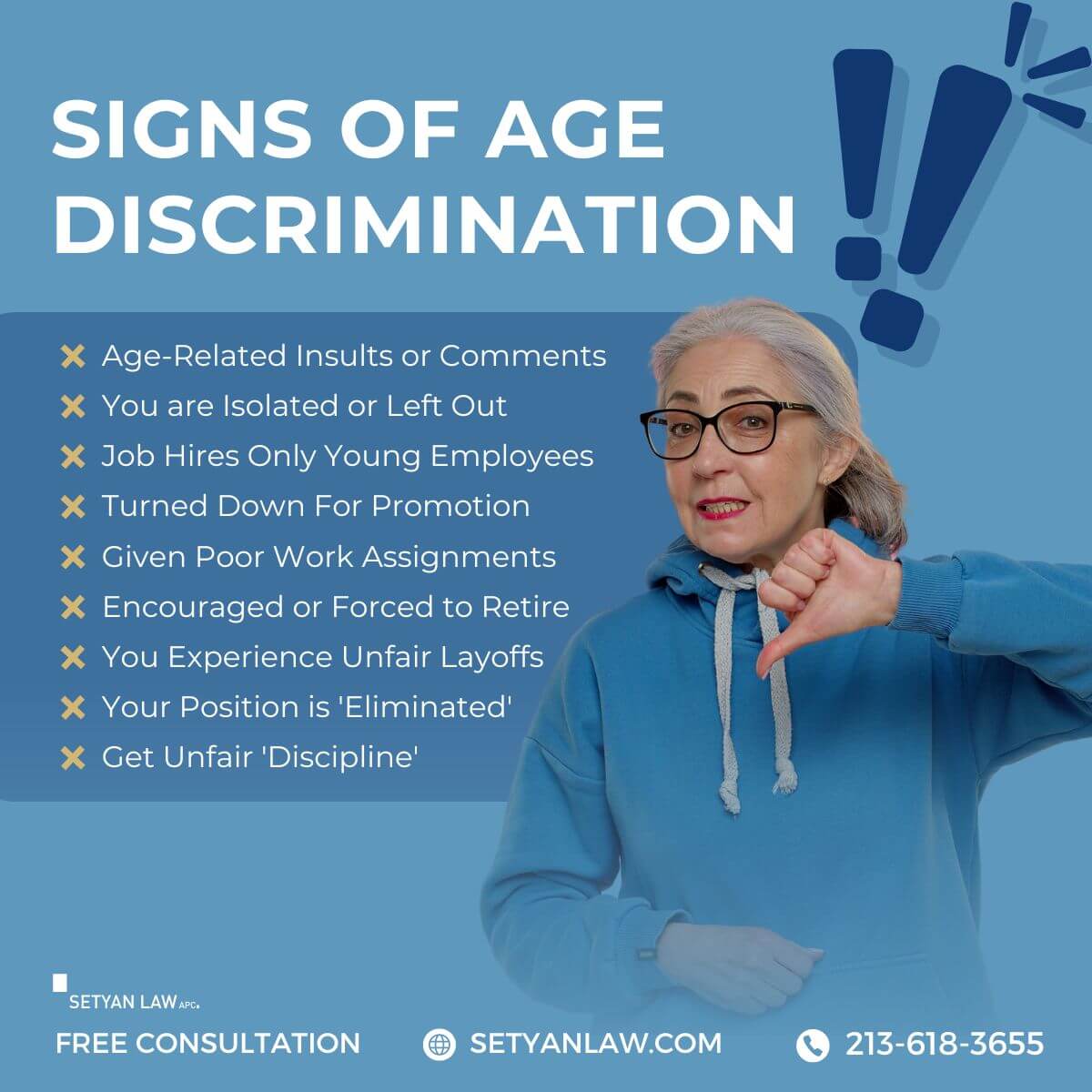
Call Setyan Law at (213)-618-3655 for a consultation.