Updated January 27, 2026
How to Calculate Your Disability Discrimination Settlement Amounts
Disability discrimination settlement amounts in California often range from $20,000 to over $1,000,000 depending on case specifics. Most victims never receive full compensation simply because they don't understand how these settlements are calculated.
When it comes to workplace disability discrimination, California offers some of the strongest legal protections in the nation. However, the actual compensation you receive depends on multiple factors including evidence strength, employer conduct, and the specific damages you've suffered.
Unfortunately, many employees accept lowball offers without realizing the true value of their claim. Understanding what goes into calculating a fair settlement is crucial before accepting any offer from your employer.
This comprehensive guide will walk you through the typical settlement ranges in California disability discrimination cases, explain the key factors that influence your potential compensation, and show you how to maximize your settlement amount with proper documentation and legal representation.
Understanding Average Settlement Ranges in California
California disability discrimination settlements typically fall into distinct financial brackets, with payouts ranging from modest amounts to multi-million dollar awards. Settlement figures vary widely based on several critical factors that both employees and employers should understand.
Low, medium, and high settlement brackets
California disability discrimination cases generally settle within three financial tiers:
Low-range settlements typically fall between $25,000 and $100,000 [1]. These amounts usually apply to cases with minimal documentation, isolated incidents, or situations where the discrimination had limited financial impact on the employee.
Mid-range settlements generally range from $100,000 to $500,000 [1]. Most disability discrimination cases in California settle within this bracket, with the median settlement around $75,000 [1].
High-range settlements start at $500,000 and can exceed $1,000,000 [1]. These substantial amounts are reserved for cases with overwhelming evidence, severe employer misconduct, or situations involving significant financial and emotional harm.
Furthermore, unlike federal cases which cap damages at $300,000, California's Fair Employment and Housing Act (FEHA) imposes no limits on emotional distress or punitive damages [2], allowing for potentially higher payouts.
How case complexity affects payout
The complexity of your case directly influences the settlement amount you might receive. Several factors determine case complexity:
Severity and duration of discrimination significantly impact settlement figures. Cases involving prolonged or particularly egregious discrimination typically receive larger payouts [3].
Economic losses play a major role in determining compensation. These include lost wages, benefits, and other financial burdens directly tied to the discrimination [3].
Employer size and financial resources affect settlement amounts, with larger companies often paying higher settlements [4].
Evidence strength is perhaps the most crucial factor. Clear documentation, witness testimony, and proof of intentional discrimination substantially increase settlement potential [4].
Additionally, cases involving multiple claims – such as disability discrimination combined with retaliation or wrongful termination – frequently result in settlements exceeding $250,000 [5].
Recent examples from California courts
Recent California disability discrimination cases demonstrate the wide range of possible outcomes:
In 2024, Microsoft agreed to a $14.4 million settlement with the California Civil Rights Department for alleged discrimination against workers who took protected disability and parental leave [2].
The Metropolitan Water District of Southern California settled a technician's disability discrimination complaint for $200,000, which included $125,000 in direct compensation plus reinstatement of sick leave and vacation time valued at approximately $75,000 [6].
In a particularly notable case, the California Department of Consumer Affairs was ordered to pay over $8 million after losing a disability discrimination lawsuit filed by an employee with fibromyalgia. The judgment included $3.3 million in damages plus nearly $5 million in attorney fees [7].
At the lower end of the spectrum, numerous cases settle for under $100,000, especially those involving isolated incidents or relatively minor accommodations issues [1].
These examples illustrate that while "average" settlement amounts exist, each case presents unique circumstances that can dramatically affect the final compensation amount.
Key Factors That Influence Your Settlement Amount
Several crucial factors determine the final amount you receive in a disability discrimination settlement in California. Understanding these elements helps set realistic expectations and strengthens your negotiating position.
Strength of documentation and evidence
The quality and quantity of evidence supporting your discrimination claim directly impacts your settlement amount. Clear documentation of adverse employment actions, denied accommodations, and discrimination incidents substantially increases your chances of a favorable settlement [8].
Strong cases typically include:
- Thorough medical documentation establishing your disability
- Records of all discrimination incidents
- Written accommodation requests and employer responses
- Witness statements from colleagues
- Internal emails or communications showing discriminatory intent
The more comprehensive and convincing your evidence, the stronger your negotiating position becomes [9]. Cases with sufficient, credible evidence demonstrating both disability and discrimination frequently result in higher compensation amounts [10].
Employer's response to accommodation requests
How your employer handled your accommodation requests profoundly affects your potential settlement. Under California law, employers must engage in a good-faith interactive process to find reasonable accommodations [9].
Notably, even delays in providing accommodations can constitute violations. A recent federal appeals court ruling emphasized that unreasonable delay alone—even without accommodation denial—may violate disability discrimination laws [11]. In one case, a six-month delay in approving an accommodation request was deemed unreasonable and constituted a failure to accommodate [12].
Employers demanding unnecessary additional medical examinations despite sufficient documentation may face increased liability [11]. Courts view such tactics as bad faith participation in the interactive process, potentially supporting higher settlements.
Impact of retaliation or termination
If you experienced retaliation for requesting accommodations or filing a discrimination complaint, your settlement value likely increases substantially [13]. Retaliation frequently leads to additional claims and damages [9].
Settlement amounts typically rise if:
- You were terminated after requesting accommodations
- You were demoted or denied promotions after disclosing your disability
- Your employer created a hostile work environment following accommodation requests
- You faced other adverse actions clearly linked to your disability status
Courts have awarded considerable compensation for wrongful termination cases, often including lost wages, front pay, and sometimes punitive damages [8]. Retaliatory or particularly egregious employer behavior typically leads to higher punitive damages [8].
Timeliness of filing your claim
Meeting filing deadlines is absolutely critical to preserving your right to compensation. In California, you must file a discrimination charge with either:
- The Equal Employment Opportunity Commission (EEOC) within 180 days (extended to 300 days in California) [14]
- The California Department of Fair Employment and Housing (DFEH) within one year from the last discrimination incident [15]
Missing these deadlines typically bars you from pursuing legal action regardless of your case's merit [15]. After receiving a "right to sue" letter from these agencies, you'll have just 90 days to file a lawsuit [15].
Consequently, acting promptly not only preserves your legal rights but also helps you gather fresher evidence while events remain clear in witnesses' memories [16]. Courts strictly enforce these timeframes, with rare exceptions [16].
Types of Compensation You May Be Entitled To
In California disability discrimination cases, understanding the specific types of compensation available helps you build a more comprehensive claim. Successful cases often result in multiple forms of compensation that address both financial losses and personal suffering.
Lost wages and benefits
Economic damages form the foundation of most disability discrimination settlements. These typically include:
Back pay covers lost wages from your last day worked until the settlement date, including salary increases you would have received [1]. This compensation aims to restore your financial position as if the discrimination had not occurred [4].
Front pay addresses future lost earnings when you cannot be reinstated or find equivalent employment. Courts consider factors like how long you would have remained employed, retirement age, and industry conditions when calculating these amounts [1].
Benefits compensation includes the full value of health insurance premiums, retirement contributions, unused vacation time, sick leave, and other benefits lost due to discrimination [17]. Moreover, courts may award retroactive tax-deferred contributions to your retirement accounts [17].
Back pay calculations include overtime, shift differentials, raises, and interest that would have accrued [17]. Importantly, although unemployment benefits are typically considered interim income, they generally do not reduce your back pay award as they come from the state rather than the employer [17].
Emotional distress and pain
Disability discrimination often causes significant psychological harm. Compensation for emotional distress covers mental anguish, anxiety, depression, loss of enjoyment of life, and reputation damage [1].
Proving emotional distress doesn't necessarily require medical documentation, although having it strengthens your claim [18]. Courts consider several factors when determining appropriate compensation, including the severity and duration of discrimination, and whether you sought professional treatment [18].
For California claims, there is no statutory cap on emotional distress damages [19], unlike federal ADA claims which limit combined emotional distress and punitive damages based on employer size—from $50,000 for smaller companies to $300,000 for large employers [20].
Punitive damages for severe misconduct
Punitive damages serve to punish employers for particularly egregious conduct and deter similar behavior. These are awarded only when the employer acted with "malice or reckless indifference" to your federally protected rights [21].
To qualify for punitive damages, you must show the employer knew its actions might violate discrimination laws yet proceeded anyway. Courts typically consider the reprehensibility of the conduct and the employer's financial position—punitive damages should "sting" but not "destroy" the employer [21].
In California, punitive damages (called "exemplary damages") require clear and convincing evidence of malice, oppression, or fraud. The Supreme Court has suggested punitive damages should not exceed nine times the compensatory damages awarded.
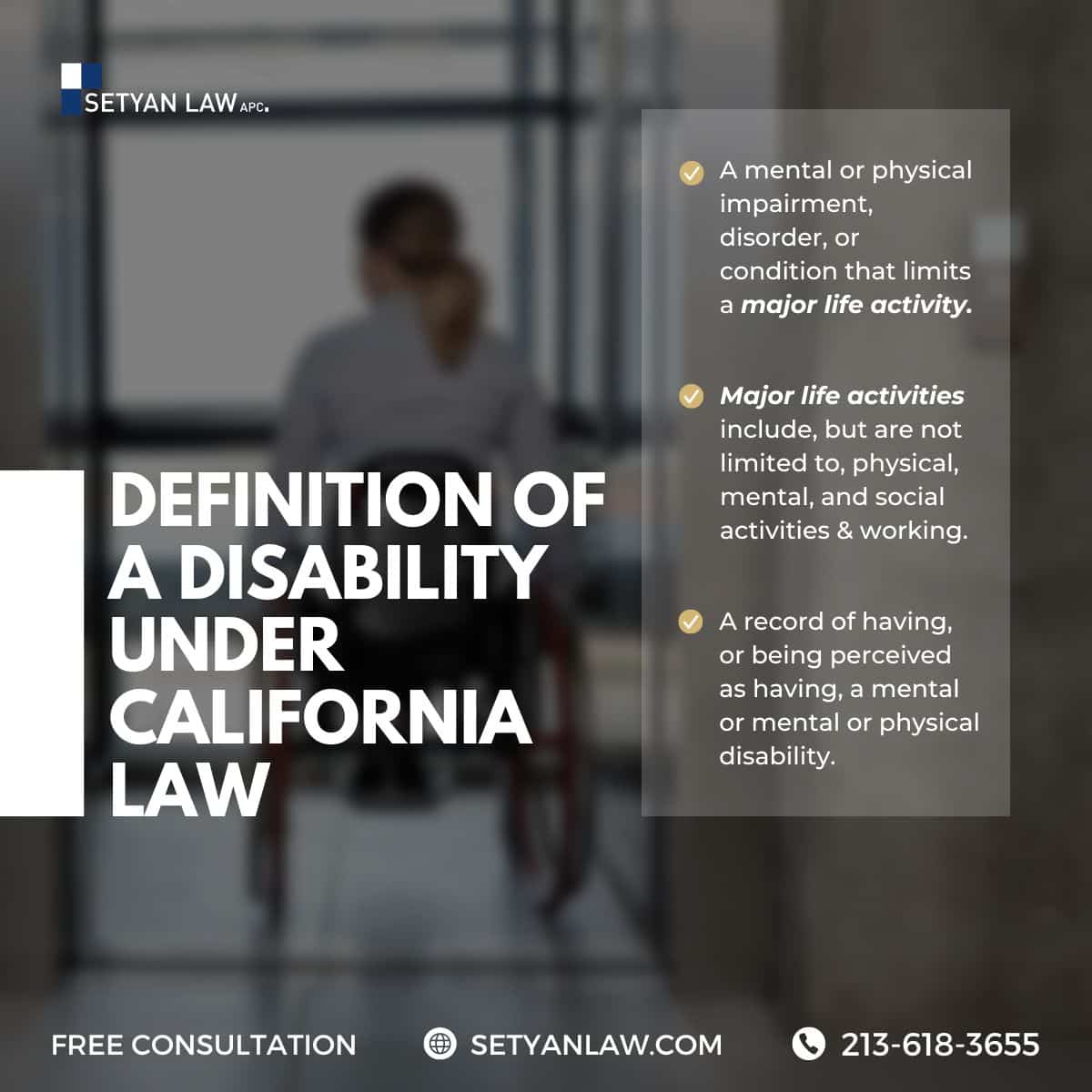
Call Setyan Law at (213)-618-3655 to schedule a free consultation.
Attorney's fees and legal costs
Legal representation can significantly increase your settlement amount, yet the cost shouldn't prevent you from pursuing justice. Disability discrimination laws provide for "fee-shifting," meaning employers may have to pay your reasonable attorney's fees if you win [23].
Many disability discrimination attorneys work on contingency—they only get paid if you win [3]. Under this arrangement, attorneys typically receive a percentage of your settlement, often around 25% of the back pay awarded [3].
Recoverable legal costs include filing fees, expert witness expenses, and other litigation costs [23]. Additionally, if your settlement results in a large lump-sum payment, you may be entitled to compensation for increased tax liability [17].
How to Prove Disability Discrimination Happened
Successful disability discrimination claims that yield substantial settlement amounts depend primarily on your ability to establish clear evidence. Building a compelling case requires methodical documentation and strategic presentation of facts.
Documenting your disability and requests
Proper documentation forms the foundation of your case. Initially, provide medical records that clearly establish your condition as a disability under California law. Remember that medical documentation should be requested by employers only when your disability or accommodation need is not obvious [24].
Maintain copies of all accommodation requests you submit. The best practice is to make these requests in writing, clearly stating:
- That you have a disability (without necessarily disclosing the specific diagnosis)
- How your disability affects your job performance
- The specific accommodations you need
- A reasonable timeframe for a response [25]
Keep records of all interactions regarding your accommodation requests, as unreasonable delays in approval—even without outright denial—may constitute discrimination [26].
Showing adverse actions linked to your condition
Establishing the connection between your disability and negative employment decisions is crucial. Document any adverse actions that occurred after disclosing your condition or requesting accommodations. This temporal relationship often serves as circumstantial evidence of discrimination.
Pay careful attention to the timing of events. If negative treatment began shortly after disclosing your disability or requesting accommodations, document this timeline precisely. Save all performance evaluations, primarily those showing satisfactory performance before disability disclosure.
Using witness statements and internal emails
Witness testimony significantly strengthens your case. Coworkers who observed discriminatory behavior or overheard biased remarks can provide powerful corroboration [6]. Similarly, statements from supervisors or HR personnel who handled your accommodation requests can offer valuable insights [6].
Internal communications often contain critical evidence. Preserve all emails, especially those:
- Containing references to your disability or accommodation requests
- Discussing your performance or employment status after disclosure
- Showing employer awareness of your condition
Courts frequently accept emails as evidence in discrimination lawsuits [29], hence preserving this digital paper trail is essential.
Call Setyan Law at (213)-618-3655 for a consultation.
Setyan Law

It’s always best to consult a qualified Medical Condition Discrimination Attorney regarding your case before you file. Employment law has many pitfalls and an attorney can help you navigate past them safely. Sam Setyan will review your grievance, tell you your options, and guide you to the most favorable outcome possible. It’s your call.
Call 213-618-3655 for a free consultation.
Demonstrating inconsistent treatment
Proving you were treated differently from non-disabled colleagues often provides compelling evidence. Document instances where:
- Similarly situated employees without disabilities received better treatment [30]
- Company policies were applied inconsistently to you versus others [28]
- Reasonable accommodation requests were denied without valid justification [30]
Essentially, document any situations where your employer's stated reasons for actions seem inconsistent with your actual performance or with how others were treated [31]. These inconsistencies often reveal discriminatory intent that directly impacts potential settlement amounts.
Why Legal Help Can Maximize Your Settlement
Legal representation often makes a substantial difference in disability discrimination settlement amounts. With proper guidance, you can navigate complex negotiations and avoid accepting offers well below your case's actual value.
How lawyers negotiate better outcomes
Attorneys experienced in disability discrimination cases leverage their knowledge to increase your settlement value. They meticulously prepare documentation, strategically present evidence, and establish minimum acceptable settlement amounts [32]. Lawyers understand employers' common defense tactics and develop custom strategies to counter them [33]. Indeed, studies show plaintiffs with legal representation receive significantly higher compensation compared to those handling cases independently [2].
What to expect during a consultation
During your initial meeting, an attorney will review your documents, listen to your experience, and provide an honest assessment of your legal options [33]. They'll evaluate the strength of your evidence, analyze applicable precedents, and discuss potential compensation ranges [32]. This evaluation helps set realistic expectations while identifying the strongest aspects of your case.
When to consider litigation vs. settlement
Your attorney will help weigh the benefits of settling versus pursuing litigation. Settlement negotiations are typically faster, less expensive, and can be kept private [5]. Conversely, litigation may yield higher compensation for particularly strong cases but requires more time and carries greater uncertainty [5]. The decision ultimately depends on evidence strength, potential compensation, personal priorities, and your financial situation [34].
Expert legal guidance ensures your rights remain protected throughout this complex process, regardless of which path you choose.
Conclusion
Understanding how disability discrimination settlements are calculated empowers you to pursue fair compensation in California. The settlement landscape varies significantly—from modest $25,000 claims to multi-million dollar awards in severe cases. Therefore, recognizing which tier your situation falls into becomes essential when evaluating offers.
Several factors undoubtedly shape your potential compensation. Strong documentation significantly increases settlement amounts, while employer bad faith during the accommodation process can strengthen your position. Additionally, retaliation or termination following disability disclosure typically enhances claim values, sometimes dramatically.
Your potential compensation extends beyond just lost wages. Most successful claims include compensation for emotional distress, while cases involving malicious employer conduct may warrant punitive damages. Furthermore, attorney fees often become recoverable, making legal representation financially accessible regardless of your current situation.
Building a compelling case requires methodical documentation of your disability, accommodation requests, and any adverse actions. Witness statements and internal communications frequently provide crucial evidence, especially when demonstrating inconsistent treatment compared to non-disabled colleagues.
Professional legal representation remains perhaps your most valuable asset in pursuing justice. Experienced attorneys can assess your case realistically, negotiate strategically, and help you determine whether settlement or litigation offers the best path forward. Above all, remember that accepting a quick settlement without proper case evaluation might leave substantial compensation unclaimed.
The path to fair compensation starts with understanding your rights under California's robust disability protection laws. Armed with knowledge about settlement calculations and proper documentation, you stand a much better chance of receiving the full compensation you deserve after experiencing workplace disability discrimination.

Call Setyan Law at (213)-618-3655 to schedule a free consultation.