Updated April 28, 2026
What You Need to Know About Hair Discrimination at Work
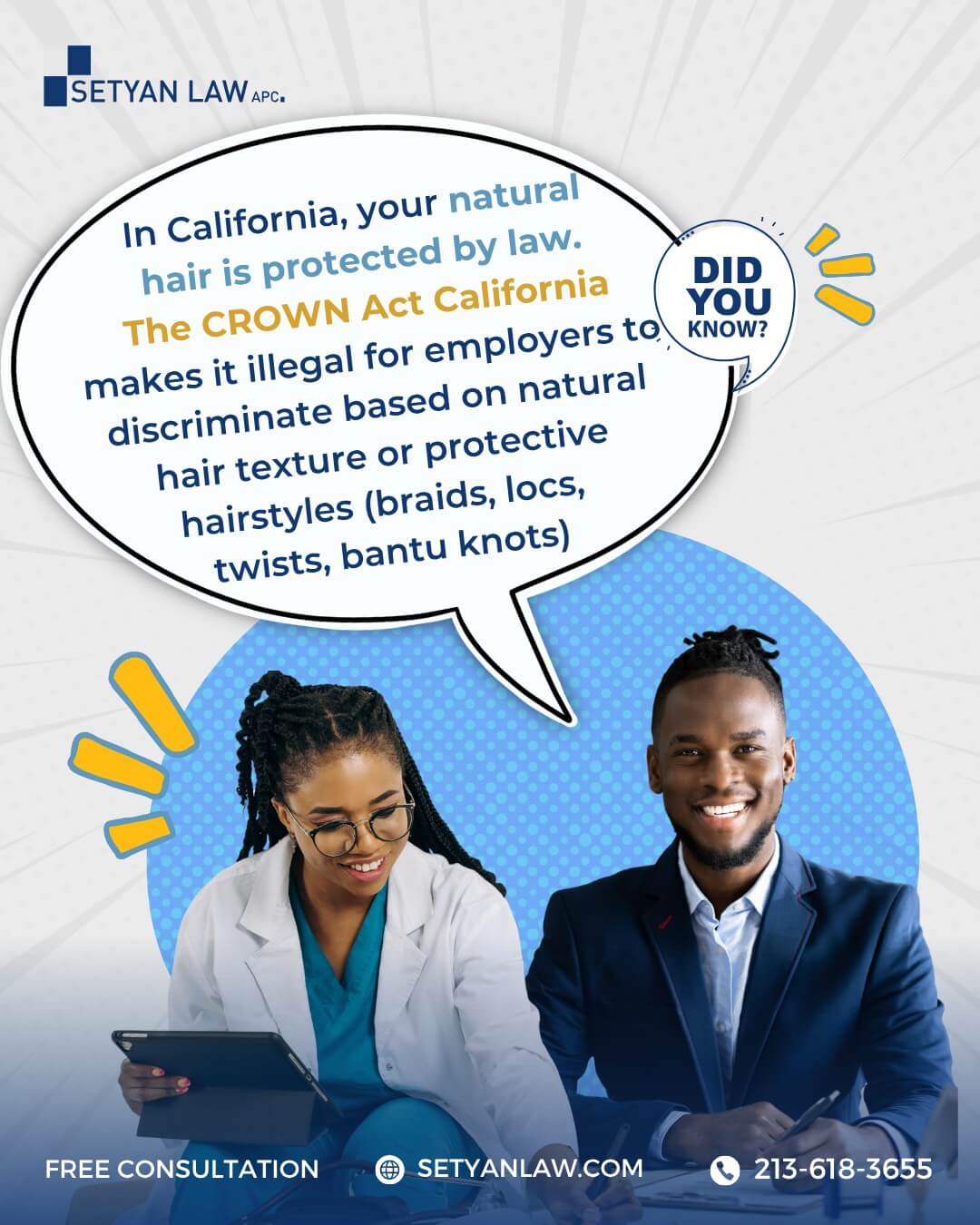
The CROWN Act protects California employees from discrimination based on natural hair textures and protective hairstyles. Many workers still face workplace policies that target Black hairstyles, including braids, locs, and twists. For this reason, understanding your rights under this law is essential to recognizing and addressing hair discrimination at work. California law specifically prohibits employers from penalizing you for wearing your natural hair or culturally significant styles. This guide explains what the CROWN Act covers, how to identify discrimination, and the legal remedies available if your employer violates your rights.
What Is the CROWN Act in California
History and Background of the Law
California made history on July 3, 2019, when Governor Gavin Newsom signed Senate Bill 188 into law, making it the first state in the nation to ban discrimination based on hairstyle. Senator Holly Mitchell, a Los Angeles Democrat who authored the bill, introduced the legislation to address what she called a "long-overdue" reform in workplace and school grooming standards.
The law passed unanimously through both the California Senate in April 2019 and the California Assembly in June 2019. The CROWN Coalition, a national alliance comprising Dove, the National Urban League, Western Center on Law & Poverty, and Color Of Change, drafted and sponsored the legislation. Their research revealed troubling statistics: Black women are 80 percent more likely to change their natural hair to meet social norms or expectations at work. Furthermore, Black women are 1.5 times more likely to have reported being sent home or know of a Black woman sent home from the workplace because of her hair.
The crown act became effective on January 1, 2020, bringing protections to California workplaces and K-12 public schools. Several high-profile incidents drove national attention to the issue, particularly when a New Jersey referee forced a Black high school wrestler to cut his dreadlocks or forfeit his match in December 2018. Governor Newsom noted the student had to choose whether "to lose an athletic competition or lose his identity".
What the CROWN Act Specifically Prohibits
The law prohibits employers and schools from enforcing purportedly "race neutral" grooming policies that restrict natural hairstyles. SB 188 ensures protection against discrimination based on hairstyles by extending statutory protection to hair texture and protective styles in the Fair Employment and Housing Act (FEHA) and the California Education Code.
Before the crown act, federal courts considered afros as a protected trait under anti-discrimination laws but did not extend the same protection to other natural Black hairstyles. The new law fills this gap by recognizing that workplace dress code and grooming policies prohibiting natural hair, including afros, braids, twists, and locks, have a disparate impact on Black individuals. These policies are more likely to deter Black applicants and burden or punish Black employees than any other group.
Employers can still require workers to secure their hair for safety or hygienic reasons. However, they cannot maintain policies that disproportionately impact persons of color or force employees to alter their natural hair texture to conform with appearance standards.
2024 Amendments and Updates
Governor Newsom signed Assembly Bill 1815 on September 26, 2024, amending the crown act to clarify and expand its protections. The amendment removed the word "historically" from the definition of race because it introduced vagueness and confusion about which traits qualify for protection. Race now includes traits associated with race, such as hair texture and protective hairstyles, without the temporal qualifier.
AB 1815 extended the crown act's protections to the Unruh Civil Rights Act, which governs business establishments and public accommodations. The amendment also applies to amateur sports clubs and related organizations in their operation, conduct, or administration of youth or amateur sports competitions, training, camps, or clubs. The bill is declaratory of existing law, meaning its provisions apply retroactively.
What Hairstyles and Hair Textures Are Protected
Natural Hair Textures Covered Under the Law
The 2024 amendment clarified the definition of race to explicitly include traits associated with race, such as hair texture and protective hairstyles. Removing the word "historically" eliminated confusion about which traits qualify for protection under California law. Hair texture now receives unambiguous protection, meaning employers cannot discriminate against employees based on how their natural hair grows from their scalp.
Natural hair encompasses all textures without chemical alteration or heat styling. Afros represent one of the most recognizable natural hairstyles protected under the CROWN Act. The law acknowledges that policies prohibiting natural hair textures disproportionately affect Black employees. Your employer cannot require you to chemically straighten, relax, or otherwise alter your natural hair texture to meet workplace standards.
The CROWN Act amends California's Fair Employment and Housing Act by expanding the definition of race to include these physical characteristics. This legal framework recognizes that hair texture carries deep cultural and historical significance for Black communities. Cornrows, locs, twists, afros, and Bantu knots all have historic connections to Black pride, culture, religion, and history.
Protective Hairstyles Recognized by the Act
California law specifically protects several hairstyles commonly worn by Black individuals and people of color. The 2024 amendment to the CROWN Act explicitly names braids, locs, and twists in the definition of protective hairstyles. These styles serve practical purposes while maintaining natural hair health and honoring cultural traditions.
Protected styles include:
- Braids and cornrows
- Locs (also called dreadlocks)
- Twists
- Bantu knots
- Afros
- Fades
The law uses "including but not limited to" language, meaning this list is not exhaustive. Other natural and protective hairstyles associated with race also receive protection. Courts will evaluate whether a particular hairstyle falls under the CROWN Act based on its connection to racial identity and cultural expression.
Who Is Protected by the CROWN Act
All California workers receive protection under the CROWN Act, including job applicants, full-time and part-time employees, interns, and independent contractors in some cases. The law applies across all industries and workplace settings. You don't need to prove your employer intentionally discriminated against you based on race. Policies that have a disparate impact on workers of a particular race violate the law, even when employers claim the policies are "race neutral."
The CROWN Act primarily addresses racial discrimination that disproportionately impacts Black workers and other racial groups who wear natural or protective hairstyles as part of their cultural identity. The legislation recognizes that people of African descent are routinely deprived of educational and employment opportunities for wearing their hair in natural or protective styles. Black hair functions as an expression of identity and culture, representing history and carrying deep emotional significance.
Employers must ensure their grooming policies remain inclusive and don't discriminate against natural hair textures and styles commonly associated with specific races. You can wear your hair in styles that reflect your racial, ethnic, and cultural identities without fear of workplace consequences.
How to Recognize Hair Discrimination at Work
Common Examples of Workplace Hair Discrimination
Research reveals the scope of workplace hair discrimination. Black women's hair is 2.5 times as likely as white women's hair to be perceived as "unprofessional". Because of this bias, approximately 66% of Black women change their hair for job interviews, with 41% changing from curly to straight. An empirical study found that candidates with curlier hair scored lower in assessments of professionalism and competence and were less likely to be recommended for hire.
The consequences extend beyond hiring. Black women with coily or textured hair face microaggressions at work twice as often as Black women with straighter hair. Over 20% of Black women ages 25-34 have been sent home from their jobs due to their hair.
Real cases demonstrate how discrimination occurs. Chastity Jones, a Black woman in Alabama, received a customer service job offer that was rescinded after she refused to cut her locs. At Business Resource Group in Hawthorne, California, a CEO called an employee "unprofessional" when she wore her hair naturally curly or in braids, asking "What did you girls do? Did you have a braid meeting over the weekend?". The CEO told her "Oh, that looks better" when she wore her hair straight.
Discriminatory Grooming Policies and Dress Codes
Discrimination appears in both overt and subtle forms. Some employers expressly prohibit hairstyles like knots, braids, dreadlocks, or cornrows in employee handbooks. Others enforce purportedly "race neutral" policies that claim to require "clean and tidy hair" but only discipline employees with braids, twists, or locs.
Employers violate the CROWN Act when they require employees to chemically straighten their hair or alter their natural hair texture to comply with "professional appearance standards". Comments during job interviews or performance reviews calling hair "unprofessional," "wild," or "not appropriate for meetings with clients" also constitute discrimination.
What Employers Can and Cannot Require
California law prohibits several employer practices:
- Policies that ban, limit, or otherwise restrict hairstyles associated with race
- Requirements to alter hair texture or hairstyle to conform with appearance standards
- Selective enforcement of grooming policies only against employees with protective hairstyles
- Harassment based on hair, including inappropriate jokes, offensive language, or repeated comments
Employers retain authority to implement legitimate workplace policies. They can require employees to secure their hair for safety or hygienic reasons. However, these policies must remain neutral, nondiscriminatory, and apply equally to all employees without disparate impact on any racial group.
What to Do If You Experience Hair Discrimination
Document the Discrimination
Taking immediate action to record discriminatory incidents strengthens your case. Keep a written record of every comment or incident, noting who made the statement, what was said, where it occurred, when it happened, and how it affected you. Save all emails, memos, performance reviews, text messages, or other written communications that illustrate pressure to alter your natural hairstyle.
Store these documents in a secure location outside your workplace, such as emailing them to your personal account. During or shortly after events or conversations, write detailed notes while the information remains fresh. This documentation becomes critical evidence if you pursue legal action.
Report to HR or Management
Your employer should maintain protocols for reporting harassment or discrimination incidents. File a complaint with your Human Resources department or notify a supervisor or manager about the hair discrimination you experienced. Internal reporting creates an official record and gives your employer an opportunity to address the violation.
File a Complaint with the California Civil Rights Department
You can file a complaint with the California Civil Rights Department (CRD) within 3 years of the incident. The CRD offers several filing options:
- Online: Register for an account through the California Civil Rights System (CCRS) for the fastest processing
- Email: Download and complete an intake form, then send it to contact.center@calcivilrights.ca.gov
- Phone: Call 800-884-1684 Monday through Friday from 8 am to 5 pm
- Mail: Send completed forms to 651 Bannon Street, Suite 200, Sacramento, CA 95811
- In person: Visit any CRD office location
Gather specific facts, copies of documents, and names and contact information of witnesses before filing. The CRD process can result in you receiving lost pay or wages, a change in the company's policy, and other actions to correct the discrimination.
When to Contact an Employment Attorney
Consulting with an employment attorney helps you understand your rights and evaluate the most strategic path forward. While hiring legal counsel is not required to file a discrimination claim, doing so is highly encouraged. An attorney can guide you through the complaint process and protect your rights from the start of your claim.
Legal Remedies Available Under the CROWN Act
Compensation and Damages You May Recover
Violations of the CROWN Act entitle you to multiple forms of financial compensation. Economic damages restore you to the position you would have occupied absent the discrimination. Back pay compensates for wages lost due to wrongful termination, demotion, or denied promotions. You can also recover employment benefits and attorney fees incurred while pursuing your case.
Non-economic damages address hardships that cannot be measured by pay stubs or account ledgers. These include compensation for emotional distress, humiliation, depression, post-traumatic stress, and anxiety resulting from the discrimination. Compensatory damages for emotional distress recognize the psychological trauma caused by discriminatory treatment.
Punitive damages become available in cases involving extreme misconduct. These damages serve to deter and punish employers from committing similar violations in the future. The CRD process can result in you receiving lost pay or wages, policy changes, and other corrective actions.
Reinstatement and Policy Changes
Beyond monetary compensation, courts can order equitable relief to correct discriminatory practices. Job reinstatement returns you to your previous position if you were wrongfully terminated. Employers may face mandates to implement company-wide anti-discrimination training programs addressing hair discrimination.
Policy reforms represent another critical remedy. Courts can require employers to revise workplace policies preventing future occurrences of discrimination or harassment. In the event that your employer maintained grooming standards violating the CROWN Act, they must eliminate those provisions from employee handbooks and appearance guidelines. The California Department of Fair Employment and Housing settled a case against Business Resource Group where the CEO agreed to compensate the complainant and receive a minimum of two hours of harassment prevention training.
Time Limits for Filing a Claim
You have three years from the date of the discriminatory act to file a complaint with the California Civil Rights Department. This deadline applies to all claims under the Fair Employment and Housing Act, which encompasses CROWN Act violations. Missing this deadline typically results in losing your right to pursue the claim through the CRD or file a lawsuit in court.
Subsequently, after filing with the CRD, you receive a right-to-sue notice if the agency concludes its investigation or you request immediate issuance. You then have one year from receiving this notice to file a lawsuit. Act promptly to preserve your legal rights and ensure fresh evidence remains available for your case.
Conclusion
Hair discrimination remains a persistent workplace issue, specifically targeting Black employees and their natural hairstyles. The CROWN Act provides essential protections, but knowing your rights is only the first step. Document every incident carefully and report violations through proper channels to build a strong case.
Given that you have three years to file a complaint with the California Civil Rights Department, don't delay taking action. The longer you wait, the harder it becomes to gather evidence and witness testimony. Your employer cannot legally penalize you for wearing braids, locs, twists, or any hairstyle that reflects your cultural identity. Understanding these protections empowers you to challenge discriminatory policies and hold employers accountable for workplace violations.
References
https://www.epi.org/publication/crown-act/
https://workplacerightslaw.com/library/faq/feha-statute-of-limitations/
https://legalaidatwork.org/factsheet/hair-discrimination-fact-sheet/
https://calcivilrights.ca.gov/complaintprocess/how-to-file-a-complaint/
https://www.lawhelpca.org/resource/california-civil-rights-department-discrimination-complaint-process