
Updated January 27, 2026
11 Hidden Signs of Disability Discrimination in the Workplace
Disability discrimination in the workplace often hides behind seemingly routine management decisions and subtle workplace behaviors. You might not even realize you're experiencing it.
Despite strong legal protections in California, identifying discrimination remains challenging for many employees with disabilities. Employers rarely admit discriminatory intent, instead masking their actions behind performance concerns or company policies.
Unfortunately, the statistics tell a troubling story. According to the Equal Employment Opportunity Commission, disability discrimination claims consistently rank among the top workplace discrimination complaints filed each year. In California specifically, these cases represent over 25% of all employment discrimination filings.
When disability discrimination occurs, it typically doesn't announce itself with obvious hostility. Instead of clear statements against your disability, you might notice unexplained changes in your work environment, sudden performance issues, or resistance to reasonable accommodation requests.
This guide examines the 11 most common yet frequently overlooked signs of workplace disability discrimination in California, explaining what they look like in real situations and what legal protections you have under current law. If you recognize any of these patterns in your workplace, you may have grounds for legal action.
1. Failing to Provide Reasonable Accommodations<
Reasonable accommodations represent a cornerstone of workplace disability protections. Their denial often marks the first sign of discrimination that many employees experience.
Failing to Provide Reasonable Accommodations Definition
Reasonable accommodations are modifications or adjustments to the work environment that enable qualified individuals with disabilities to perform essential job functions [1]. Under California law, employers with five or more employees must provide these accommodations unless doing so would cause "undue hardship" [2]. Failing to accommodate occurs whenever an employer neglects a qualified employee's reasonable request for workplace support [3]. This includes refusing accessible workspaces, denying assistive technology, rejecting modified schedules, or maintaining inflexible workplace policies [3].
Failing to Provide Reasonable Accommodations Real-world Example
A retail employee with a visual impairment requests screen-reading software for their computer terminal. Although the accommodation would cost less than $500 [4], the manager denies the request without exploring alternatives or discussing potential solutions. Furthermore, the Department of Labor reports that 59% of reasonable accommodation requests have no associated cost [4]. This refusal prevents the employee from performing essential job functions while similarly situated employees without disabilities can work without barriers.
Failing to Provide Reasonable Accommodations Legal Implications
Failing to provide reasonable accommodations constitutes disability discrimination under both federal and California law [5]. Consequently, employers face potential EEOC complaints, California Civil Rights Department investigations, and lawsuits [5]. Additionally, California law creates separate liability for failing to engage in a timely, good-faith interactive process [2].
2. Refusing Time Off for Medical Appointments
Time off for medical needs represents a critical accommodation frequently denied to employees with disabilities, creating significant barriers to continued employment.
Refusing Time Off for Medical Appointments Definition
Refusing time off for medical appointments occurs when employers deny employees with disabilities necessary leave for treatment, therapy, or medical consultations. Under California law, time off for medical appointments is a required accommodation for all employers [6]. This protection applies to all employees regardless of classification (hourly, exempt, full-time, part-time) [6]. Notably, employers cannot require employees to schedule appointments outside working hours [6], even though medical offices typically operate during standard business hours [6].
Refusing Time Off for Medical Appointments Real-world Example
In a documented case (Colwell v. Rite Aid Corp.), a court ruled against an employer who refused to adjust an employee's schedule to accommodate medical appointment needs [7]. The ruling emphasized the importance of considering individual circumstances. Likewise, employers who permit leave for non-disability reasons but deny similar requests for disability-related medical appointments violate anti-discrimination laws [8].
Refusing Time Off for Medical Appointments Legal Implications
Refusing medical appointment time can trigger violations under multiple laws. The ADA requires employers to modify leave policies as reasonable accommodations [8]. Moreover, California's Fair Employment and Housing Act mandates employers provide leave for medical care [9]. Employers must treat disability-related leave requests the same as other leave requests [8]. Importantly, employers cannot penalize employees for using leave as an accommodation, as this constitutes both discrimination and potential retaliation [8].
3. Demotion or Termination After Disability Disclosure
One of the most troubling patterns of workplace discrimination occurs when employees face negative consequences after revealing their disability status.
Demotion or Termination After Disability Disclosure Definition
This form of discrimination happens when employers take adverse employment actions—including termination, demotion, reassignment, or pay reduction—shortly following an employee's disclosure of a disability. In fact, according to the U.S. Equal Employment Opportunity Commission, there were 1,338 disability charges filed in California in fiscal year 2022, accounting for 5.4% of all disability charges filed nationwide [10]. These adverse actions often follow a previously positive work record, raising questions about the true motivation behind the employer's decision.
Demotion or Termination After Disability Disclosure Real-world Example
Following his diagnosis of chronic obstructive pulmonary disease (COPD) and hand issues, George Davis Sr. disclosed his condition to his employer. Initially accommodated with desk duties, he was later reassigned to a position paying approximately $22,000 less than his original role [11]. The timing between his disclosure and the adverse employment action illustrates how employers sometimes attempt to mask discrimination behind seemingly legitimate business decisions.
Demotion or Termination After Disability Disclosure Legal Implications
Under California law, particularly the Fair Employment and Housing Act (FEHA), employers cannot legally terminate or demote employees based on disability status [10]. Courts typically examine:
- Timing between disclosure and adverse action
- Internal communications about the employee
- How non-disabled employees in similar situations were treated [12]
Employers may only legally terminate employees with disabilities under limited circumstances: when the termination is unrelated to the disability, when the employee cannot perform essential job functions with reasonable accommodations, or when the employee poses a direct safety threat [13].
4. Retaliation for Requesting Accommodations
Requests for workplace accommodations should never result in negative treatment, yet many employees face backlash after exercising this legal right.
Retaliation for Requesting Accommodations Definition
Retaliation occurs when employers take adverse action against employees who request reasonable accommodations for disabilities. This protected activity triggers protections under both federal and state laws. Adverse actions may include termination, demotion, salary cuts, unjustified negative performance reviews, increased scrutiny, unwarranted disciplinary actions, or creating a hostile work environment [14]. First, it's important to recognize that requesting an accommodation is explicitly protected under California's Fair Employment and Housing Act Section 12940(m)(2), which makes it illegal for employers to retaliate against employees who request disability accommodations [15].
Retaliation for Requesting Accommodations Real-world Example
In a recent case, an employee took leave for depression and later requested a reduced work schedule upon return. Shortly afterward, the employer eliminated the employee's position. Several months later, when additional funding became available, the employer hired someone else for the same position despite the original employee's application [16]. The timing between the accommodation request and adverse action established a causal connection that supported the retaliation claim.
Retaliation for Requesting Accommodations Legal Implications
Under California law, employers face liability even if the accommodation request was denied [15]. Importantly, non-disabled employees can pursue retaliation claims if they made accommodation requests in good faith [16]. The EEOC reports that retaliation has been the most frequently alleged basis of discrimination in the federal sector since 2008 [17]. Yet, employers prevailed in 75% of federal retaliation cases since 2009 [17], highlighting the complexity of proving these claims in court.
5. Forcing Work Despite Medical Restrictions
Medical restrictions from healthcare providers serve as crucial workplace protections for employees with disabilities. Yet many workers face pressure to exceed these limitations, risking their health and legal rights.
Forcing Work Despite Medical Restrictions Definition
Forcing work despite medical restrictions occurs when employers require employees to perform tasks that violate doctor-prescribed limitations. This includes assigning physically demanding work beyond capacity, extending hours contrary to medical advice, or pressuring employees to return before medically cleared. Under California law, employees cannot be forced to return if their treating physician determines they aren't medically ready [18].
Forcing Work Despite Medical Restrictions Real-world Example
A warehouse worker recovering from back injury receives a doctor's note limiting lifting to 20 pounds. Upon returning, their supervisor assigns them to move 50-pound packages, claiming HR approved the assignment. When the employee objects, they face threats of termination. This represents both a safety hazard and violation of the employee's legal protections [19].
Forcing Work Despite Medical Restrictions Legal Implications
California law offers several protections against this form of discrimination:
- Employers must respect documented medical restrictions [20]
- Employees have the right to refuse tasks violating restrictions without penalty [21]
- Labor Code §132a specifically protects injured workers from being fired, demoted, or harassed [18]
- Employers who disregard restrictions may face discrimination claims under both the ADA and California FEHA [22]
Beyond potential lawsuits, employers ignoring restrictions risk prolonging employee recovery times and causing additional injuries that could lead to further disability claims [20].
6. Sudden Negative Performance Reviews
Performance reviews often serve as official documentation of an employee's work quality, yet they can become tools of discrimination against employees with disabilities.
Sudden Negative Performance Reviews Definition
Sudden negative performance reviews occur when employees with disabilities receive unexpectedly poor evaluations shortly after disclosing their condition or requesting accommodations. These evaluations typically feature vague criticisms, unsubstantiated claims, or focus on disability-related limitations rather than actual job performance. Indeed, employers sometimes use a disability as justification to discipline or terminate an employee instead of providing accommodations.
Sudden Negative Performance Reviews Real-world Example
An employee with consistently positive evaluations for three years discloses her newly diagnosed multiple sclerosis and requests modified work hours. Within two months, she receives her first negative review citing "lack of enthusiasm" and "decreased productivity" without specific examples. Subsequently, the supervisor increases scrutiny of her work compared to non-disabled colleagues, creating documentation to support potential termination.
Sudden Negative Performance Reviews Legal Implications
Courts generally look for timing connections between disability disclosure and sudden performance criticisms. Essentially, evidence of discrimination includes:
- Discrepancies between evaluations and actual performance
- Positive evaluations that suddenly turn negative after disability disclosure
- Inconsistent application of performance standards between disabled and non-disabled employees
- Lack of prior documentation supporting performance concerns
Employees should maintain records of all performance conversations and immediately document any shift in evaluation patterns.
7. Exclusion from Projects or Meetings
Social isolation represents a powerful yet often unrecognized form of disability discrimination, especially when it systematically excludes employees from career-building opportunities.
Exclusion from Projects or Meetings Definition
Exclusion occurs when employees with disabilities are consistently left out of important workplace activities, including team meetings, decision-making processes, professional development, or social gatherings. Studies reveal that 40% of employees feel isolated at work, with underrepresented groups experiencing this exclusion more frequently. This isolation manifests as:
- Not being included in key meetings or decision-making processes
- Being left out of email threads or communication channels
- Being overlooked for projects despite capability
Exclusion from Projects or Meetings Real-world Example
At a technology firm, a hearing-impaired engineer stops receiving invitations to spontaneous brainstorming sessions after requesting captioning services. Colleagues claim these meetings are "just informal discussions," yet important decisions regularly emerge from them. Ultimately, 96% of people polled reported experiencing this form of workplace bullying [24].
Exclusion from Projects or Meetings Legal Implications
Workplace exclusion creates significant legal exposure when it intersects with disability status. Beyond discrimination claims, this practice costs American companies approximately $13 billion annually through lost productivity and turnover [24]. The financial impact partially explains why 26% of workers leave their positions due to workplace incivility and exclusion [2]. Courts increasingly recognize systematic exclusion as evidence of hostile work environments when it prevents employees from accessing career advancement opportunities.
8. Failure to Engage in the Interactive Process
The interactive process represents a mandatory dialog between employers and employees that many companies neglect, officially creating discrimination through procedural failures.
Failure to Engage in the Interactive Process Definition
The interactive process refers to a timely, good faith dialog between employers and employees with disabilities to identify effective accommodations. California law requires employers to initiate this process when an employee requests accommodation, when a disability becomes apparent, or when an employee exhausts available leave [25]. Failure occurs when employers:
- Delay or ignore accommodation requests
- Create unnecessary procedural roadblocks
- Demand excessive medical documentation
- Make unilateral decisions without employee input
Failure to Engage in the Interactive Process Real-world Example
An employee returning from medical leave presents restrictions from their doctor. The manager immediately tells them they cannot return until they're "100% healed" without discussing potential accommodations. This policy effectively denies the employee the opportunity to identify possible modifications that would allow continued work. Courts view this as a "documented example of failure to engage in the interactive process, which equals liability" [26].
Failure to Engage in the Interactive Process Legal Implications
In California, failure to engage in the interactive process constitutes an independent violation, separate from the failure to accommodate itself [25]. Significantly, both the employer and employee must participate in "bilateral cooperation and communication" [27]. Hence, courts examine:
- Whether the employer responded promptly to requests
- If discussions were conducted collaboratively
- If the employer put up unnecessary procedural barriers
- Whether alternative accommodations were considered
Effectively, an employer acting in bad faith faces liability even if no reasonable accommodation ultimately existed [28].
Setyan Law

It’s always best to consult a qualified Medical Condition Discrimination Attorney regarding your case before you file. Employment law has many pitfalls and an attorney can help you navigate past them safely. Sam Setyan will review your grievance, tell you your options, and guide you to the most favorable outcome possible. It’s your call.
Call 213-618-3655 for a free consultation.
9. Invasive Questions About Disability
Inappropriate questions about medical conditions constitute a subtle yet pervasive form of disability discrimination that many employees experience throughout their careers.
Invasive Questions About Disability Definition
Invasive questions about disability include inquiries likely to elicit information about an employee's medical condition, history, or limitations. Fundamentally, these questions cross professional boundaries and often violate legal protections. Examples of prohibited questions include asking about specific conditions, treatment history, medication usage, workers' compensation claims, or requiring excessive documentation for non-obvious disabilities [29]. Conversely, employers may legitimately ask about an employee's ability to perform specific job functions without referencing disability status [29].
Invasive Questions About Disability Real-world Example
During an interview, a manager notices an applicant's limp and begins questioning: "What happened to you? How long have you had that condition? Will it affect your attendance?" [4]. In another instance, a supervisor repeatedly asks an employee with depression about medication side effects and whether they're "feeling stable enough" to handle projects—questions not asked of other team members [4]. Nonetheless, both scenarios represent inappropriate disability-related inquiries.
Invasive Questions About Disability Legal Implications
California law strictly regulates disability-related questions. Accordingly, potential employers cannot ask disability-related questions or require medical examinations before making conditional job offers [3]. Once employed, questions about disabilities must be job-related and consistent with business necessity [30]. Furthermore, all medical information must be kept confidential in separate files [31]. Violations can lead to discrimination claims under both federal ADA provisions and California's Fair Employment and Housing Act, which provides broader protections than federal law [32].
10. Harassment Based on Disability
Verbal attacks and hostile behaviors toward employees with disabilities extend beyond simple rudeness—they constitute a legally actionable form of discrimination.
Harassment Based on Disability Definition
Disability harassment involves unwelcome conduct directed at employees because of their disability, creating a hostile, intimidating, or offensive work environment. This mistreatment encompasses nicknames, teasing, name-calling, offensive jokes, pranks, pulling faces, or any behavior found distressing by the affected employee [1]. Importantly, intent is irrelevant—even seemingly well-meaning comments can qualify as harassment if they cause distress [1]. After all, harassment can occur even when the harasser knows the employee doesn't actually have a disability [1].
Harassment Based on Disability Real-world Example
Within a warehouse environment, coworkers systematically bullied an employee with an intellectual disability by moving her work tools, calling her derogatory names, hiding her belongings, and intimidating her at the bus stop [33]. In another instance, a scout leader repeatedly asked a boy with multiple sclerosis if he was "feeling alright" despite parents' requests to stop these inquiries in front of other scouts—creating unnecessary attention to his condition [1].
Harassment Based on Disability Legal Implications
Under California's Fair Employment and Housing Act (FEHA), harassment against employees with disabilities is strictly prohibited [5]. Employers bear strict liability for harassment committed by supervisors or agents [5]. As demonstrated by legal precedent, employers may also be responsible for harassment by non-employees if they knew or should have known about the conduct yet failed to take corrective action [1]. Victims can report disability harassment to police as a hate crime in severe cases [1].
11. Being Passed Over for Promotions
Career advancement opportunities frequently become roadblocks for employees with disabilities when discriminatory practices interfere with the promotion process.
Being Passed Over for Promotions Definition
Promotion discrimination occurs when qualified employees with disabilities are overlooked for advancement opportunities due to their disability status rather than legitimate business factors. Under the California Fair Employment and Housing Act (FEHA), employers cannot legally discriminate against employees with disabilities when making promotion decisions. While companies may deny promotions for legitimate reasons—such as insufficient qualifications, lack of experience, or poor performance—using disability as a factor violates state law.
Being Passed Over for Promotions Real-world Example
In a documented case, an employee with cognitive disabilities was repeatedly denied promotions despite meeting job requirements. The employer's disability service company, Opportunity Partners, inadvertently attached stigmas to the worker that drew discriminatory attention from management. Throughout the process, the employee's qualifications were secondary to perceptions about their disability status, ultimately leading to a formal discrimination charge.
Being Passed Over for Promotions Legal Implications
To establish a legal claim, employees must demonstrate they: belong to a protected class, suffered a negative employment decision, were treated differently than non-disabled colleagues, and can show a causal connection between their disability and the promotion denial. Upon successful legal action, employees may recover lost wages, benefits, bonuses, and potentially have legal fees covered by the employer.
Conclusion
Recognizing the subtle signs of disability discrimination remains essential for California employees seeking to protect their rights in the workplace. Throughout this guide, we've examined how discrimination often hides behind seemingly legitimate business decisions – from accommodation denials to promotion blockades.
Despite strong legal protections under both California's Fair Employment and Housing Act and federal ADA provisions, discrimination persists because employers rarely admit discriminatory intent. Instead, they mask these actions behind performance concerns or company policies.
Undoubtedly, the first step toward addressing workplace discrimination involves identifying its presence. Therefore, employees should document all interactions related to their disability, accommodation requests, and any subsequent changes in treatment. Additionally, maintaining copies of medical documentation, performance reviews, and communication with supervisors provides crucial evidence if legal action becomes necessary.
California law specifically offers broader protections than federal regulations, giving employees powerful tools to combat discriminatory practices. Nevertheless, many workers hesitate to enforce their rights due to fear of retaliation or uncertainty about what constitutes illegal behavior.
While navigating disability discrimination claims can feel overwhelming, understanding these hidden signs empowers you to recognize when your rights have been violated. Employees experiencing any of the patterns described in this guide should consider consulting with an employment attorney familiar with California disability discrimination laws.
Above all, remember that disability discrimination is not just illegal – it undermines workplace diversity, stifles talent, and damages company culture. Every employee deserves equal opportunity to contribute their skills and advance their career regardless of disability status. Consequently, identifying and addressing discrimination benefits not only individual workers but entire organizations and society as a whole.
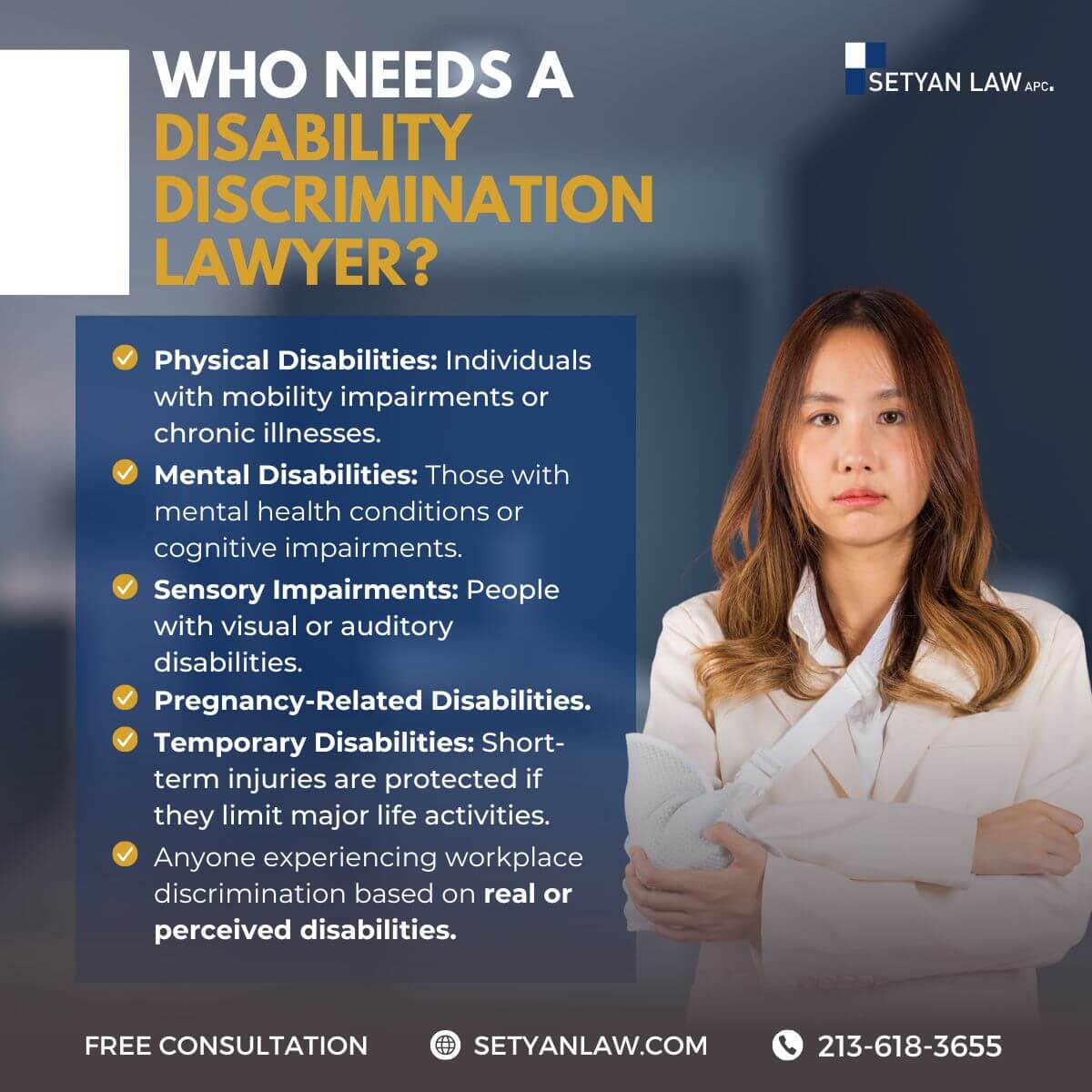
Call Setyan Law at (213)-618-3655 to schedule a free consultation.