Updated July 25, 2026
Labor Code 1102.5: What to Do When You're Fired for Reporting Health Violations
Labor Code 1102.5 protects California employees who report health and safety violations from employer retaliation. When you lose your job after reporting illegal activity or dangerous conditions, you may have grounds for a whistleblower retaliation claim. You have the right to speak up about workplace violations without fear of termination, demotion, or other adverse employment actions. Understanding your protections under this law, recognizing retaliation, and taking immediate action after being fired are essential steps to hold your employer accountable and recover compensation for wrongful termination.
Understanding California Labor Code 1102.5
California Labor Code Section 1102.5 serves as the state's primary whistleblower protection statute. This law prohibits employers from retaliating against workers who report violations of state or federal laws, disclose noncompliance with regulations, or refuse to participate in illegal activity. The statute applies broadly across both private and public sectors throughout California, offering protections that extend beyond what many federal whistleblower laws provide.
What Labor Code 1102.5 protects
Section 1102.5(b) shields employees who disclose information to government agencies, law enforcement, or any person with authority over them when they have reasonable cause to believe the information reveals a violation of law or regulation. This protection extends to internal reports made to supervisors, managers, HR departments, or compliance officers, as long as the recipient has authority to investigate or correct the violation.
Section 1102.5(c) protects employees who refuse to participate in conduct that would violate state or federal law or noncompliance with regulations. This means you cannot be fired for declining to falsify records, participate in fraudulent practices, or ignore safety violations.
Section 1102.5(h) clarifies that employees remain protected even when reporting misconduct falls within their job duties. This provision addresses situations where compliance officers, safety managers, or internal auditors face retaliation for doing exactly what their positions require.
The reasonable belief standard represents a critical feature of California whistleblower protection. You do not need to prove an actual violation occurred. The statute requires only that you had reasonable cause to believe the disclosed conduct violated a law or regulation based on the information available to you. However, courts distinguish between complaints about illegal conduct and complaints about unfair or unethical behavior. Reports referencing wage theft, safety violations, discrimination, fraud, or regulatory noncompliance receive stronger protection than general workplace grievances.
Types of health violations covered
The law protects disclosures concerning a wide range of violations:
- Workplace safety violations or hazardous conditions
- Discrimination, harassment, or wage and hour violations
- Fraud, embezzlement, or financial misconduct
- Environmental law violations
- Improper use of public funds or false claims
- Unsafe working conditions or work practices in your employment or place of employment
Reports can address violations of California statutes (such as the Labor Code or Fair Employment and Housing Act), federal statutes (such as the Fair Labor Standards Act or OSHA), local ordinances, or administrative rules and regulations. Employees in regulated fields benefit from industry-specific reporting options under statutes such as the California Healthcare Whistleblower Protection Act and the Financial Code.
Who is protected under this law
The statute covers employees broadly, including full-time, part-time, and temporary workers in both public and private sectors. Contractors and subcontractors receive protection, particularly where the hiring employer exerts some control. Job applicants who suffer retaliation before formal hiring may qualify for protection in certain cases.
Section 1102.5(h) extends protection to family members of whistleblowers. If your employer retaliates against you because a family member reported violations, you have legal recourse. Section 1102.5(d) protects employees from retaliation for having exercised whistleblower rights in former employment.
Employers who violate this law face civil penalties of up to $10,000 per employee for each violation. Courts may order reinstatement, back pay, lost benefits, and reasonable attorney's fees.
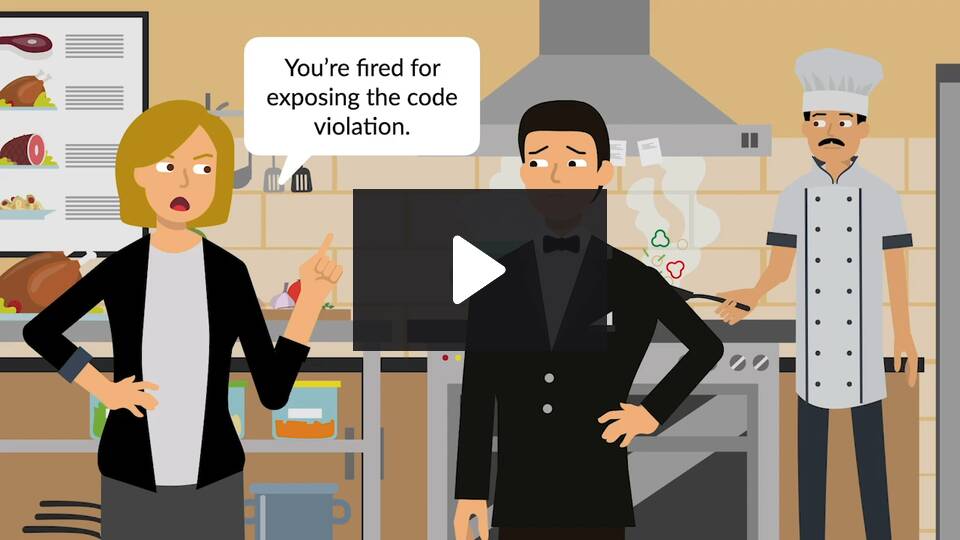
See: Employment Law Videos: Tort-Based Limits on Termination
Determining if your firing qualifies as retaliation
Not every termination after reporting violations qualifies for protection under labor code 1102.5. You must meet specific legal requirements to establish that your firing resulted from whistleblowing activity rather than legitimate business reasons.
Requirements for whistleblower protection
Three elements form the foundation of any whistleblower retaliation claim. First, you must prove by a preponderance of evidence that you engaged in protected activity. This means reporting information you reasonably believed disclosed a legal violation or refusing to participate in illegal conduct.
Second, you must demonstrate that you suffered an adverse employment action. Retaliation extends beyond termination to include demotion, reduction in pay, denial of promotion, negative performance evaluations, suspension, or reassignment to less desirable duties.
Third, you must establish a causal connection between the protected activity and the adverse employment action. This connection can be proven through direct evidence, such as emails or statements linking your report to your termination, or through circumstantial evidence like timing patterns.
Labor Code Section 1102.6 sets forth a burden-shifting framework adopted in 2003. You must first establish by a preponderance of evidence that the alleged retaliation was a contributing factor in your termination. Once you meet this initial burden, the burden shifts to your employer. The employer must then demonstrate by clear and convincing evidence that it would have taken the same action for legitimate reasons independent from your whistleblower activities.
Reasonable belief standard explained
You do not need to prove an actual violation occurred. The statute requires only that you had reasonable cause to believe the information disclosed a violation. This objective reasonableness standard asks whether a reasonable person in your position would believe a violation occurred.
California courts protect employees whose beliefs prove legally incorrect, as long as those beliefs were objectively reasonable. In one case, an employee mistakenly accused his employer of violating the Equal Pay Act by paying him less than other workers. The EPA only protects against pay disparity based on sex, race, or ethnicity. The jury found his mistaken interpretation reasonable from a layperson's perspective, particularly after a deputy labor commissioner suggested a potential violation existed.
Courts distinguish between complaints about illegal conduct and complaints about unfair or unethical behavior. Stating something is "unfair" or "bad management" may not qualify. However, pointing to some legal foundation for your suspicion satisfies the requirement. Accepting arguments that employees need perfect legal interpretation would defeat the legislature's purpose and discourage workers lacking legal training from reporting suspected violations.
Timeline between reporting and termination
Temporal proximity between your report and termination provides powerful circumstantial evidence of retaliation. Courts consider periods ranging from twelve days to one month as "very close" in time. When termination follows very close to whistleblowing activity, temporal proximity alone may establish the causal link.
Beyond one month, courts typically require additional evidence besides timing to demonstrate causation. The further removed your termination from your report, the more you need supporting evidence such as changed treatment patterns, pretextual justifications, or employer statements revealing retaliatory motive.
Immediate steps to take after being fired
Your response to termination shapes the strength of your retaliation case. Employers typically control access to most documents and information related to whistleblower disputes. Acting quickly to preserve evidence before losing access protects your legal rights.
Document everything related to your termination
Create a chronological record of all events surrounding your termination. Record each incident with the date, time, location, people involved, and a concise description of what happened. Note any witnesses present who could corroborate your account.
Contemporaneous documentation carries significantly more weight than later recollections. Records created at or near the time events occur provide stronger evidence than reconstructing details from memory weeks later. If you're starting documentation after termination, begin immediately and note which details come from memory versus contemporaneous records.
Document patterns of treatment changes following your report. A sudden shift in management behavior, exclusion from meetings, or unexplained negative reviews become powerful evidence when they occur shortly after your whistleblower activity.
Gather evidence of your health violation report
A copy of your written complaint strengthens your case by proving your employer knew about the protected activity. Without written documentation, employers may claim your verbal complaint never happened, was vague, or failed to identify specific violations.
If you filed reports with government agencies like OSHA or the California Attorney General's Whistleblower Hotline, obtain copies of those submissions. Internal emails referencing your concerns, incident reports, or safety complaints establish that you engaged in protected activity under labor code 1102.5.
Preserve communications with your employer
Save all relevant communications before losing access to work systems. This includes emails sent to your work and personal accounts, text messages, voicemails, direct messages on workplace platforms, memos, and written notifications. Forward important emails to a personal account, but avoid violating confidentiality policies or taking proprietary information.
Performance reviews prove particularly valuable. Recent positive evaluations discredit employer claims of poor performance and demonstrate that termination justifications represent after-the-fact pretexts for retaliation. Emails and texts often reveal retaliatory intent when decision-makers let their guard down and express their true mindset.
Do not access documents containing trade secrets, personal information about other employees, client lists, or proprietary information. Consult an employment lawyer about which documents may be considered off-limits.
Contact a whistleblower attorney
Early legal consultation provides guidance on evidence preservation boundaries, particularly with complex regulatory violations or confidentiality concerns. An attorney helps you understand reporting strategies and which documents you can legally collect.
Whistleblower attorneys protect your rights and help you recover lost pay and litigation costs. Given that jurors tend to punish companies for firing employees who report misconduct, legal representation strengthens your position for settlement negotiations or trial.
Settlement Rates, Legal Representation, Compensation and More
Wrongful termination cases, while potentially complex, can yield favorable outcomes for employees, with a high percentage settling before trial, and those with legal representation having a higher chance of receiving compensation. Here’s a more detailed breakdown:
Building your whistleblower retaliation case
Proving retaliation requires more than showing your termination followed your report. You must present specific evidence that connects your protected activity to the adverse employment action, then your employer bears the burden of justifying its decision.
Proving you reported illegal activity
Your first task involves demonstrating you engaged in protected activity under labor code 1102.5. Written complaints create the strongest foundation. Emails clearly identifying conduct and explaining why it may violate a specific law reduce disputes about what you reported and when. Statements such as "I believe this violates California overtime laws" or "This appears to violate OSHA safety regulations" carry more weight than general complaints about unfairness.
Internal reports to supervisors, managers, or HR qualify as protected activity if the recipient had authority to investigate or correct the violation. External reports to government agencies like OSHA, the California Attorney General's Whistleblower Hotline, or industry regulators also establish protected activity. Keep copies of all submissions, confirmation receipts, and any responses you received.
Establishing causal connection to termination
Causation forms the core of your retaliation case. Under Labor Code Section 1102.6, you must establish by a preponderance of evidence that your whistleblowing was a contributing factor in your termination. This standard means showing your protected activity played any role, however small, in the employment decision.
Timing provides the most powerful circumstantial evidence. Termination occurring within days or weeks of your report raises strong inference of retaliation. Beyond temporal proximity, several evidence types support causation:
- Sudden negative performance reviews appearing only after your complaint
- Changed treatment compared to other employees in similar situations
- Employer applying rules inconsistently after your report
- Hostile comments or increased scrutiny following your disclosure
- Violations of company procedures during your termination process
- Witness testimony confirming management reactions to your report
Performance records from before your report prove particularly valuable. Positive evaluations, awards, bonuses, or lack of prior discipline contradict employer claims of poor performance. Post-complaint conduct patterns, such as unexpected micromanagement, public criticism, or exclusion from meetings, strengthen your causation argument.
Meeting the burden of proof requirements
Once you establish contributing factor, the burden shifts to your employer. The employer must prove by clear and convincing evidence that it would have taken the same action for legitimate, independent reasons even without your whistleblowing activity. This higher standard of proof favors you as the employee.
You do not need to prove the employer's stated reason was pretextual. The Labor Commissioner acts as a neutral fact-finder, interviewing you, your employer, and relevant witnesses. If sufficient evidence supports retaliation, remedies may include reinstatement, lost wages payment, interest, removal of negative reports from your personnel file, and penalties up to $10,000 per violation.
Filing your claim and legal process
Strict deadlines govern whistleblower retaliation claims, making prompt action essential after termination.
Understanding filing deadlines
Labor Code 1102.5 provides a three-year statute of limitations from the date of retaliation to file a civil lawsuit. This deadline begins when you receive notice of termination or when it takes effect, whichever occurs first. However, filing a complaint with the Labor Commissioner requires meeting a shorter one-year deadline. Before filing a lawsuit, you must notify both the California Labor and Workforce Development Agency through an online form and your employer via certified mail. The agency has 65 days to decide whether to investigate, after which you may proceed with your own lawsuit.
Choosing between state agencies and court
You can file directly in court or submit a complaint to the Labor Commissioner. Direct lawsuits offer broader remedies and avoid administrative delays. Agency complaints may resolve through settlement or mediation without litigation costs.
What happens during the investigation
Agency investigations include interviews with you, your employer, and witnesses, plus review of employment records and communications. Investigators aim to resolve disputes through settlement, mediation, or formal findings.
Settlement vs going to trial
Settlement negotiations often occur before trial, offering compensation while avoiding litigation expenses and publicity. Successful claims yield reinstatement, back pay plus interest, benefits, civil penalties up to $10,000, and attorney's fees.
Conclusion
Whistleblower protection under Labor Code 1102.5 gives you powerful legal recourse when fired for reporting health violations. As a matter of fact, your rights extend beyond just keeping your job; you can recover lost wages, secure reinstatement, and hold your employer accountable through civil penalties.
Success depends on immediate action. Document everything, preserve evidence before losing access to work systems, and contact a whistleblower attorney promptly. The three-year filing deadline provides time, but early preparation strengthens your case significantly.
Your employer cannot silence you for doing the right thing. Take the steps outlined here to protect yourself and seek the compensation you deserve.
References
https://www.forbes.com/sites/ericbachman/2022/03/16/3-pivotal-documents-in-a-corporate-whistleblower-retaliation-case/
https://codes.findlaw.com/ca/labor-code/lab-sect-1102-5/
If you’re employed by a California employer, contact an expert Wrongful Termination Attorney first, for expert assistance regarding your case. Call today for a free and confidential consultation.