
Los Angeles Wage and Hour Lawyers
You earned it. We make your employer pay it.
Shorted on your paycheck, denied overtime, or still waiting on your last check? Setyan Law APC represents Los Angeles employees who were not paid what California law requires — workers only, never employers.
- Free, confidential consultation
- Employee-only advocacy
- No fee unless we win
- Hablamos Español
Tell us what happened and we will call you back. Your information stays confidential.
No Win, No Fee. Submitting this form does not create an attorney-client relationship.
Recovered for sexual harassment survivors
Recovered for fired employees
Employment cases handled
Verdict against Costco Wholesale
California Wage and Hour Trial Attorney
Sam Setyan represents employees only, never employers. In unpaid wage cases, employers pay full value only when they know you are ready to take them to court. Sam offers a confidential, judgment-free space to tell your story, pairing hands-on client advocacy with trial preparation built to recover every dollar you earned.
On this page
Shorted on your paycheck, denied overtime, or still waiting on your last check? Setyan Law APC – Wrongful Termination & Sexual Harassment Lawyer represents Los Angeles employees who were not paid what California law requires. We represent workers only, never employers, and we pursue every dollar you earned, plus interest, penalties, and attorney fees the law allows.
When you hire Sam Setyan as your wage and hour attorney, you work directly with him from your first call to your final check. Your consultation is free, and you pay no fee unless we win.
Common Wage and Hour Violations in California
California gives workers some of the strongest pay protections in the country, but many employers still cut corners to save on payroll. Setyan Law recovers pay for Los Angeles workers facing the wage and hour violations California employers commit most often, including:
- Paying less than the state or local minimum wage
- Off-the-clock work, such as pre-shift security checks or answering texts after hours
- Overtime and double time that was never paid
- Missed, late, or interrupted meal and rest breaks
- Late or missing final paychecks
- Illegal paycheck deductions
- Unreimbursed work expenses, such as mileage and personal cell phone use, under Labor Code 2802
- Inaccurate or incomplete wage statements
- Denied or underpaid paid sick leave
- Unpaid reporting time pay and split shift pay
Some employers sidestep these rules by calling workers independent contractors or “exempt” salaried employees. If that sounds like your job, California law looks at how the work is really done, not the label on your paperwork, to decide who is an employee.
Minimum Wage in Los Angeles (2026)
Your minimum wage depends on where you physically do the work, not where your employer is based. Current rates for the Los Angeles area are:
- City of Los Angeles: $18.42 per hour since July 1, 2026, for anyone who works at least two hours a week inside city limits
- Unincorporated Los Angeles County: $18.47 per hour since July 1, 2026
- California statewide: $16.90 per hour since January 1, 2026
- Covered fast food workers: $20.00 per hour statewide
- Hotel workers at Los Angeles hotels with 60 or more rooms (50 or more near LAX): $25.00 per hour since July 1, 2026
- Certain health care workers: separate, higher minimums under state law, based on the type of facility
Cities such as Pasadena, Santa Monica, and West Hollywood set their own rates, so check our 2026 guide to California city minimum wages. Whether you are paid hourly, by the piece, or on commission, you must earn at least minimum wage for every hour worked, and California never allows tips to count toward it.
Wage Theft in Los Angeles: What to Do When You Were Not Paid

Wage theft happens any time an employer keeps money you earned. It is rarely an accident. Unpaid wages usually come from a company policy applied to everyone on the schedule. Setyan Law APC – Wrongful Termination & Sexual Harassment Lawyer helps Los Angeles employees turn the questions below into claims that get paid, and speaking with a wage theft attorney early protects both your evidence and your deadlines.
My Employer Didn’t Pay Me. What Can I Do?
Start by building your own record. Write down the dates and hours you worked, and save your pay stubs, schedules, timecard screenshots, and any texts or emails about your pay. You have the right to request your payroll records in writing, and California employers must provide them within 21 days.
From there, you can file a wage claim with the California Labor Commissioner or sue in court. Unpaid wages earn interest, and penalties often grow faster than employers expect. A slow month, a cash flow problem, or a dispute about your performance never legally excuses them from paying you.
My Boss Didn’t Pay Me for All My Hours. Is That Wage Theft?
Yes. California requires pay for all time you spend under your employer’s control. If your employer knew or should have known you were working, they owe you those hours. Common examples include:
- Working before clocking in or after clocking out
- Answering calls, texts, or emails during unpaid time
- Waiting through mandatory bag checks or security screenings
- Time rounding that consistently favors the employer
- A manager editing your timecard to remove hours
What If I Wasn’t Paid Overtime?
If you are thinking, “I worked overtime and didn’t get paid for it,” California law is on your side. Most hourly employees earn time and a half after eight hours in a workday or 40 hours in a workweek, and double time after 12 hours in a day. Your employer must pay those hours even if no one approved the extra time in advance.
Not getting paid overtime because you are on salary or paid a flat day rate? A job title or pay method alone does not make you exempt. Our unpaid overtime page explains how overtime is calculated and how we work to recover it.
Can My Employer Punish Me for Complaining About My Pay?
No. California law bars employers from firing, demoting, cutting hours, or threatening workers who complain about pay, request payroll records, or file a wage claim. Under Senate Bill 497, if your employer takes action against you within 90 days of a complaint, the law presumes retaliation and the employer must show a legitimate reason. Learn more on our workplace retaliation page.
Meal and Rest Break Violations

Most nonexempt California employees are entitled to an unpaid, uninterrupted 30-minute meal break that begins before the end of the fifth hour of work, and a paid 10-minute rest break for every four hours worked or major fraction of four hours.
If an employer denies, shortens, or interrupts those breaks, it owes you one additional hour of pay at your regular rate for each workday you miss a meal break, and another hour for each missed rest break.
For the full rules, including second meal breaks and on-duty meal periods, see our California meal and rest break laws guide.
Final Paycheck and Waiting Time Penalties
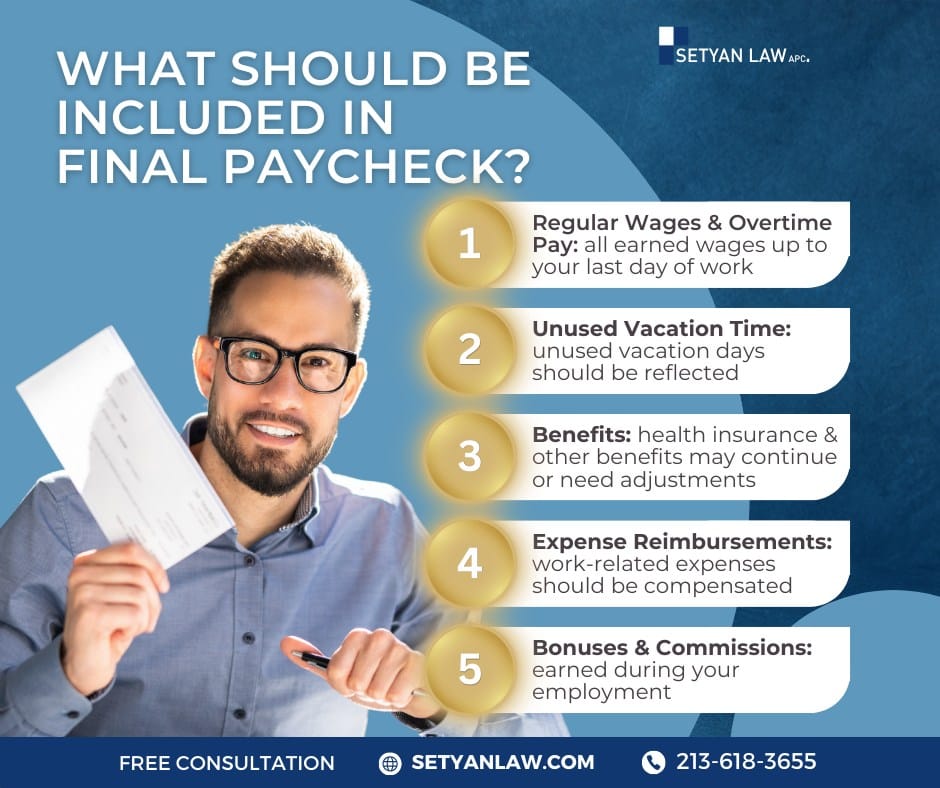
Your final check must include all wages earned through your last day, including overtime, earned commissions, and any accrued, unused vacation or PTO. California also sets strict deadlines for your final pay.
- Fired or laid off: due immediately, on your last day
- Quit with at least 72 hours’ notice: due on your last day
- Quit without notice: due within 72 hours
My Employer Didn’t Give Me My Last Paycheck. What Now?
If your employer willfully pays late, it owes waiting time penalties of one full day’s wages for every day the check is late, up to 30 days. For a worker earning $240 a day, that can mean $7,200 in penalties on top of the wages owed. A final check that bounces can trigger the same penalties. Our guides to California’s final paycheck law and calculating waiting time penalties walk through the math.
Tell us who you worked for, what you were paid, and what is missing. The consultation is free and confidential.
Illegal Paycheck Deductions
Employers can withhold taxes and deductions you approve in writing, such as health insurance premiums or retirement contributions. Labor Code 221 makes it unlawful for an employer to collect back any part of the wages it paid you. Additionally, employers may not:
- Deduct cash register shortages, breakage, or lost equipment without proof of a dishonest or willful act or gross negligence
- Charge you for uniforms the job requires
- Take back wages already paid through chargebacks or business expense deductions
- Make deductions that drop your pay below minimum wage
- Pass business costs like tools, mileage, or phone bills on to you without reimbursement
Paid Sick Leave in Los Angeles, California

If you work at least two hours a week inside the City of Los Angeles, the city’s ordinance gives you more paid sick leave than state law. We see employers miss these rules often, especially with part-time and seasonal staff.
- Use: at least 48 hours (six days) per year
- Accrual: one hour for every 30 hours worked, or 48 hours provided upfront each year
- Carryover: unused hours roll over to the next year, and any cap on accrued hours can be no lower than 80 hours or 10 days under state law
- Timing: you can begin using leave on your 90th day of employment
Outside city limits, California’s statewide law guarantees at least 40 hours (five days) of paid sick leave per year. Under either law, your employer cannot deny sick leave when you need it for yourself or a family member, or retaliate against you for using it.
Labor Commissioner Claim vs. Lawsuit
There are two main paths to recover unpaid wages in California, and the right one depends on how much you are owed and what else happened at work.
Filing With the Labor Commissioner
The California Labor Commissioner’s Office accepts wage claims at no cost. Most claims start with a settlement conference; unresolved claims move to an informal hearing (a Berman hearing), followed by a written decision. Either side can appeal to superior court, and an employer that appeals must post a bond for the amount awarded. Learn more about how to file a wage claim in California.
Filing a Lawsuit
A lawsuit gives you tools a wage claim does not, including formal discovery to obtain your employer’s records, the ability to bring group claims on behalf of coworkers, and the ability to combine your wage claim with retaliation or wrongful termination claims.
Many California wage laws also require employers to pay the winning employee’s attorney fees. Experienced wage claim attorneys can tell you which path is likely to recover more in your situation.
Joining Other Employees in a Wage Claim

If your employer shorted you, it likely shorted your coworkers too. Setyan Law evaluates whether your case is best brought on its own or alongside others. Group options include:
Class Actions
For many employees affected by the same pay policy.
PAGA Claims
Allow employees to seek civil penalties on behalf of the state and their coworkers, with 35% of the penalties going to affected employees.
Federal Collective Actions
FLSA claims that coworkers join by opting in.
If you signed an arbitration agreement, it may affect how a group claim proceeds, but it does not always end one. Our wage theft lawyers can review your paperwork and explain your options. You can also read our guide on whether to join a class action against your employer.
Filing Deadlines for California Wage Claims
Wage claims have strict time limits, and the longer you wait, the more pay periods fall outside the deadline. Common deadlines include:
- Three years: most California Labor Code claims, including minimum wage, overtime, and meal and rest break premiums
- Four years: restitution under California’s Unfair Competition Law and claims based on a written contract
- Two years: claims based on an oral promise of pay
- One year: PAGA penalty claims and retaliation complaints filed with the Labor Commissioner
- Two or three years: federal FLSA claims, depending on whether the violation was willful
For more detail, see our article on the statute of limitations for unpaid wages, or call us to confirm your deadline.
Why California Workers Trust Setyan Law to Recover Stolen Wages
When you need a wage and hour lawyer Los Angeles workers can reach directly, Sam Setyan handles your case himself. Setyan Law APC – Wrongful Termination & Sexual Harassment Lawyer prepares every case for trial from day one.
Sam has handled more than 500 employment cases, including a federal jury verdict against Costco Wholesale. Employers pay closer to full value when they know your lawyer has Sam’s experience and is ready for court.
We know California employers try to hide wage violations behind rounding policies, “salaried” job titles, and missing time records. Here is what we do for you:
Rebuild Your Hours
We reconstruct the hours you worked and calculate every dollar owed, including interest and penalties.
Demand Your Records
We obtain your payroll and personnel records so the numbers come from your employer’s own files.
Put It in Writing
We send a formal demand letter for unpaid wages before anything else escalates.
Negotiate or Try It
We negotiate for a full settlement, or file and try your case in court.
Coordinate Group Claims
Where coworkers were affected by the same policy, we bring the claims together.
Protect You From Retaliation
We shield you from retaliation while your claim is pending.
Los Angeles Wage and Hour FAQs
What counts as a wage and hour violation in California?
Any failure to pay what California law requires is a violation. Examples include paying below minimum wage, unpaid overtime, off-the-clock work, missed meal or rest breaks, late final paychecks, illegal deductions, unreimbursed expenses, inaccurate pay stubs, and denying paid sick leave. Misclassifying employees as contractors to avoid these rules counts.
What is the minimum wage in Los Angeles?
Since July 1, 2026, the City of Los Angeles minimum wage has been $18.42 per hour for work inside city limits. Unincorporated Los Angeles County requires $18.47. Cities without their own ordinance follow the $16.90 state minimum. Covered fast food workers earn $20, and large LA hotels must pay $25.
What can I do if my employer is not paying me overtime?
Keep your own record of hours, save pay stubs and schedules, and request your payroll records in writing. California requires overtime after eight hours in a day or 40 in a week. You can file a claim with the Labor Commissioner or sue to recover wages owed, interest, and penalties.
Can my employer withhold my final paycheck?
No. If you are fired or laid off, final pay is due immediately. If you quit with 72 hours’ notice, it is due on your last day; without notice, within 72 hours. It must include unused vacation. A willful delay triggers waiting time penalties of up to 30 days’ wages.
Is my employer allowed to make deductions from my paycheck?
Only in narrow cases. Employers may deduct taxes, legally required amounts, and items you authorized in writing, like insurance premiums. They cannot charge for required uniforms or deduct for cash shortages or broken equipment unless you acted dishonestly, willfully, or with gross negligence. Deductions cannot push pay below minimum wage.
What are meal and rest break violations, and what can I recover?
A violation occurs when your employer denies, shortens, interrupts, or delays your 30-minute meal break or 10-minute rest breaks. For each workday you miss a meal break, you can recover one extra hour of pay at your regular rate, plus another hour for each missed rest break.
Should I file a wage claim with the Labor Commissioner or file a lawsuit?
A Labor Commissioner claim is free and works well for straightforward unpaid wages. A lawsuit adds pretrial discovery, attorney fees, group claims, and related claims like retaliation or wrongful termination. Many workers start by speaking with a lawyer, since the right choice depends on what you are owed.
Can I join other employees in a wage and hour lawsuit?
Often, yes. When an employer’s pay policy affects many workers, employees can bring a class action, a PAGA representative claim on behalf of the state and coworkers, or a federal collective action. Arbitration agreements can limit some group claims, but California law protects you from retaliation for participating.
What is the deadline to file a wage and hour claim in California?
Most California claims for unpaid wages, overtime, and meal and rest break premiums must be filed within three years. Some claims allow four years, while PAGA claims have one year and federal FLSA claims two or three. Every pay period you wait can mean losing money, so act quickly.
How much does a wage and hour lawyer cost?
Setyan Law APC handles wage cases on contingency, so you pay nothing upfront and no attorney fee unless we recover money for you. Consultations are free. California law also often requires employers who lose wage cases to pay the employee’s attorney fees.
Get Paid What You Earned
Every week you wait is another paycheck your employer keeps. Call Setyan Law APC to speak with a Los Angeles wage and hour attorney about your case. Tell us your employer, what happened, and when. Your information stays confidential, and the consultation is free.
Tell us what happened and we will call you back. Your information stays confidential.
No Win, No Fee. Submitting this form does not create an attorney-client relationship.
The information on this page is for general informational purposes only and is not legal advice. Prior results do not guarantee a similar outcome. Contacting Setyan Law does not create an attorney-client relationship.

