Updated August 29, 2026
Wrongly Terminated in Fullerton? Here's What Most Lawyers Won't Tell You
Wrongly terminated lawyers frequently gloss over a startling fact: most employees in Fullerton believe they have no recourse after being fired. Despite California's reputation as an "at-will" employment state, you actually possess far more protections than your former employer wants you to know about.
Many terminated workers walk away from legitimate claims, mistakenly thinking their employer had the legal right to fire them for any reason. Unfortunately, this widespread misconception costs countless employees their rightful compensation every year. In fact, numerous terminations that companies frame as "business decisions" or "performance issues" actually violate specific state and federal laws.
This guide cuts through the legal jargon to reveal what most attorneys won't tell you upfront about wrongful termination in Fullerton. We'll explore the limitations of at-will employment, hidden protections under California law, and how to recognize disguised retaliation. Additionally, we'll cover what you should really know about potential damages and why many promising cases fail before they even reach a courtroom.
What Most People Don’t Know About At-Will Employment
The foundational principle governing employment in California often surprises terminated workers. Unlike what many believe, being fired doesn't automatically constitute wrongful termination, nor does it always give you grounds to sue. Understanding the nuances of employment law might completely change how you view your recent job loss.
California's at-will rule explained
California operates under an "at-will" employment doctrine, which means employers can terminate workers without advance notice and for almost any reason. This principle works both ways – you can likewise quit your job without providing justification. The legal basis for this comes from California Labor Code Section 2922, which states that employment without a specified term may be ended "at the will of either party."
Many workers mistakenly believe they're entitled to warnings, progressive discipline, or some form of due process before termination. However, unless your employment contract specifically guarantees these protections, your employer generally doesn't need to follow a specific procedure to let you go.
Why 'any reason' doesn't mean 'every reason'
Although the at-will doctrine grants employers considerable freedom, numerous crucial exceptions exist. These exceptions form the foundation of wrongful termination claims. Your employer cannot legally fire you for:
- Discrimination based on protected characteristics (race, religion, gender, etc.)
- Retaliation for reporting harassment or discrimination
- Whistleblowing or refusing to participate in illegal activities
- Taking legally protected leave (FMLA, CFRA, etc.)
- Exercising workplace rights like filing wage claims
Furthermore, your employer cannot terminate you if doing so violates public policy or an implied contract. For instance, if your employee handbook outlines specific termination procedures that your employer ignores, you might have grounds for a claim based on breach of implied contract.
Common misconceptions about legal firings
One prevalent myth is that employers must provide a reason for termination. Under at-will employment, they typically don't need to explain why you're being fired. This often leads to confusion when workers are suddenly terminated without clear justification.
Another misunderstanding involves performance-based terminations. Many employees believe they can't be fired if they're meeting performance metrics. Nevertheless, unless you have a contract specifying performance standards, employers can generally raise those standards or change job requirements at any time.
Moreover, many workers wrongly assume that unfair treatment automatically equals illegal treatment. While your boss might be unreasonable, playing favorites, or even demonstrating poor management skills, these behaviors alone don't necessarily constitute wrongful termination. The termination must violate specific laws or contracts to be legally actionable.
Perhaps most importantly, employees often don't realize that timing and documentation matter tremendously in termination cases. If you were fired shortly after engaging in protected activity (like reporting harassment), this timing creates a presumption of retaliation that your employer must overcome. Consequently, recognizing these patterns can significantly strengthen your case.
Ultimately, while California's at-will employment doctrine gives employers substantial leeway, it doesn't grant them unlimited power to terminate employees. Understanding these limitations is your first step toward recognizing whether your termination might have crossed legal boundaries.
Hidden Protections Under California Law
Beyond California's at-will employment framework exists a powerful set of legal protections that many terminated employees overlook. California's employment laws often provide substantially more protection than their federal counterparts, yet many workers remain unaware of these critical safeguards until it's too late.
FEHA: What it covers and why it matters
The Fair Employment and Housing Act (FEHA) serves as California's primary shield against workplace discrimination. Unlike federal laws that typically apply only to larger companies, FEHA covers employers with just five or more employees. This broader reach means substantially more California workers have legal protection than most realize.
FEHA prohibits discrimination based on an extensive list of protected characteristics including race, color, religion, gender, sexual orientation, gender identity, disability, medical condition, age (40+), and numerous others. What makes FEHA particularly powerful is its comprehensive remedies: victims can seek back pay, front pay, reinstatement, policy changes, damages for emotional distress, punitive damages, and attorney's fees.
Notably, FEHA's harassment protections apply to all workplaces regardless of size – even those with just a single employee. This means virtually every California worker has protection from harassment, a fact many wrongly terminated lawyers fail to emphasize.
Federal vs. state protections
California consistently offers stronger worker protections than federal law. For instance, Title VII (federal) only applies to employers with 15+ employees, whereas FEHA covers those with 5+ employees. This threshold difference alone means thousands more California workers have discrimination protection.
Additionally, FEHA's protected categories extend well beyond federal law, covering marital status, medical conditions, and gender expression. For government employees, FEHA allows higher damage awards, including emotional distress and punitive damages not always available under federal law.
Disability, gender, and age discrimination
California's disability protections surpass federal standards in significant ways. While the Americans with Disabilities Act (ADA) defines disability as an impairment that "substantially limits" major life activities, FEHA requires only that the impairment makes performance "difficult". This distinction means conditions like stress, anxiety, depression, and irritable bowel syndrome qualify as protected disabilities in California.
Regarding gender discrimination, California prohibits unequal treatment based on gender identity, gender expression, and sexual orientation. The state also enforces the Fair Pay Act, which forbids employers from paying different wages based on gender for substantially similar work.
For age discrimination, both FEHA and the federal Age Discrimination in Employment Act protect workers 40 and older. Yet FEHA applies to smaller employers and permits greater remedies.
Pregnancy and family leave rights
California pregnancy protections exceed federal standards through Pregnancy Disability Leave (PDL), which provides up to four months of job-protected leave for pregnancy-related conditions. Employers must maintain health coverage during this period.
Furthermore, the California Family Rights Act (CFRA) allows eligible employees up to 12 weeks of leave to bond with a new child or care for family members. Unlike the federal FMLA, CFRA doesn't count pregnancy as a serious health condition, effectively allowing new mothers to stack PDL and CFRA for longer protected leave.
These robust protections create a safety net for California workers that goes far beyond what many terminated employees initially believe they have.
Setyan Law

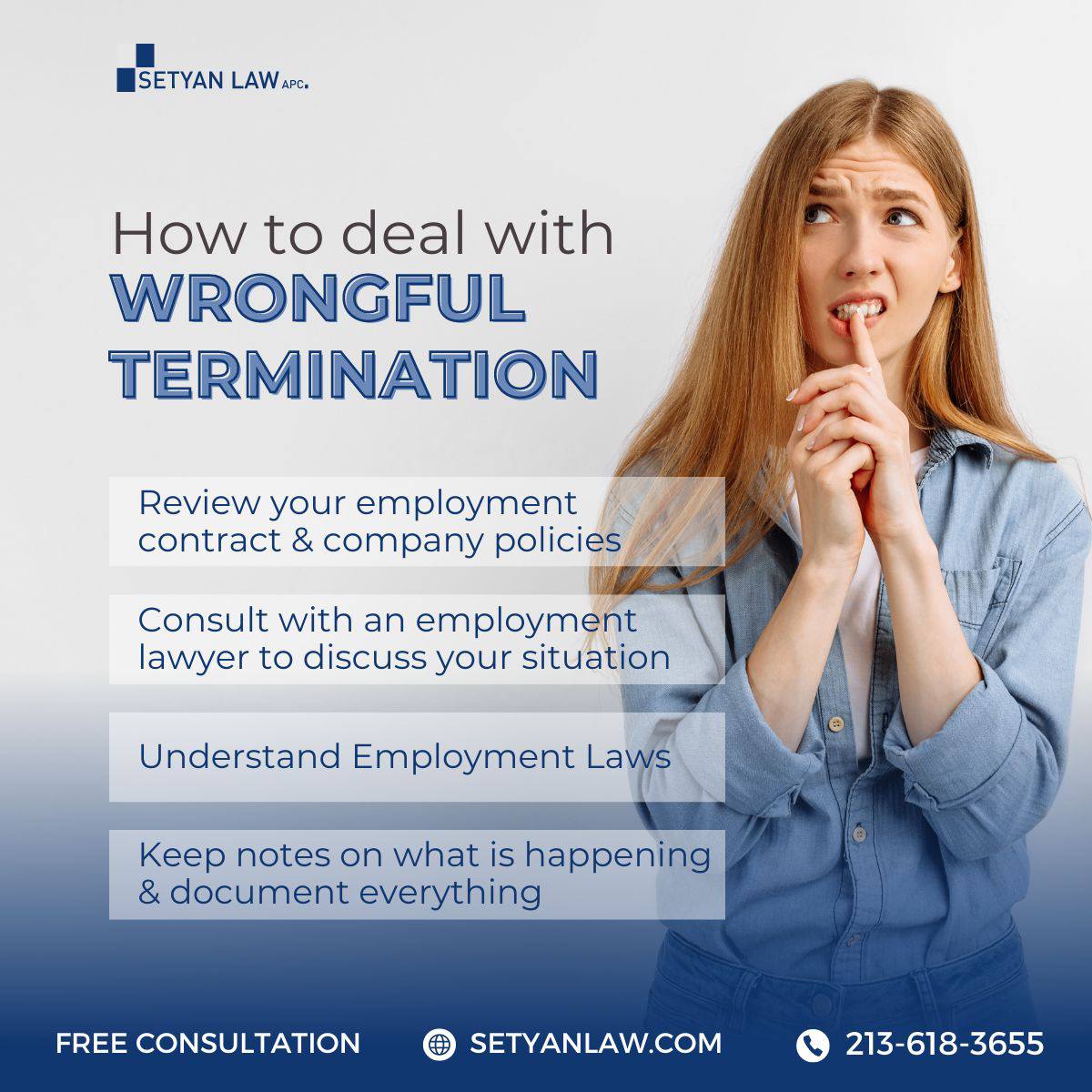
It’s always best to consult a qualified Wrongful Termination Attorney regarding your case before you file. Employment law has many pitfalls and an attorney can help you navigate past them safely. Sam Setyan will review your grievance, tell you your options, and guide you to the most favorable outcome possible. It’s your call.
Call 213-618-3655 for a free consultation.
Retaliation: The Most Overlooked Form of Wrongful Termination
Retaliation claims consistently rank as the most frequently filed complaints with employment agencies yet remain widely misunderstood by terminated employees. According to multiple surveys, this form of wrongful termination often goes unrecognized because employers rarely admit their true motives for firing an employee who has "caused trouble."
What counts as retaliation
Legally speaking, workplace retaliation occurs when an employer takes adverse action against an employee for engaging in a legally protected activity. To establish a valid retaliation claim in California, you must prove three essential elements: first, you participated in a protected activity; second, your employer took negative action against you; and finally, there exists a causal connection between your protected activity and the adverse action.
This causal connection often hinges on timing. If you're fired shortly after reporting harassment or requesting accommodation, this suspicious timing itself can serve as compelling evidence of retaliation. Of course, employers typically deny retaliatory intent, presenting seemingly legitimate reasons for termination instead.
Examples of protected activities
Many terminated employees don't realize just how many workplace actions California law shields from employer punishment. Protected activities include:
- Reporting workplace violations such as safety hazards, wage theft, or discrimination
- Filing complaints about harassment or discrimination (even if ultimately unproven)
- Participating in internal or external workplace investigations
- Requesting reasonable accommodations for disabilities or religious practices
- Taking legally protected leave (medical, family, disability)
- Refusing to engage in illegal activities at your employer's direction
- Supporting coworkers who are exercising their legal rights
- Discussing salary information with colleagues
- Participating in union activities
Remember that protection extends beyond merely filing formal complaints. Even informal conversations with supervisors about potential legal violations qualify as protected activities under California law.
How employers disguise retaliatory firings
Since outright admitting to retaliation would create obvious legal liability, employers typically disguise retaliatory terminations behind seemingly legitimate reasons. One common tactic involves suddenly identifying "performance issues" that were never mentioned before you engaged in protected activity.
Other disguise tactics include implementing progressive discipline immediately after you exercise your rights, eliminating your position under the pretense of "restructuring" (then later refilling it with someone else), or creating a hostile work environment designed to force your resignation.
Especially troubling is when employers begin documenting minor infractions or imposing new standards immediately following protected activities. This paper trail creation serves to manufacture justification for an already-planned termination.
Ultimately, recognizing disguised retaliation requires examining patterns rather than isolated incidents. Sudden changes in how you're treated after engaging in protected activities—even subtle ones—often reveal the employer's true motives behind a termination that might otherwise appear legitimate on paper.
What Lawyers Rarely Mention About Damages
Money talks—and in wrongful termination cases, understanding potential damages determines whether pursuing a case makes financial sense. What most wrongly terminated lawyers won't immediately tell you is that calculating compensation involves more complex factors than simply multiplying your salary by time unemployed.
Lost wages and future income
Damages typically start with back pay—compensation from termination until settlement or judgment. This includes not just salary but also bonuses, commissions, and benefits like health insurance and retirement contributions. Courts aim to restore you financially to where you would have been without the termination.
Front pay becomes relevant when reinstatement isn't feasible, covering future earnings you would have received if still employed. Calculations consider your age, position, and how long finding comparable employment might take. Importantly, courts require "mitigation"—reasonable efforts to find comparable work. If you secure a lower-paying position, you may recover the difference as damages.
Emotional distress compensation
Wrongful terminations often cause anxiety, depression, and damaged self-worth. These non-economic damages frequently become the largest portion of recovery, particularly in cases with minimal wage loss. In practice, emotional distress damages typically require either:
- Personal testimony plus statements from friends/family describing your suffering
- Documentation from mental health professionals (which strengthens claims)
Punitive damages and when they apply
Punitive damages aren't designed to compensate you but to punish employers for egregious misconduct. Courts award these only when employers acted with "oppression, fraud or malice". Unlike compensatory damages, punitive damages come with no predetermined statutory limit under California law.
Reinstatement vs. settlement
While reinstatement (getting your job back) seems appealing, it's often impractical due to damaged relationships. Settlements typically include specific dollar amounts in exchange for releasing all claims against the employer, eliminating uncertainty of trial.
Attorney fees and hidden costs
Uniquely, California employment laws permit recovery of attorney fees from your employer if you win. This explains why many employment lawyers work on contingency (taking 33-40% of your recovery). Nevertheless, the fee recovery provision creates extraordinary risk for employers—in one case, a plaintiff who rejected a $600,000 settlement ultimately received $3.3 million at trial, plus nearly $5 million in attorney fees.
Throughout litigation, attorneys may bill $1,000+ hourly in complex cases. This potential liability often encourages employers to settle early, as they could end up paying fees "for both sides" if they lose.
Why Many Cases Fail Before They Start
Even the strongest wrongful termination claims can crumble before reaching court for three common reasons. Indeed, understanding these pitfalls can be the difference between securing justice and walking away empty-handed.
Lack of documentation
Documentation serves as the foundation of any successful wrongful termination case. Without it, your claim becomes merely your word against your employer's. Employers routinely maintain detailed records of employee performance and conduct, certainly giving them an immediate advantage.
Critical documentation varies by claim type:
- For harassment: HR claims, threatening messages, eyewitness statements
- For discrimination: Performance reviews, discriminatory comments
- For retaliation: Inconsistent reviews, termination timing after protected activities
Forward yourself relevant emails or messages that demonstrate harassment or discrimination, as long as they aren't confidential company materials.
Missing deadlines for filing
Recent statistics reveal that 67% of wrongful termination claims in California get dismissed solely due to missed deadlines. Typically, you have three years from termination to file an administrative claim under California law.
After receiving a right-to-sue letter, you have only one year to file a lawsuit. These employment law deadlines are strictly enforced by courts, with few exceptions granted.
Choosing the wrong type of lawyer
Not all attorneys possess the specialized knowledge needed for wrongful termination cases. Employment law contains nuanced regulations that general practice attorneys might overlook.
How to prepare before contacting an attorney
Prior to your consultation, gather every relevant document: employment contracts, emails, pay stubs, performance reviews, and termination paperwork. Document each work-related event with dates, times, locations, and witnesses.
Write down all questions beforehand. Consider timing – request documentation within days after dismissal when information remains fresh. If possible, ask your former employer for a written explanation of your termination.
Ultimately, proper preparation maximizes your chances of success, given that 83% of successful claims involve workers who acted within the first 30 days after termination.
Conclusion
Wrongful termination cases present far more complexity than most Fullerton workers initially recognize. Though California's at-will employment doctrine appears to favor employers, numerous legal protections actually exist to shield you from unjust dismissal. Understanding these safeguards might completely change your perspective about your termination.
Time matters tremendously when pursuing wrongful termination claims. Without question, those who act quickly after dismissal position themselves for significantly better outcomes. Delay often leads to lost evidence, faded memories, and missed filing deadlines that permanently bar legitimate claims.
Documentation serves as your strongest ally throughout this process. Therefore, preserve all communications, performance reviews, and evidence of any protected activities you engaged in before termination. This evidence frequently determines whether your case succeeds or fails.
Recognizing disguised retaliation requires careful attention to patterns and timing. Sudden performance concerns, unexpected discipline, or abrupt policy changes following protected activities often reveal an employer's true motives behind what they frame as legitimate termination.
California's robust employment protections surpass federal standards in numerous ways. Still, these protections only benefit those who recognize their rights and take appropriate action to defend them. Most employers count on terminated workers remaining unaware of these legal safeguards.
The path forward after wrongful termination depends on your specific circumstances. Consequently, consulting with an experienced employment attorney who specializes in wrongful termination claims represents your best chance at achieving justice. Armed with proper knowledge and guidance, you can effectively challenge employers who believe they can dismiss you without consequences.
Remember – your former employer's power stops where your legal rights begin. Accordingly, knowing these rights might make all the difference between walking away empty-handed and receiving the compensation you rightfully deserve.