
Updated January 26, 2026
Warning Signs of Grooming: A California Guide to Spotting Hidden Harassment
One of the most confusing and commonly searched questions employees have is whether behavior can still qualify as sexual harassment when the person engaging in it is “nice,” friendly, or supportive at other times. Many employees dismiss or minimize their own experiences because the harasser is not openly aggressive, threatening, or consistently inappropriate.
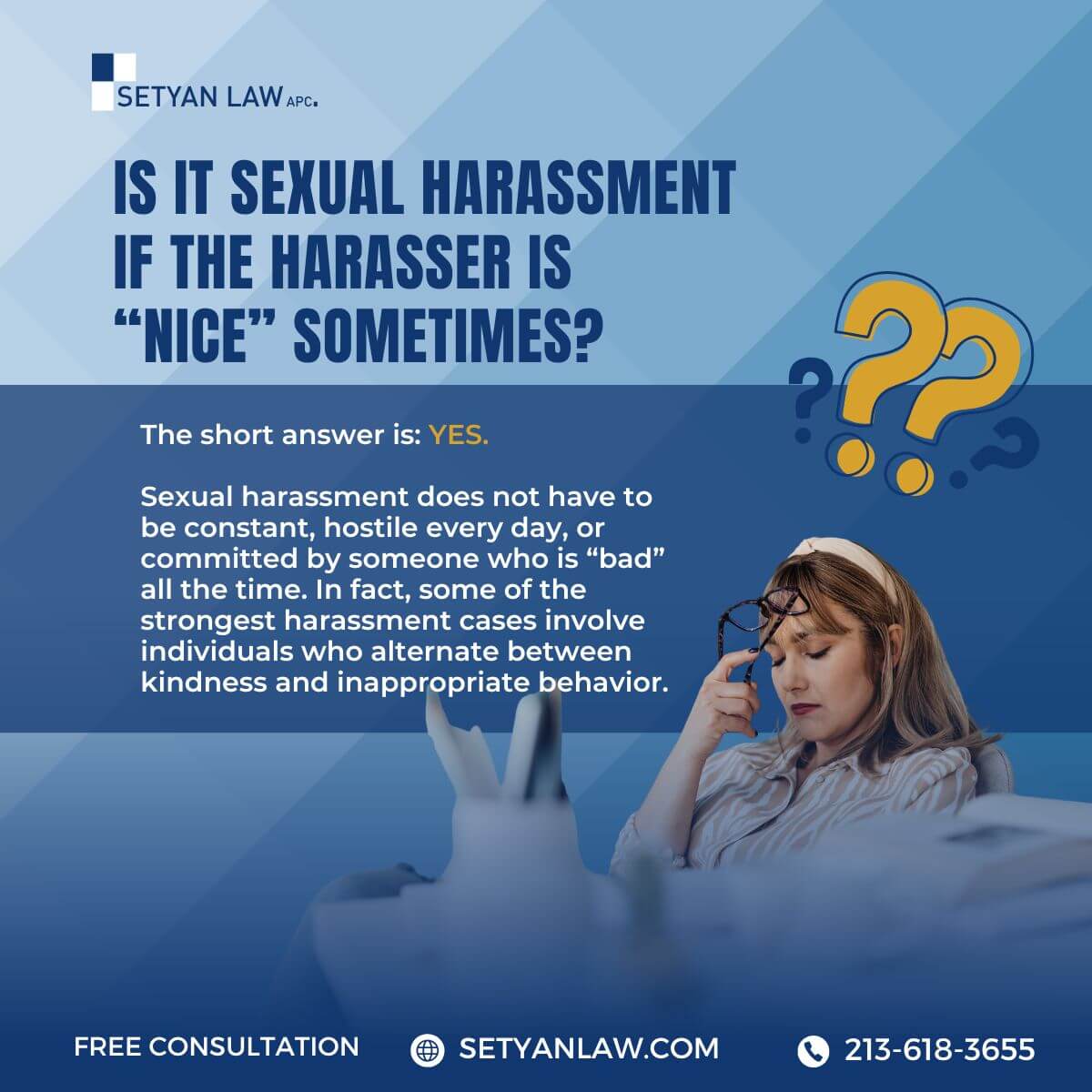
The short answer is: yes. Sexual harassment does not have to be constant, hostile every day, or committed by someone who is “bad” all the time. In fact, some of the strongest harassment cases involve individuals who alternate between kindness and inappropriate behavior.
Why “Niceness” Does Not Cancel Sexual Harassment
Sexual harassment is judged by the impact of the conduct, not the personality of the person engaging in it. A supervisor or coworker can be friendly, helpful, or complimentary one moment and still engage in unlawful behavior the next.
Courts and enforcement agencies look at whether the conduct was:
- Unwelcome
- Based on sex, gender, sexual orientation, or gender identity
- Severe or pervasive enough to alter working conditions
None of these factors depend on whether the harasser is polite, joking, or supportive in other contexts.
Common Examples of “Nice” Sexual Harassment
Employees often experience harassment that feels confusing because it is mixed with kindness or praise. Examples include:
- Complimenting your appearance while also making sexual comments
- Offering career help or mentorship while crossing personal boundaries
- Sending supportive messages mixed with flirtatious or suggestive texts
- Being respectful in meetings but inappropriate in private conversations
- Apologizing after incidents but repeating the behavior later
This pattern can make employees question whether they are “overreacting” or misinterpreting intent. The law does not require you to prove malicious intent—only that the behavior was unwelcome and harmful.
Warning Signs of Grooming: A California Guide to Spotting Hidden Harassment
Recognizing the signs of grooming can be challenging because perpetrators deliberately disguise their manipulative behaviors as friendship, mentorship, or genuine care. Unlike obvious forms of harassment, grooming operates in shadows, making it particularly dangerous for victims who often don't realize they're being targeted until significant harm has occurred.
Grooming represents a calculated process where an individual systematically builds trust with a potential victim while simultaneously breaking down their boundaries. Unfortunately, these tactics frequently go undetected by both victims and observers. In California, where strong legal protections exist, identifying these behaviors early remains the most effective way to prevent escalation into serious abuse.
This guide examines the distinct stages of grooming, reveals the warning signs everyone should know, and explains where this behavior commonly occurs. Furthermore, we'll explore California-specific legal protections and provide clear steps for reporting suspected grooming behavior before it progresses to criminal activity.
What is grooming and why it’s hard to detect
Grooming emerges as a subtle, calculated process where an individual builds trust with a potential victim specifically to break down their defenses over time. This psychological tactic fundamentally differs from other forms of exploitation in its gradual, methodical approach. Understanding this process helps us identify the warning signs before serious harm occurs.
Grooming vs. harassment: understanding the difference
Grooming and harassment, although both harmful, operate through distinctly different mechanisms. Harassment typically involves direct, unwanted behaviors that intimidate or disturb the victim. These actions are often immediately recognizable as inappropriate—unwelcome comments, inappropriate touching, or persistent unwanted attention.
In contrast, grooming involves a calculated progression of seemingly innocent behaviors designed to establish trust first. The groomer appears helpful, understanding, and supportive—offering solutions to problems or fulfilling needs the victim may have. Only after establishing this foundation does the perpetrator gradually introduce inappropriate elements to the relationship.
This critical distinction explains why grooming remains so dangerous—it begins with behaviors that appear positive rather than threatening. The victim often feels appreciation toward the groomer long before recognizing any manipulation.
Why grooming often goes unnoticed
Grooming frequently escapes detection for several key reasons. First, groomers deliberately select environments where their attention appears normal or even commendable. Teachers showing extra interest in a struggling student, religious leaders counseling a troubled youth, or workplace mentors spending additional time with new employees all represent situations where additional attention seems appropriate rather than suspicious.
Additionally, groomers excel at presenting two faces—one public persona that appears above reproach and a private one revealed only to the victim. This dual presentation makes accusations difficult to believe, especially when the groomer has established a positive reputation.
Moreover, groomers typically target individuals with specific vulnerabilities:
- Those lacking strong support networks
- People seeking approval or validation
- Individuals experiencing emotional difficulties
- Those with limited experience recognizing manipulation
The progressive nature of grooming also contributes to its invisibility. Since boundaries shift gradually, victims struggle to identify exactly when acceptable behavior crossed into inappropriate territory.
The psychological manipulation behind grooming
At its core, grooming represents sophisticated psychological manipulation. Groomers employ various techniques to maintain control without raising alarms. Initially, they conduct careful observation to identify potential vulnerabilities before positioning themselves as uniquely capable of fulfilling the victim's needs.
Subsequently, the groomer creates dependency by becoming increasingly essential to the victim's emotional wellbeing. This dependency forms through various methods—providing resources unavailable elsewhere, offering validation not received from others, or creating situations where the victim relies on the groomer's expertise or guidance.
As the relationship develops, the groomer normalizes boundary violations through desensitization. Small violations accumulate over time, gradually preparing the victim to accept increasingly inappropriate behavior. Throughout this process, groomers utilize emotional leverage—alternating between praise and criticism to create emotional instability that makes the victim more susceptible to influence.
Perhaps most insidiously, groomers often implicate victims in their own exploitation through shared secrets or minor transgressions, fostering shame that prevents disclosure. This psychological entanglement explains why victims frequently feel conflicted about reporting—they may simultaneously feel violated yet protective of their groomer.
Recognizing these psychological tactics represents the first step toward identifying the signs of grooming before exploitation occurs.
The 5 stages of grooming behavior
Grooming follows a methodical, predictable pattern that predators use to manipulate their victims. Understanding these distinct stages helps identify concerning behaviors before abuse occurs. Each stage builds upon the previous one, creating a progressively entangling situation for the victim.
1. Targeting the victim
Predators rarely choose victims randomly. Instead, they strategically select individuals based on perceived vulnerabilities. They typically target those who appear lonely, isolated, or display low self-confidence. Children with minimal parental supervision, emotional neediness, or those experiencing difficulties at school or in social settings often become prime targets. Perpetrators may also consider environmental circumstances when selecting victims, looking for those who lack adequate support systems or resources.
2. Gaining trust and access
Once a target is identified, perpetrators work diligently to establish themselves as trustworthy figures. They carefully observe the victim to understand their vulnerabilities and determine how best to approach them. During this stage, groomers offer special attention, understanding, and sympathy while engaging in activities that foster friendship and trust. They may provide gifts, special treats, or other forms of attention to both the victim and their family. This dual-targeting approach helps the groomer appear helpful and trustworthy to everyone in the victim's circle.
3. Filling a need or role
After establishing initial trust, the groomer positions themselves as essential in the victim's life. They manipulate the relationship to appear as though they uniquely understand and meet specific needs that others cannot. Perpetrators often exploit the victim's empathy by convincing them that they are the only one who truly understands or can help the groomer. This creates a sense of reciprocal dependency where the victim feels responsible for the relationship. During this phase, the groomer may begin breaking minor rules set by parents or guardians, creating shared secrets that further bind the victim.
4. Isolating the victim
Isolation represents a critical turning point in the grooming process. The perpetrator systematically separates the victim from their support network, making them increasingly dependent on the groomer alone. They accomplish this by offering rides, creating special outings, or finding other opportunities to be alone with the victim. In some cases, isolation happens psychologically rather than physically, with the groomer undermining the victim's other relationships or making them feel misunderstood by others. This isolation serves a dual purpose: it provides private access to the victim while eliminating potential witnesses or interference.
5. Escalating boundary violations
The final stage involves the gradual erosion of physical and emotional boundaries. Initially, the perpetrator introduces minor violations that may seem accidental or innocent—casual touches, hugs, or other physical contact that doesn't immediately appear sexual. Over time, these boundaries shift as the groomer systematically desensitizes the victim to increasingly inappropriate behavior. This desensitization process occurs deliberately, with each small violation making the next one seem less significant. Throughout this escalation, the perpetrator reinforces secrecy through threats, guilt, or convincing the victim that their special relationship would be misunderstood by others.
Throughout these stages, perpetrators maintain control by creating dependency and enforcing secrecy, making it exceptionally difficult for victims to recognize or report the abuse.
8 warning signs of grooming to watch for
Identifying suspicious behavior early remains our best defense against grooming. These eight warning signs represent specific red flags that often appear before abuse occurs. By recognizing these patterns, we can intervene before harmful escalation takes place.
1. Excessive attention to one individual
Perpetrators often single out specific targets, showing disproportionate interest in one particular person. They may favor a certain child over others [1] or display a clear preference for a specific age and gender [2]. This excessive focus typically involves spending unusual amounts of time with the individual, seeking them out consistently, or positioning themselves as an unusually strong presence in their life [3].
2. Secretive communication or meetings
Groomers regularly create opportunities to be alone with their target. They might frequently seek alone time in places that aren't easily monitored [4] or find reasons for one-on-one interaction [5]. Online, this often manifests as private messaging through social media, gaming platforms, or text messages [4]. Parents might notice their child becoming secretive about how they spend their time both online and offline [2].
3. Inappropriate gift-giving
Unexpected or unexplained gifts serve as a powerful grooming tool. Perpetrators may give gifts without parental permission [4] while demanding secrecy around these presents [4]. These gifts create obligation and test boundary-crossing. Watch for children who suddenly possess money or items they can't explain [2] or when an adult gives frequent gifts without appropriate occasions [3].
4. Overstepping physical boundaries
Physical boundary violations typically begin subtly and escalate gradually. Initially, a groomer might engage in unnecessary physical contact like long hugs, back pats, or massages [3]. Over time, these boundary violations intensify, sometimes including partially clothed activities or "accidental" touching of private areas [1]. This progressive desensitization makes it difficult for victims to identify exactly when appropriate behavior crosses into inappropriate territory.
5. Undermining other relationships
Groomers systematically isolate victims by weakening their connections to others. They undermine relationships with parents and friends through subtle criticism, positioning themselves as uniquely understanding [1]. Some directly claim that "no one understands you like I do" [2]. This isolation tactic may involve spreading false stories to damage the victim's reputation with friends [6] or manipulating community perception [6].
6. Making the victim feel 'special'
Creating feelings of uniqueness represents a core grooming strategy. Perpetrators deliberately establish emotional connections by showing favoritism [7] and providing special attention that sets the victim apart [8]. They position themselves as the only ones who truly understand or care about the victim [9], fostering dependency and emotional attachment.
7. Gradual sexualization of conversations
Introducing sexual content occurs incrementally as trust builds. Groomers may share sexual materials to normalize sexual activity [4], make inappropriate jokes [10], or encourage age-inappropriate conversations about sexual topics [4]. In online settings, this sexualization often happens surprisingly quickly—research indicates it frequently occurs within 24 hours of first contact [11].
8. Encouraging secrecy or guilt
Finally, perpetrators maintain control through enforced secrecy. They explicitly request that communications remain hidden from others [3], using guilt, threats, or fear to ensure compliance [4]. Common tactics include statements like "No one will believe you" or threats of danger to loved ones [4].
The Role of Power and Influence
When the person engaging in the conduct has authority over your job—such as a supervisor, manager, or company owner—the impact of “nice” harassment is even more significant.
Employees often tolerate inappropriate behavior because the harasser:
- Controls promotions, schedules, or pay
- Has influence over performance reviews
- Acts as a mentor or gatekeeper to opportunities
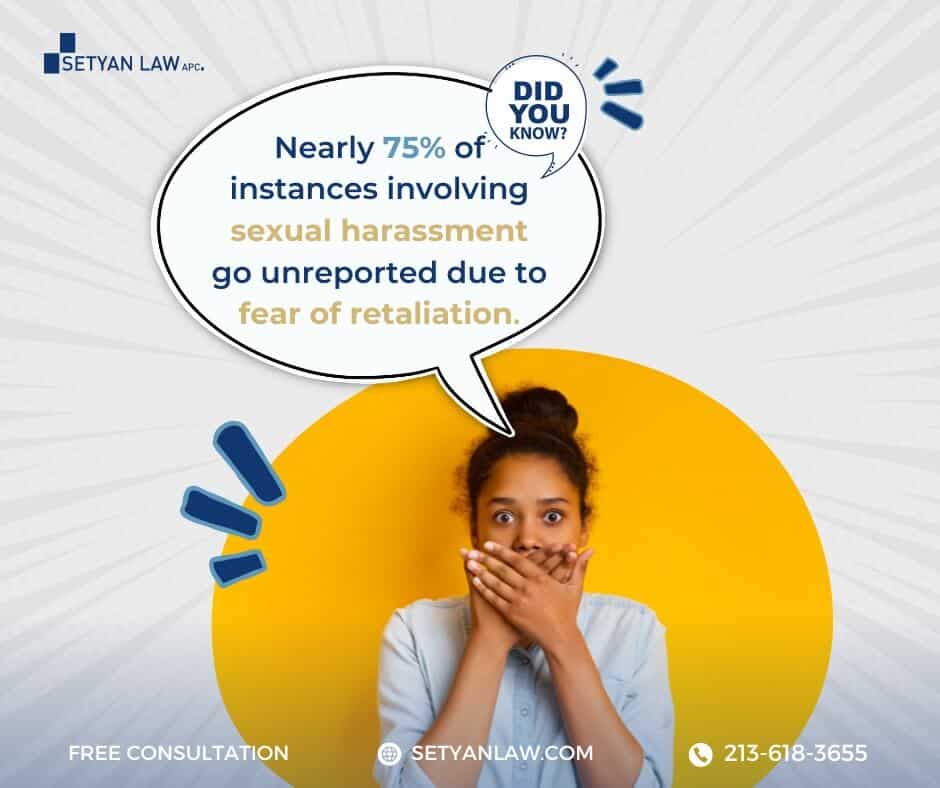
This creates a situation where the employee feels pressured to stay quiet to avoid retaliation, even if the conduct makes them uncomfortable.
Why Mixed Signals Are So Common in Harassment Cases
Harassment is rarely obvious or extreme at the beginning. It often escalates gradually, starting with comments that seem harmless or friendly. When the harasser alternates between kindness and inappropriate behavior, it can:
- Make the employee doubt their own perception
- Discourage reporting because the behavior feels “not bad enough”
- Create fear of not being believed
This pattern is recognized by employment lawyers and courts as a real and harmful dynamic—not a defense for the employer or the harasser.
You Do Not Have to Confront the Harasser
Many employees feel they must clearly tell the person to stop in order for the behavior to count as harassment. While telling someone to stop can help establish that conduct is unwelcome, it is not required in every situation—especially when power imbalances or fear of retaliation exist.
Silence, discomfort, avoidance, or emotional distress can all be evidence that the conduct was unwelcome.
What If You Feel Guilty for Speaking Up?
Employees often hesitate to report harassment because they feel bad about “getting someone in trouble” who has also been kind or supportive. This guilt is common—and understandable—but it does not change your legal rights.
Reporting sexual harassment is not about punishment. It is about:
- Protecting your ability to work without fear or discomfort
- Preventing continued or escalating behavior
- Holding employers accountable for maintaining a safe workplace
What You Can Do If This Is Happening to You
If you are experiencing inappropriate behavior from someone who is “nice” sometimes, consider:
- Documenting incidents with dates, locations, and witnesses
- Saving texts, emails, or messages
- Reviewing your company’s harassment policy
- Speaking with an employment attorney before reporting internally
You do not need to wait until the behavior becomes extreme to seek advice.
Final Thoughts
Sexual harassment does not require cruelty, yelling, or constant misconduct. A person can be friendly, generous, or supportive—and still violate the law. If someone’s behavior makes your workplace uncomfortable, intimidating, or emotionally draining, it is worth taking seriously.
Trust your instincts. If something feels wrong, it deserves attention.
If you need workplace harassment litigation, please call Setyan Law at (213)-618-3655. Free consultation.