
Updated January 25, 2026
Hidden But Real: The Truth About Subtle Health Condition Discrimination
Mental health discrimination remains a persistent yet often invisible barrier for California workers despite comprehensive legal protections. Although California boasts some of the strongest workplace protection laws in the nation, employees with mental health conditions still face significant discrimination that can be difficult to identify and address. In fact, many workers experience subtle forms of prejudice that fly under the radar but nevertheless cause real harm to their careers and wellbeing.
The gap between legal safeguards and workplace realities is particularly troubling as mental health awareness continues to grow across the state. Despite increasing recognition of conditions like depression, anxiety, PTSD, and bipolar disorder as legitimate disabilities, many California employers still fail to provide appropriate accommodations or maintain discrimination-free environments. Furthermore, the invisible nature of these conditions often makes proving discrimination more challenging than with physical disabilities.
Focus: Invisible Disabilities and Mental Health Conditions
This guide examines the true state of mental health discrimination in California workplaces, clarifies your rights under state and federal law, and provides practical guidance for those facing unfair treatment. Whether you're currently experiencing discrimination or want to understand the protections available to you, knowing how California's legal framework applies to mental health in the workplace is essential for protecting your career and wellbeing.
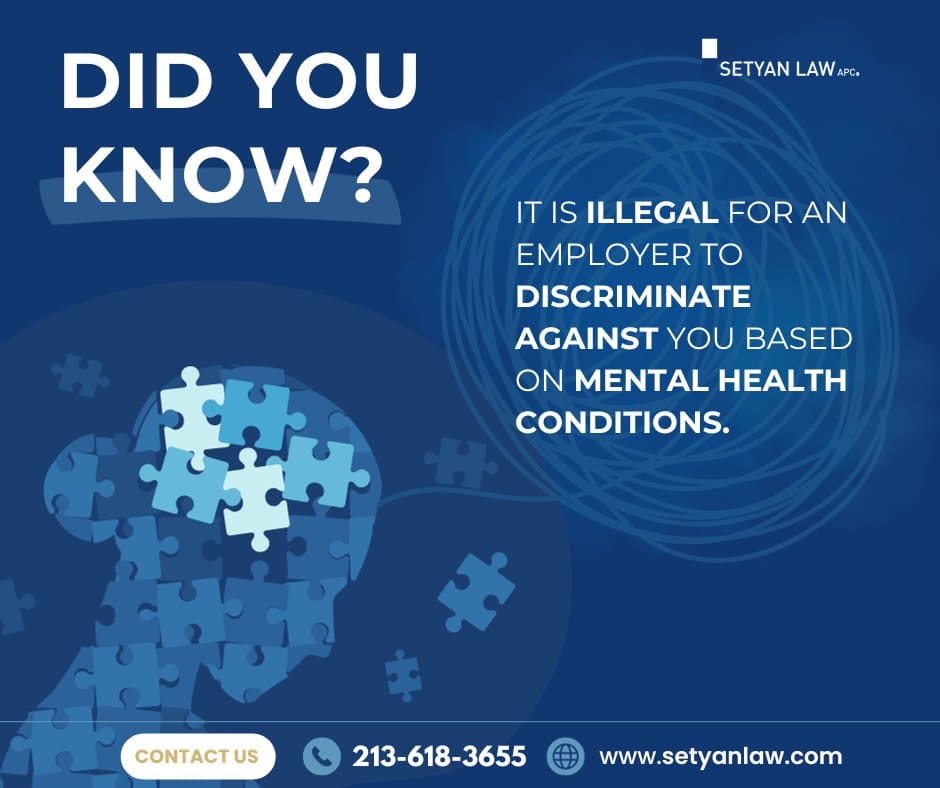
What Counts as a Mental Health Disability in California
California's definition of mental health disabilities goes beyond what many workers realize. Understanding these classifications is crucial for those facing workplace discrimination.
Recognized mental health conditions under FEHA
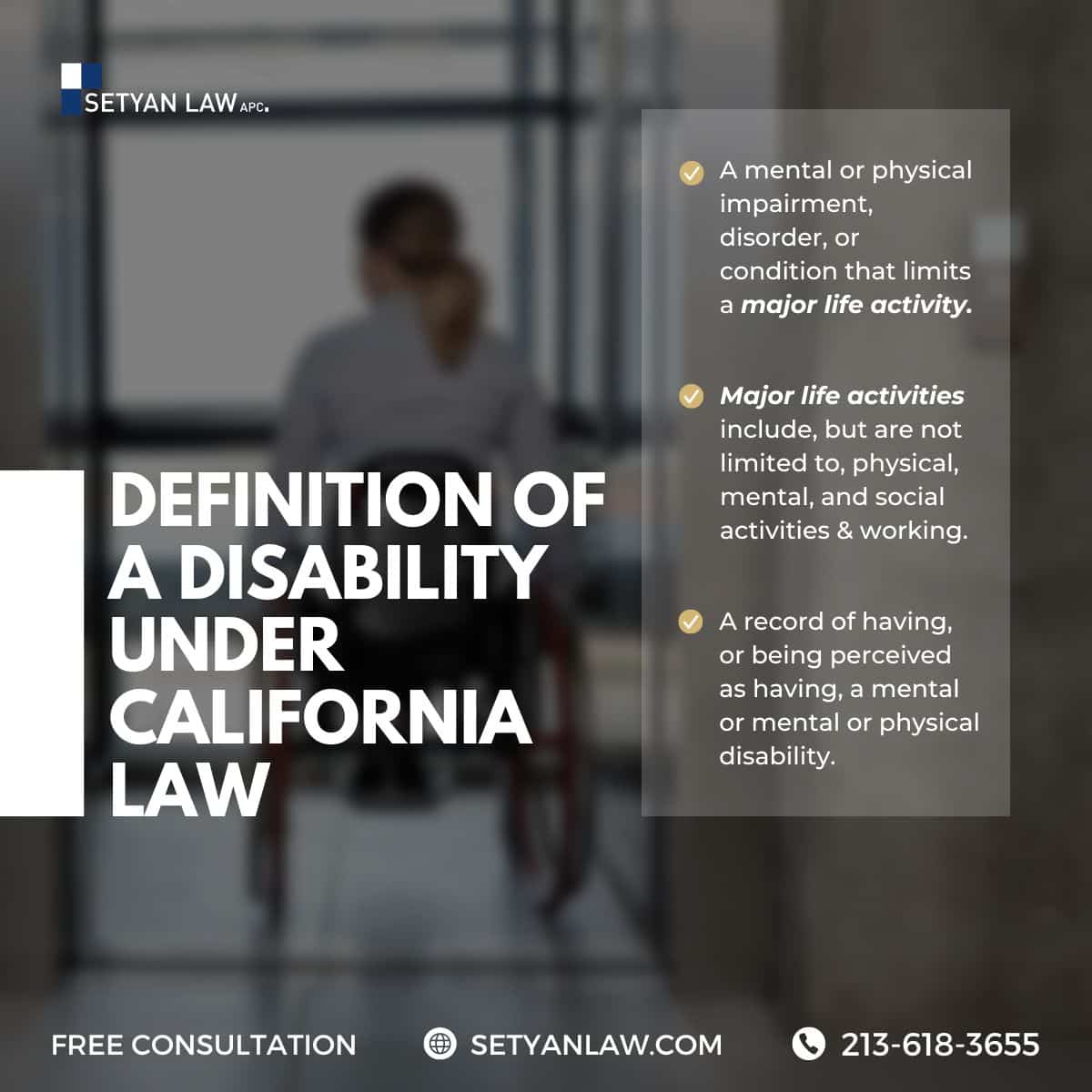
The California Fair Employment and Housing Act (FEHA) provides broader protections than most workers expect. Under FEHA, mental disabilities include any psychological or mental disorder that limits a major life activity.
Qualifying mental health conditions encompass:
- Anxiety disorders
- Depression and bipolar disorder
- Post-traumatic stress disorder (PTSD)
- Attention-deficit/hyperactivity disorder (ADHD)
- Autism spectrum disorder (ASD)
- Obsessive-compulsive disorder (OCD)
- Eating disorders
- Substance use disorders (in recovery)
- Schizophrenia
It's important to note that FEHA specifically excludes certain conditions from protection, including pyromania, kleptomania, compulsive gambling, and sexual behavior disorders . Additionally, current illegal drug use is not covered, though those in recovery programs are protected.
How California law differs from federal ADA
While the Americans with Disabilities Act (ADA) provides baseline protections, California's FEHA offers significantly stronger safeguards for employees with mental health conditions. The primary difference lies in the threshold for qualification.
Under the ADA, a mental impairment must "substantially limit" a major life activity. However, FEHA only requires that the condition "limit" a major life activity . This distinction might seem subtle yet dramatically expands who qualifies for protection under state law.
Moreover, FEHA applies to employers with five or more employees, whereas the ADA only covers workplaces with 15 or more workers . The California legislature has explicitly stated that "although the federal act provides a floor of protection, this state's law has always, even prior to passage of the federal act, afforded additional protections" .
Examples of invisible disabilities
Many mental health conditions fall under the category of "invisible disabilities" – conditions not readily apparent to observers but nonetheless significantly impact daily functioning. These non-apparent disabilities present unique challenges in the workplace since colleagues and supervisors may question their legitimacy.
PTSD serves as a prime example. Consider someone who experienced a traumatic car accident. While their physical injuries may have healed, they might experience debilitating panic attacks when asked to drive . To coworkers, this person appears completely fine in an office setting, yet their disability becomes painfully real in specific situations.
Other invisible disabilities include chronic fatigue syndrome, dyslexia, sensory processing disorders, and many neurodevelopmental conditions. Adults with these invisible disabilities report experiencing frequent mental distress almost five times as often as adults without disabilities .
The sunflower symbol has emerged as a discreet way for people with non-apparent disabilities to signal their status without disclosing specific conditions . This approach helps bridge the gap between needing accommodation and maintaining privacy about personal health information.
Understanding what qualifies as a mental health disability under California law is essential for both employees seeking protection and employers working to maintain compliance with the state's robust anti-discrimination framework.
Call Setyan Law at (213)-618-3655 to schedule a free consultation.
Legal Protections for Workers with Mental Health Conditions
California workers with mental health conditions are protected by robust legal frameworks that go beyond simple non-discrimination requirements. These laws create affirmative duties for employers to support employees with mental disabilities.
Overview of FEHA and ADA
Two primary laws safeguard employees with mental health conditions: the California Fair Employment and Housing Act (FEHA) and the federal Americans with Disabilities Act (ADA).
FEHA provides significantly broader coverage than federal protections. It applies to employers with just five or more employees, whereas the ADA only covers workplaces with 15 or more workers . This expanded reach ensures that more California workers receive protection against mental health discrimination.
Another key distinction is how these laws define disability. FEHA uses a more inclusive standard, requiring only that a condition "limits" a major life activity, while the ADA demands that a disability "substantially limits" such activities . Consequently, many mental health conditions that might not qualify under federal law receive protection under California regulations.
Both laws prohibit discrimination based on actual or perceived mental health conditions . This means employers cannot discriminate even if they merely suspect an employee has a mental health issue rather than having confirmed knowledge of a diagnosis.
The role of the interactive process
Central to both FEHA and ADA is the mandatory "interactive process" – a structured dialog between employer and employee to identify effective workplace accommodations.
This process begins when:
- An employee requests accommodations for a mental health condition
- An employer becomes aware of a potential need through observation
- A third party notifies the employer of the potential need
- An employee exhausts available leave but still requires accommodation
Importantly, employees don't need to use legal terminology like "reasonable accommodation" to trigger this process. Even simple statements about difficulty performing work due to a health condition are sufficient .
Once initiated, the interactive process requires timely, good faith communication. Employers must respond promptly and cannot delay or obstruct discussions . According to California regulations, this isn't a one-time conversation but an ongoing dialog that continues as needs evolve .
During this process, employers may request reasonable medical documentation confirming the disability and accommodation needs, but cannot inquire about underlying medical causes . All medical information must remain confidential and be stored separately from personnel files .
Reasonable accommodation requirements
Reasonable accommodations are adjustments that enable qualified employees to perform essential job functions without causing undue hardship to employers. For workers with mental health conditions, these might include:
- Flexible work schedules to accommodate therapy appointments
- Remote work options
- Modified job duties to reduce stress or avoid triggers
- Extended leave for treatment or recovery
- Workspace modifications like quieter work areas or noise-canceling headphones
Employers aren't required to provide the exact accommodation requested as long as the alternative effectively addresses the limitation . Additionally, accommodations that remove essential job functions, endanger health and safety, or cause "undue hardship" aren't required .
An undue hardship refers to "significant difficulty or expense" for the employer, considering factors like the accommodation's cost, the employer's resources, and operational impacts . Before refusing an accommodation on these grounds, employers must document good-faith efforts to explore all options .
Failure to engage in the interactive process or provide reasonable accommodations constitutes a violation of law, giving employees grounds for discrimination claims . Essentially, these protections exist not just on paper but as enforceable rights with meaningful remedies.
Common Forms of Mental Health Discrimination at Work
Despite protective laws, discrimination against workers with mental health conditions persists in various forms across California workplaces. Understanding how this discrimination manifests helps employees recognize and address unfair treatment.
Discrimination during hiring or promotion
Research shows that job applicants who disclose mental health conditions face significant barriers even before employment begins. Applicants with mental health issues have approximately 27% lower probability of receiving interview invitations and 22% lower chance of any positive employer response . This discrimination often stems from skepticism and stereotyping rather than legitimate performance concerns.
Unfortunately, even when hired, employees with mental health conditions frequently encounter roadblocks to career advancement. Many find themselves passed over for promotions or leadership roles based on unfounded assumptions about their capabilities or reliability . This pattern persists regardless of demonstrated performance or qualifications, creating invisible barriers to professional growth.
Retaliation after requesting accommodations
Perhaps the most common form of mental health discrimination occurs after employees request reasonable accommodations. Importantly, both federal and California law explicitly prohibit retaliation for accommodation requests , yet this protection is often violated.
Retaliatory actions typically appear shortly after accommodation requests and may include:
- Sudden negative performance reviews
- Unjustified disciplinary actions
- Reduced work hours or responsibilities
- Exclusion from important projects or meetings
- Termination or forced resignation
The timing of adverse actions is often telling. Courts recognize that negative employment actions occurring within weeks of accommodation requests create a plausible inference of retaliation . In fact, the EEOC reports that retaliation has been the most frequently alleged basis of discrimination in the federal sector since 2008 .
Hostile work environments and microaggressions
Beyond overt discrimination, many employees with mental health conditions experience subtle but harmful microaggressions – brief daily verbal or behavioral indignities that communicate hostility or prejudice . These can include dismissive comments like "snap out of it," "it's all in your head," or "everyone gets stressed sometimes" .
The impact of these seemingly minor incidents compounds over time. Research indicates that experiencing microaggressions regularly can cause higher levels of anxiety, depression, and isolation . For employees already managing mental health conditions, this "death by a thousand cuts" erodes self-esteem, trust in colleagues, and workplace productivity .
Microaggressions also foster an environment where more overt discrimination becomes acceptable. Many people with mental health conditions report experiencing assumptions of inferiority, patronizing behaviors, and subtle avoidance from colleagues .
Employer Responsibilities and Mistakes to Avoid
Employers face significant legal obligations to support workers with mental health conditions. Unfortunately, many companies make costly mistakes that lead to discrimination claims and damaged workplace culture.
Failing to recognize invisible disabilities
One of the most frequent errors employers make is failing to acknowledge that mental health conditions qualify as legitimate disabilities. The ADA Amendments Act of 2008 substantially broadened coverage and lowered the threshold for what constitutes a disability, meaning close calls typically favor employees . Many employers mistakenly believe that only physical impairments warrant accommodation.
Mental health conditions like anxiety, depression, and PTSD often fall into the category of "invisible disabilities" – conditions not readily apparent but that significantly impact daily functioning . When companies overlook these non-apparent disabilities, affected employees may suffer in silence, leading to decreased productivity, higher turnover, and increased legal exposure .
Not training managers on compliance
Managers typically serve as the first point of contact when employees need accommodations, yet many lack proper training on mental health matters. Nearly three-quarters of employees initially approach their direct supervisors about accommodation needs . Without appropriate training, managers often mishandle these conversations – sometimes ignoring, denying, or mismanaging legitimate requests.
Effective training should focus on:
- Recognizing signs of mental health issues
- Understanding legal obligations under ADA and FEHA
- Handling accommodation requests with sensitivity
- Creating a stigma-free workplace environment
Training must emphasize that chronic stress is a valid reason for accommodation requests and should be taken seriously . Organizations that invest in regular anti-discrimination training create environments where mental health is openly discussed without fear of judgment .
Ignoring accommodation requests
Perhaps the most serious mistake employers make is failing to properly address accommodation requests. Once an employee discloses a mental health condition or requests assistance, employers have immediate legal obligations to engage in a good-faith interactive process . Delaying or obstructing this dialog not only violates the law but can also constitute illegal retaliation.
The interactive process must be ongoing rather than a one-time conversation . Many employers erroneously assume that their leave policies end ADA coverage, yet unpaid leave remains a fundamental accommodation even when company leave entitlements are exhausted .
For mental health conditions specifically, reasonable accommodations might include flexible schedules for therapy appointments, remote work options, quieter work environments, or more frequent breaks . Companies that handle these requests properly not only avoid legal penalties but foster a more productive and loyal workforce.
Setyan Law

It’s always best to consult a qualified Medical Condition Discrimination Attorney regarding your case before you file. Employment law has many pitfalls and an attorney can help you navigate past them safely. Sam Setyan will review your grievance, tell you your options, and guide you to the most favorable outcome possible. It’s your call.
Call 213-618-3655 for a free consultation.
What Employees Can Do If They Face Discrimination
Facing mental health discrimination at work requires taking strategic action. When your workplace rights are violated, knowing the proper steps can make a significant difference in resolving your situation.
How to document incidents
Thorough documentation serves as the foundation for any discrimination claim. Start by keeping a detailed journal of all discriminatory incidents, recording dates, times, locations, people involved, and exactly what occurred. Be factual and objective in your descriptions.
Preserve all relevant communications including emails, text messages, and written responses to accommodation requests. These records create a paper trail that substantiates your experience. Additionally, gather performance evaluations, especially those showing inconsistencies or sudden negative changes after disclosing your condition.
Filing a complaint with the CRD or EEOC
Before pursuing external action, first submit a written complaint to your supervisor or Human Resources department. Afterward, if internal reporting doesn't resolve the issue, you can file a formal complaint with government agencies.
In California, you can file with the California Civil Rights Department (CRD) or the federal Equal Employment Opportunity Commission (EEOC). The CRD handles cases for employers with five or more employees, whereas the EEOC covers workplaces with at least 15 employees . Most discrimination claims must be filed within three years of the discriminatory act .
When filing, prepare to provide detailed information about the incidents, contact information for all parties involved, and any supporting documentation you've collected .
Seeking legal representation
Consulting with an employment attorney experienced in mental health discrimination cases offers substantial benefits. A qualified lawyer can evaluate your situation, determine if the behavior qualifies as unlawful discrimination, and handle communications with employers and government agencies .
Many employment attorneys work on a contingency basis, meaning you pay nothing upfront and only pay a percentage if they recover money for you . This arrangement makes legal representation accessible even when finances are tight.
Conclusion
Mental health discrimination continues to affect countless California workers despite the state's robust legal framework. Workers face subtle yet damaging biases that manifest through hiring barriers, promotional glass ceilings, and retaliatory actions after accommodation requests. FEHA and ADA protections certainly provide strong legal safeguards, though many employees remain unaware of their full rights under these laws.
Equally important, employers often fail to recognize invisible disabilities or properly train managers to handle accommodation requests. This knowledge gap creates situations where discrimination flourishes unintentionally yet harmfully. Recognizing mental health conditions as legitimate disabilities represents the first critical step toward workplace equity.
Documentation stands as your strongest ally when facing discrimination. Detailed records of incidents, communications, and performance reviews create essential evidence should you need to file a complaint with the CRD or EEOC. Legal representation additionally provides invaluable guidance through what can become a complex process.
California laws offer significantly stronger protections than federal standards, particularly through the lower threshold for disability qualification and broader employer coverage. Nevertheless, the gap between legal protection and workplace reality remains substantial. Stigma still surrounds mental health conditions, therefore making advocacy and education essential components of progress.
Mental health discrimination affects not just individual careers but overall workplace culture and productivity. Workers deserve environments where they can thrive regardless of their mental health status. Understanding your rights, recognizing discrimination when it occurs, and knowing how to address it effectively empowers you to protect both your career and wellbeing. Though challenges persist, increased awareness and proper enforcement of existing laws can help create workplaces where mental health conditions no longer limit professional opportunities.
References
https://www.csulb.edu/student-affairs/bob-murphy-access-center/non-apparent-disabilities
https://equalopp.santaclaracounty.gov/reasonable-accommodation-quick-reference-guide
https://pmc.ncbi.nlm.nih.gov/articles/PMC9755972/
[13] – https://burtslaw.com/employment-discrimination-against-people-with-mental-health-conditions/
[14] – https://www.eeoc.gov/laws/guidance/depression-ptsd-other-mental-health-conditions-workplace-your-legal-rights
https://www.forbes.com/sites/pragyaagarwaleurope/2019/03/29/how-microaggressions-can-affect-wellbeing-in-the-workplace/
https://calcivilrights.ca.gov/complaintprocess/how-to-file-a-complaint/
Call Setyan Law at (213)-618-3655 to schedule a free consultation.