
Updated April 2, 2026
California Labor Code 2802: What Employers Must Reimburse
Did you know that California Labor Code 2802 might entitle you to reimbursement for expenses you're currently paying out of pocket? Many employees unknowingly cover work-related costs that their employers should legally be handling.
As remote and hybrid work arrangements become increasingly common, understanding your rights under this important labor code is more critical than ever. Furthermore, with evolving workplace dynamics expected through 2026, both employees and employers need clarity on what exactly must be reimbursed.
California's employee expense reimbursement law stands as one of the most protective in the nation, requiring employers to cover all "necessary expenditures" incurred by employees while performing their job duties. However, many workers remain unaware of the full scope of their reimbursement rights, while employers often misinterpret their obligations.
This comprehensive guide examines what California Labor Code 2802 requires employers to pay for in 2026, from cell phone and internet usage to home office equipment and travel expenses. We'll explore the legal tests that determine legitimate reimbursement claims, common compliance mistakes, and practical strategies for employers to meet their legal obligations.
What is California Labor Code Section 2802?
California Labor Code Section 2802 stands as one of the most protective employee expense reimbursement laws in the United States. At its core, this statute requires employers to compensate workers for expenses they incur while performing their jobs.
Purpose of the law
The fundamental purpose of Labor Code 2802 is straightforward yet powerful: to prevent employers from passing their operating costs onto employees. The statute specifically states that "an employer shall indemnify his or her employee for all necessary expenditures or losses incurred by the employee in direct consequence of the discharge of his or her duties".
This provision essentially creates a legal obligation for businesses to bear the financial burden of their operations rather than shifting costs to workers. The law recognizes that when employees spend their own money to perform their jobs, they are essentially subsidizing their employer's business.
The statute covers a broad range of "necessary expenditures," defined as "all reasonable costs". Notably, this includes attorney's fees incurred when employees must take legal action to enforce their reimbursement rights. Additionally, reimbursement awards carry interest at civil judgment rates, accumulating from the date the employee incurred the expense.
Historical context and evolution
Labor Code Section 2802 traces its origins back to 1872, when it was originally part of the Civil Code as Section 1969. This long-standing legal principle has been refined through legislative updates and court interpretations over the decades.
The statute has evolved significantly through case law. In Gattuso v. Harte-Hanks Shoppers, Inc., California courts identified three acceptable methods for complying with Section 2802 for vehicle expenses: actual expense reimbursement, mileage reimbursement, and lump-sum payment.
More recently, courts have expanded the interpretation of the law to address modern work arrangements. The Court of Appeal clarified that an employer's responsibility extends to expenses that are a direct consequence of job duties, regardless of whether the employer directly caused those expenses. This interpretation has significant implications for remote work arrangements.
Why it matters in 2026
As we move into 2026, understanding Labor Code 2802 becomes increasingly critical due to several emerging factors. First, recent legislative updates have explicitly confirmed that the law covers costs associated with personal and commercial vehicle use. Senate Bill 809 specifically addressed vehicle expenses for commercial drivers who own their trucks, tractors, or trailers.
Second, the continued prevalence of remote and hybrid work arrangements makes this law particularly relevant. Courts have ruled that employers remain responsible for home office expenses even when remote work results from government mandates rather than employer directives. This sets a clear precedent that intervening causes don't eliminate an employer's reimbursement obligations.
The law's strict enforcement mechanisms also heighten its importance. Beyond court actions, the Labor Commissioner can issue citations against non-compliant employers, with procedures similar to those for wage violations. These enforcement tools give the statute real teeth in 2026.
For California businesses, compliance with Section 2802 represents not just a legal obligation but a significant financial consideration. With the state's higher-than-average costs for expenses like vehicle operation, employers must carefully calculate reimbursement rates to avoid potential liability, which can include three years of back-pay for unreimbursed expenses plus interest and attorney's fees.
Types of Expenses Employers Must Reimburse
Under California Labor Code 2802, employers must reimburse various expenses that employees incur while performing their duties. These reimbursements extend far beyond basic supplies, encompassing several crucial categories that directly impact workers' finances.
Cell phone and internet usage
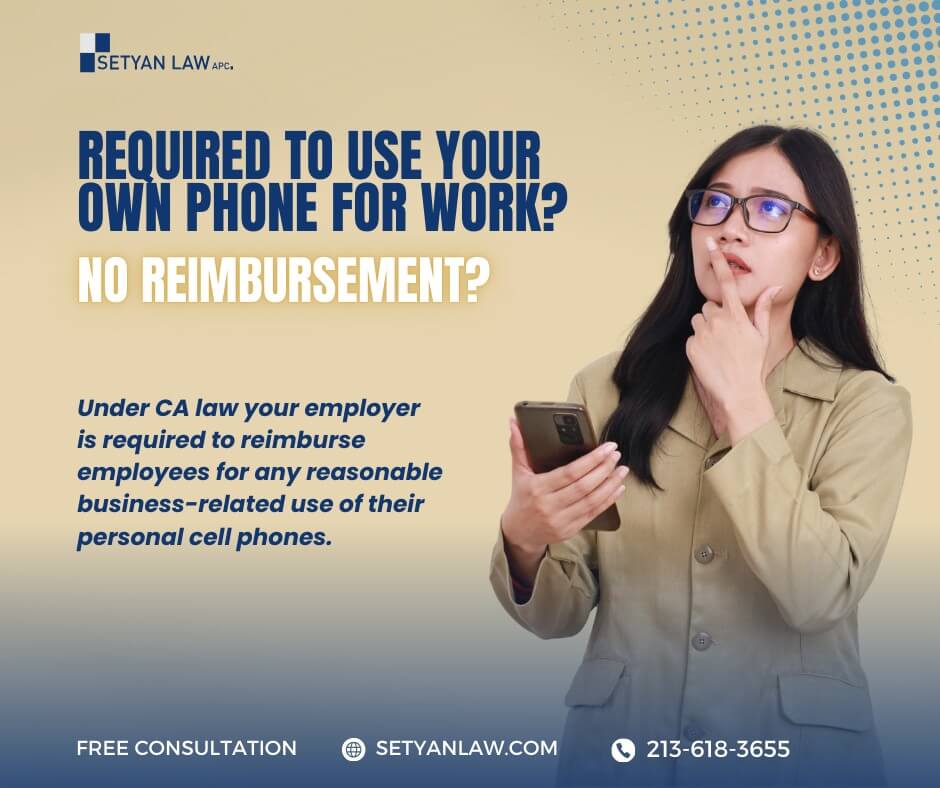
California employers must reimburse a reasonable percentage of cell phone bills when employees use personal phones for work purposes. In the landmark case Cochran v. Schwan's Home Service, courts ruled that reimbursement is required even when employees have unlimited plans or incur no additional costs. Most company reimbursements for mobile expenses typically range between $30-$50 monthly, with the average being $40.20 per employee.
For remote workers, employers must similarly cover a reasonable portion of home internet costs when needed to perform job duties. This obligation exists regardless of who mandated the remote work arrangement—whether by employer policy or government order. The July 2023 Thai v. IBM ruling confirmed that remote workers must be reimbursed for these necessary expenses.
Personal vehicle and mileage
When employees use personal vehicles for business purposes (excluding regular commuting), California law mandates full reimbursement. For 2026, the standard IRS mileage reimbursement rate is 72.5 cents per mile. This rate covers not just fuel costs but also:
- Vehicle depreciation
- Insurance premiums
- Maintenance and repairs
- Registration fees
Employers can use alternative calculation methods, including lump-sum payments or actual expense tracking, provided they fully cover all necessary costs. In Gattuso v. Harte-Hanks Shoppers, Inc., the court established these three acceptable reimbursement methods.
Home office equipment and utilities
For employees working remotely, employers must cover reasonable costs of setting up and maintaining home offices. This includes a portion of:
- Furniture and supplies necessary for the home office
- A reasonable percentage of utilities such as heating, electricity, and internet
- Office equipment like desks, ergonomic chairs, and other materials
Moreover, during pandemic-related remote work, many employers were required to cover costs of setting up complete home offices, including printers, laptops, and ergonomic equipment.
Tools, uniforms, and job-specific gear
California generally requires employers to provide and maintain all tools and equipment necessary for job performance. Nevertheless, there's a narrow exception: employees earning at least twice the minimum wage may be required to provide hand tools customarily required by their trade.
For uniforms, California law is particularly strict. Employers must pay for any required clothing of distinctive design or color, including footwear that cannot normally be worn outside work. Additionally, any uniform requiring dry cleaning or special maintenance must be covered by the employer.
Travel, lodging, and meals
Business travel expenses extend beyond basic transportation. Starting October 1, 2024, meal reimbursements follow federal standards—up to $68 daily for meals and incidental expenses. Employees can receive up to $16 for breakfast, $19 for lunch, $28 for dinner, and $5 for incidental expenses.
Other reimbursable travel costs include:
- Lodging during business trips
- Parking fees and tolls
- Taxi fares and public transit
- Currency conversion fees for international travel
- Reasonable tips (up to $2 or 20%, whichever is greater)
In conclusion, California's reimbursement requirements comprehensively protect employees from bearing their employers' operational costs, ensuring businesses cannot pass these expenses to their workforce.
Legal Tests and Case Law That Define Reimbursement
Courts across California have shaped how Labor Code 2802 works through numerous landmark decisions. These rulings establish clear standards for determining when employers must reimburse expenses and what qualifies as "necessary" under the law.
The three-part test for reimbursement
To successfully claim reimbursement under California Labor Code 2802, courts apply a specific three-part test. An employee must demonstrate:
- They made expenditures or incurred losses
- These expenditures occurred as a direct consequence of performing job duties or following employer directions
- The expenditures were reasonable and necessary
This test, established in Stuart v. RadioShack Corp. (2009), has been widely adopted by federal courts interpreting California law. According to this standard, once an employer knows or has reason to know an employee incurred a reimbursable expense, the employer must exercise due diligence to ensure proper reimbursement.
Key cases: Cochran, Stuart, Sinohui
Several pivotal court decisions have expanded the scope of employee reimbursement rights:
In Cochran v. Schwan's Home Service (2014), the California Court of Appeal ruled employers must always reimburse employees for mandatory use of personal cell phones, even when employees incur no additional costs through unlimited plans. The court held that reimbursement should cover "a reasonable percentage of the cell phone bills".
Stuart v. RadioShack Corp. formalized the three-part test that courts now consistently apply. Meanwhile, Sinohui v. CEC Entertainment (2016) clarified that necessity is determined by examining each job classification rather than individual circumstances.
Most recently, the Thai v. IBM (2023) decision established that employers must reimburse remote work expenses regardless of whether the employer directly caused the remote arrangement.
How courts interpret 'necessary' expenses
Courts evaluate "necessary" expenses based on reasonableness of employee choices. For instance, if an employer provides alternatives (like in-office computers) but an employee chooses to use a personal device for convenience, the expense might not qualify as necessary.
For remote workers, courts consider both job requirements and industry standards. In Thai v. IBM, the court recognized that software engineers need "physical space, internet, and electricity" to perform their duties, making these expenses reimbursable.
Consequently, expenses are deemed "necessary" when they are actually required for job performance, not merely convenient or preferred by the employee.
Common Employer Mistakes and Misconceptions
Many California businesses face costly legal settlements because they misunderstand their obligations under Labor Code 2802. RadioShack paid $4.5 million and Walgreens settled for $23 million in cases involving reimbursement violations. These expensive lessons highlight critical misconceptions that continue to trip up employers.
Assuming a policy alone is enough
Simply having a reimbursement policy doesn't shield employers from liability. RadioShack's multi-million dollar settlement stemmed from a policy that only reimbursed employees who followed proper company procedures when submitting expenses. Unfortunately, an employee's failure to follow submission protocols doesn't eliminate the employer's obligation to reimburse necessary expenses. Instead of relying solely on written policies, companies must proactively ensure all legitimate business expenses are identified and reimbursed, regardless of procedural compliance.
Failing to track known expenses
Some employers mistakenly believe they're only responsible for expenses they explicitly approve or request. Yet courts have firmly rejected this notion. The California Court of Appeal clarified that "the obligation does not turn on whether the employer's order was the proximate cause of the expenses; it turns on whether the expenses were actually due to performance of the employee's duties". Beyond that, employers have a duty to exercise due diligence in identifying expenses that employees reasonably incur to perform their jobs.
Overlooking remote work costs
Even after years of widespread remote work arrangements, many employers still underestimate their reimbursement obligations for home-based employees. Indeed, the Thai v. IBM ruling established that employers must reimburse remote work expenses even when government orders, not employer decisions, necessitated working from home. This includes proportional costs for internet access, electricity, and physical workspace. Failure to account for these expenses has triggered numerous lawsuits, especially since the pandemic began.
Not applying rules to exempt employees
A persistent myth suggests exempt employees aren't entitled to expense reimbursements. This is categorically false. Both exempt and non-exempt employees have equal rights under Section 2802. The law makes no distinction based on salary or classification status. Unlike certain wage and hour requirements that exempt high-earning or salaried professionals, expense reimbursement obligations apply universally to all employee classifications.
How Employers Can Stay Compliant in 2026
Staying ahead of California Labor Code 2802 compliance requires proactive measures from employers. With potential penalties including attorney's fees and interest dating back to when expenses were incurred, developing systematic approaches to reimbursement becomes crucial for California businesses.
Creating a clear reimbursement policy
First, employers should develop comprehensive written policies that outline eligible expenses and submission procedures. An effective policy must:
- Define what qualifies as "necessary" expenses for different job roles
- Establish clear submission deadlines and documentation requirements
- Outline the reimbursement timeline
- Include a mechanism for employees to challenge inadequate reimbursements
Beyond the policy itself, companies should consider implementing lump-sum payments for predictable expenses. The California Supreme Court has approved this method as compliant with Section 2802, provided the amount reasonably covers actual costs. Nevertheless, any lump-sum approach must allow employees to demonstrate if the payment is insufficient.
Training managers and HR teams
Subsequently, companies must invest in training supervisors who oversee expense approvals. Proper training ensures consistent application of reimbursement policies across departments. Managers should understand:
- Which expenses require pre-approval versus automatic reimbursement
- How to evaluate "necessity" under California's legal standards
- Their role in monitoring potential reimbursable expenses even when not explicitly requested
Using technology to track expenses
Modern expense management systems offer substantial protection against compliance failures. Effective technological solutions should:
- Automate expense submission and approval workflows
- Generate documentation that demonstrates compliance
- Provide audit trails for all reimbursement transactions
Ultimately, employers should regularly audit reimbursement records to identify potential gaps in compliance.
Encouraging employee feedback
Open communication channels protect both employees and employers. Companies should create structured feedback mechanisms where workers can report inadequate reimbursements without fear of retaliation. This approach helps identify potential problems before they escalate into legal claims.
For maximum protection, employers should document all reimbursements with receipts, payroll entries, or expense reports. These records prove invaluable if disputes arise later, demonstrating good-faith compliance efforts.
Conclusion
California Labor Code 2802 stands as a powerful shield protecting employees from bearing business-related expenses. Understanding this statute thoroughly benefits both parties—employers avoid costly lawsuits while employees receive their legal entitlements. The landscape of work continues evolving, especially with remote and hybrid arrangements becoming standard practice through 2026 and beyond.
Employers must recognize their obligations extend far beyond basic office supplies. Cell phone bills, internet costs, home office equipment, vehicle expenses, uniforms, and business travel all fall within the scope of mandatory reimbursement. Courts have consistently reinforced these requirements through landmark decisions that expand rather than limit employee protections.
Compliance requires more than just having policies. Employers need systematic approaches that actively identify, track, and properly reimburse all necessary expenses. Many companies still misunderstand their obligations, particularly regarding remote work expenses or costs incurred by exempt employees. These misconceptions lead to significant legal exposure, as evidenced by multi-million-dollar settlements against major corporations.
Looking ahead to 2026, employers should adopt proactive strategies rather than reactive approaches. Clear reimbursement policies, well-trained managers, effective expense tracking systems, and open communication channels all contribute to successful compliance. Companies that embrace these practices not only fulfill their legal obligations but also foster employee satisfaction and loyalty.
Remember that Labor Code 2802 applies universally across all employee classifications. Neither salary level nor exempt status removes an employer's responsibility to reimburse necessary business expenses. The law's purpose remains unchanged since 1872—preventing businesses from shifting operational costs to their workforce.
Staying informed about court interpretations and legislative updates will help California employers navigate this complex area of employment law. Likewise, employees armed with knowledge about their reimbursement rights can better advocate for fair treatment in the workplace. Although compliance may seem burdensome initially, establishing proper systems ultimately creates clarity and prevents costly disputes for all parties involved.
References
https://hrmanual.calhr.ca.gov/home/manualitem/1/2203
https://www.govinfo.gov/content/pkg/USCOURTS-cand-3_16-cv-03294/
https://www.tiktok.com/@thewadeempire (image)
Call Setyan Law at (213)-618-3655 to schedule a free consultation.