
Updated January 27, 2026
Why Your “100% Healed” Policy Violates ADA Compliance in California
Many employers unknowingly violate ADA compliance by maintaining “100% healed” policies that prevent employees with disabilities from returning to work. These policies typically require employees to fully recover from injuries or medical conditions before resuming their duties, regardless of whether they could perform essential job functions with reasonable accommodations.
Unfortunately, this approach directly contradicts federal and state disability laws. Instead of fostering workplace inclusion, these policies create significant legal exposure and can result in costly settlements, damaged reputations, and unnecessary hardship for employees who could otherwise continue working productively.
In California specifically, where the Fair Employment and Housing Act (FEHA) provides even stronger protections than federal law, employers face particularly strict scrutiny when implementing return-to-work standards. Courts have consistently ruled against “100% healed” policies, yet many organizations continue this practice without understanding the legal risks.
This guide examines why these policies violate disability laws, explores notable case examples, and provides practical alternatives that fulfill your legal obligations while maintaining workplace efficiency. You’ll learn how to implement compliant return-to-work procedures that respect both employee rights and legitimate business needs.
The Problem with ‘100% Healed’ Policies
Despite clear legal guidance, “100% healed” policies remain surprisingly common across American workplaces. These policies require employees returning from medical leave to be completely recovered with absolutely no restrictions before resuming work. The Equal Employment Opportunity Commission (EEOC) has explicitly identified these practices as per se violations of the Americans with Disabilities Act (ADA), yet many employers continue implementing them.
Why these policies are still common
Employers maintain these problematic policies for several understandable—albeit legally flawed—reasons:
Safety concerns: Companies often believe they’re protecting employees and minimizing liability by ensuring workers are fully recovered.
Administrative simplicity: A one-size-fits-all approach seems easier to implement than case-by-case evaluations.
Misunderstanding of legal requirements: Many employers incorrectly assume that requiring medical clearance automatically satisfies their legal obligations.
Focus on productivity: Organizations worry that accommodating restrictions might reduce efficiency or create precedents they’d rather avoid.
Furthermore, employers frequently argue that regular attendance constitutes an essential job function, making full recovery necessary. However, courts have repeatedly rejected this rationale when used to justify blanket policies rather than individualized assessments.
How they typically play out in the workplace
The implementation of these policies follows predictable patterns with serious consequences for both employees and employers:
When an employee takes medical leave, companies with “100% healed” policies typically require a physician’s full release without any restrictions as a condition for returning to work. If the employee has ongoing limitations—even minor ones that wouldn’t affect essential job functions—they face impossible choices: return against medical advice, remain on unpaid leave, or lose their job entirely.
For example, FedEx allegedly placed Ramp Transport Drivers with restrictions on temporary light duty for up to 90 days, after which they were put on unpaid leave until all restrictions were lifted [1]. Similarly, UPS maintained a policy where employees on medical leave for 12 months were automatically “administratively separated” from employment unless they could return without restrictions [2].
The EEOC has aggressively pursued enforcement actions against companies with such policies. Interstate Distributor Company paid $4.85 million to settle claims that it refused to allow employees with medical restrictions to return without considering alternatives [3]. Nevada Restaurant Services paid $3.50 million for requiring employees to prove they were “100% healed” before returning [3]. Additionally, Blood Bank of Hawaii agreed to pay $175,000 for requiring employees to return without limitations after FMLA leave [4].
Companies often compound the problem by failing to engage in the legally required “interactive process” with employees who have restrictions. This process—identifying possible accommodations that might allow the employee to perform essential job functions—is a crucial ADA requirement that “100% healed” policies inherently bypass.
The EEOC’s 2016 guidance clearly states that an employer violates the ADA by requiring employees to have no medical restrictions if they could perform their jobs with reasonable accommodations [5]. Nevertheless, these policies persist across industries, creating substantial legal exposure and unnecessarily excluding qualified employees from the workforce.
Understanding ADA and FEHA Requirements
The legal landscape governing return-to-work policies involves complex requirements at both federal and state levels. Both frameworks explicitly prohibit blanket “100% healed” policies, though with important distinctions in their approach and scope.
What the ADA says about returning to work
The Americans with Disabilities Act establishes fundamental protections for employees with disabilities returning to work after medical leave. According to federal regulations, employees with disabilities have the right to reasonable accommodations, which can include work-leave as one form of accommodation. Essentially, the ADA requires employers to make modifications that enable qualified individuals to perform essential job functions or enjoy equal employment benefits.
The ADA explicitly prohibits “100% healed” policies. These policies have been found to violate the law because they deny workers their right to accommodation. Even if an employee isn’t completely recovered, they could possibly still work effectively with proper accommodations. As the EEOC guidance clarifies, an employer violates the ADA by requiring employees to have no medical restrictions if they could perform their jobs with reasonable accommodations [5].
Moreover, automatically terminating workers who exceed a pre-set amount of leave also violates ADA requirements. Employers must determine accommodations on an individual basis – not through blanket policies. The amount of leave granted depends on both the job and the disability, and employers must provide leave as an accommodation unless doing so would cause “undue hardship” [6].
California’s FEHA and its stricter standards
The California Fair Employment and Housing Act provides significantly broader protections than the ADA, reflecting California’s leadership in disability rights. Government Code Section 12926.1(a) explicitly declares that “the law of this state in the area of disabilities provides protections independent from those in the federal Americans with Disabilities Act” and that California’s law has “always afforded additional protections” [7].
Key differences that make FEHA stricter include:
Lower threshold for disability definition: FEHA requires only that a condition “limit” a major life activity, whereas the ADA demands “substantial limitation” [7]
Broader employer coverage: FEHA applies to employers with five or more employees, compared to the ADA’s 15-employee threshold [7]
Stronger accommodation requirements: FEHA creates an affirmative duty for employers to accommodate employees even when not specifically requested [7]
No statutory limit on leave: FEHA provides no fixed duration for leave accommodations, provided they don’t impose undue hardship [7]
Under FEHA, a policy requiring an injured worker to be 100% healed is unquestionably unlawful. Your employer must decide on an individualized basis whether you can return to your former job, with or without restrictions, or be reassigned [8].
The role of the interactive process
At the core of both laws is the requirement for an “interactive process” – a procedure through which employers determine appropriate accommodations. This process is generally more robust under FEHA than the ADA.
The interactive process must begin when an employee requests accommodation or when the employer becomes aware of the need through observation or third parties. Notably, FEHA requires employers to initiate this process when “the employee with a disability has exhausted leave under the California Workers’ Compensation Act” yet still needs accommodation [9].
During this process, employers must:
Identify and analyze the particular job and its essential functions
Consult with the employee about limitations and potential accommodations
Consider the employee’s preference but implement accommodations that effectively enable essential job functions
Document each step thoroughly
Failing to engage in this process is itself a separate cause of action under FEHA’s Government Code Section 12940(n), potentially allowing claims even if reasonable accommodation wasn’t possible [7]. Consequently, California employers face even greater legal exposure when implementing blanket “100% healed” policies that bypass this crucial interactive dialog.
Real-World Legal Consequences for Employers
Companies implementing “100% healed” policies face substantial financial and legal consequences when challenged in court. Multiple high-profile cases demonstrate courts consistently side with employees, resulting in significant settlements and mandated policy changes.
Case study: EEOC v. UPS
In a landmark case, the Equal Employment Opportunity Commission (EEOC) sued United Parcel Service (UPS) over its policy of “administratively separating” employees who couldn’t return to work after 12 months of medical leave. The case centered on Trudi Momsen, an administrative assistant diagnosed with multiple sclerosis who was fired after exceeding UPS’s 12-month leave policy, even though she could have returned to work after just two additional weeks of leave [10].
Initially, UPS defended its policy by arguing that regular attendance was an essential job function permitted under the ADA. The court, undeniably, rejected this reasoning. Instead, it ruled that UPS’s policy constituted an unlawful “qualification standard” that screened out individuals with disabilities [11]. The court determined this violated Section 12112(b)(6) of the ADA because it applied blanket rules rather than conducting individualized assessments [12].
DFEH settlement example
The California Department of Fair Employment and Housing (DFEH) secured a $290,000 settlement against Liberty Union High School District in another telling case [13]. Mark Miguel, a school custodian, successfully performed all job duties for several months following a back injury, until the district abruptly deemed him unqualified due to lifting restrictions [14].
The district’s testing requirements effectively mandated employees be “100% healed” before returning to work. Following DFEH’s lawsuit, the district agreed to:
Pay $290,000 in damages
Offer reinstatement with reasonable accommodations
Clarify that lifting restrictions don’t prevent applicants from taking screening tests
Ensure screening tests apply only to new applicants, not returning employees
Provide disability accommodation training for supervisors and HR staff [15]
DFEH Director Kevin Kish emphasized: “Policies requiring employees to be ‘100% healed from injury’ in order to work deny employees their right to an individual assessment and violate the FEHA” [13].
How courts interpret ‘100% healed’ policies
Courts forthwith reject “100% healed” requirements as impermissible qualification standards. Most courts hold that such policies constitute per se violations of the ADA [16]. This legal interpretation rests primarily on the recognition that these policies inherently bypass the legally required interactive process.
In 2016, the EEOC explicitly stated that employers violate the ADA “if it requires an employee with a disability to have no medical restrictions… if the employee can perform her job with or without reasonable accommodation” [17]. Following this guidance, the EEOC has actively pursued enforcement against companies maintaining these policies, with settlements frequently reaching millions of dollars [17].
The message from courts remains consistent: return-to-work decisions must focus on the interactive process and whether reasonable accommodations could enable employees to perform essential job functions—not on arbitrary time limitations or blanket medical clearance requirements [2].
What Employers Should Do Instead
Implementing proper return-to-work procedures offers a legally compliant alternative to problematic “100% healed” policies. By following these structured steps, employers can fulfill their obligations while maintaining workplace effectiveness.
Clarify restrictions with the employee
The appropriate starting point is opening a dialog with the employee about their medical limitations. When an employee discloses a disability or returns with restrictions, employers should promptly initiate an interactive conversation to understand specific limitations. This discussion helps identify what barriers might prevent the employee from performing their job effectively.
An employer can request medical documentation when limitations aren’t obvious, yet must explain why any initial documentation is insufficient and allow employees reasonable time to provide supplemental information. Medical inquiries must remain job-related and consistent with business necessity, focusing solely on determining functional limitations requiring accommodation.
Review essential job functions
Subsequently, employers must analyze the specific position and identify which functions are genuinely essential. According to EEOC guidance, essential functions are basic job duties an employee must perform, with or without reasonable accommodation. Factors determining whether a function is essential include:
Whether the position exists primarily to perform that function
The number of other employees available to perform the function
The degree of expertise required for the function
Consequences of not requiring the employee to perform the function
The actual experience of current and previous employees in the role
Written job descriptions created before advertising positions serve as evidence of essential functions but aren’t conclusive without additional supporting factors.
Explore all reasonable accommodations
Correspondingly, employers must identify potential accommodations that would enable the employee to perform essential job functions. Reasonable accommodations might include:
Job restructuring
Modified work schedules
Acquiring or modifying equipment
Reassignment to vacant positions
Providing readers or interpreters
While employers should consider employee preferences, they ultimately may select any accommodation that effectively enables essential job functions. Importantly, leave itself can constitute a reasonable accommodation when needed for recovery or treatment.
Document every step of the process
Ultimately, thorough documentation protects both parties throughout this process. Employers should record:
All communications with the employee
Medical information received
Accommodations considered and implemented
Reasons why certain accommodations were rejected
Ongoing assessment of accommodation effectiveness
This documentation creates a defensible record demonstrating good faith participation in the interactive process, which itself is a legal requirement separate from providing accommodations.
Common Mistakes That Lead to Liability
Even well-meaning employers make critical mistakes when handling disability accommodations. Indeed, these errors often lead to significant legal exposure, regardless of intention.
Failing to initiate the interactive process
Employers must initiate accommodation discussions without waiting for formal requests. The EEOC guidance states that employers should start the interactive process when they know an employee has a disability and workplace problems exist because of it—even without an explicit accommodation request. Ignoring verbal, visual, or behavioral cues indicating accommodation needs creates immediate liability.
Relying on outdated job descriptions
Job duties evolve over time, hence outdated descriptions become legally dangerous. Many employers create job descriptions when positions first open, then file them away permanently. This neglect renders documents useless in ADA contexts, as they no longer accurately reflect current essential functions.
Rejecting accommodations without analysis
Employers often erroneously dismiss seemingly unreasonable accommodation requests without proper analysis. Even if an initial request appears unreasonable—like “removal of all stress-inducing responsibilities”—employers must engage in dialog to identify potential alternatives.
Using blanket policies like ‘maximum leave’
Maximum leave policies that automatically terminate employees after preset time periods directly violate ADA requirements. The EEOC has secured multiple multi-million dollar settlements against companies with inflexible leave policies, including a $6.2 million settlement against Sears for terminating employees under their one-year maximum leave policy.
Conclusion
Maintaining “100% healed” policies clearly puts California employers at substantial legal risk. These policies directly contradict both federal ADA requirements and California’s more stringent FEHA protections, regardless of their administrative convenience or perceived safety benefits. The consistent rulings against companies like UPS, FedEx, and Liberty Union High School District demonstrate how courts view these practices as inherently discriminatory.
Therefore, smart employers must abandon these outdated policies and instead adopt individualized assessment procedures. The legally mandated interactive process, though seemingly more complex initially, actually protects organizations from costly settlements while fostering an inclusive workplace culture. Companies can certainly maintain high performance standards while still accommodating employees with limitations who remain fully capable of performing essential job functions.
Additionally, thorough documentation throughout the return-to-work process creates a defensible position if disputes arise later. This approach not only fulfills legal obligations but also retains valuable employees who might otherwise face unnecessary termination.
Above all, remember that disability accommodation isn’t merely a legal requirement but a business advantage. Organizations that properly engage with returning employees often discover that minimal adjustments allow talented team members to continue contributing productively. The interactive process frequently reveals simple solutions that benefit everyone involved.
Taking these steps now will undoubtedly protect your company from significant liability while creating a workplace that values every employee’s contributions. Though implementing proper procedures requires more thoughtful consideration than blanket policies, the investment pays dividends through reduced legal exposure, improved employee retention, and enhanced workplace culture.
Setyan Law

It’s always best to consult a qualified Medical Condition Discrimination Attorney regarding your case before you file. Employment law has many pitfalls and an attorney can help you navigate past them safely. Sam Setyan will review your grievance, tell you your options, and guide you to the most favorable outcome possible. It’s your call.
Call 213-618-3655 for a free consultation.
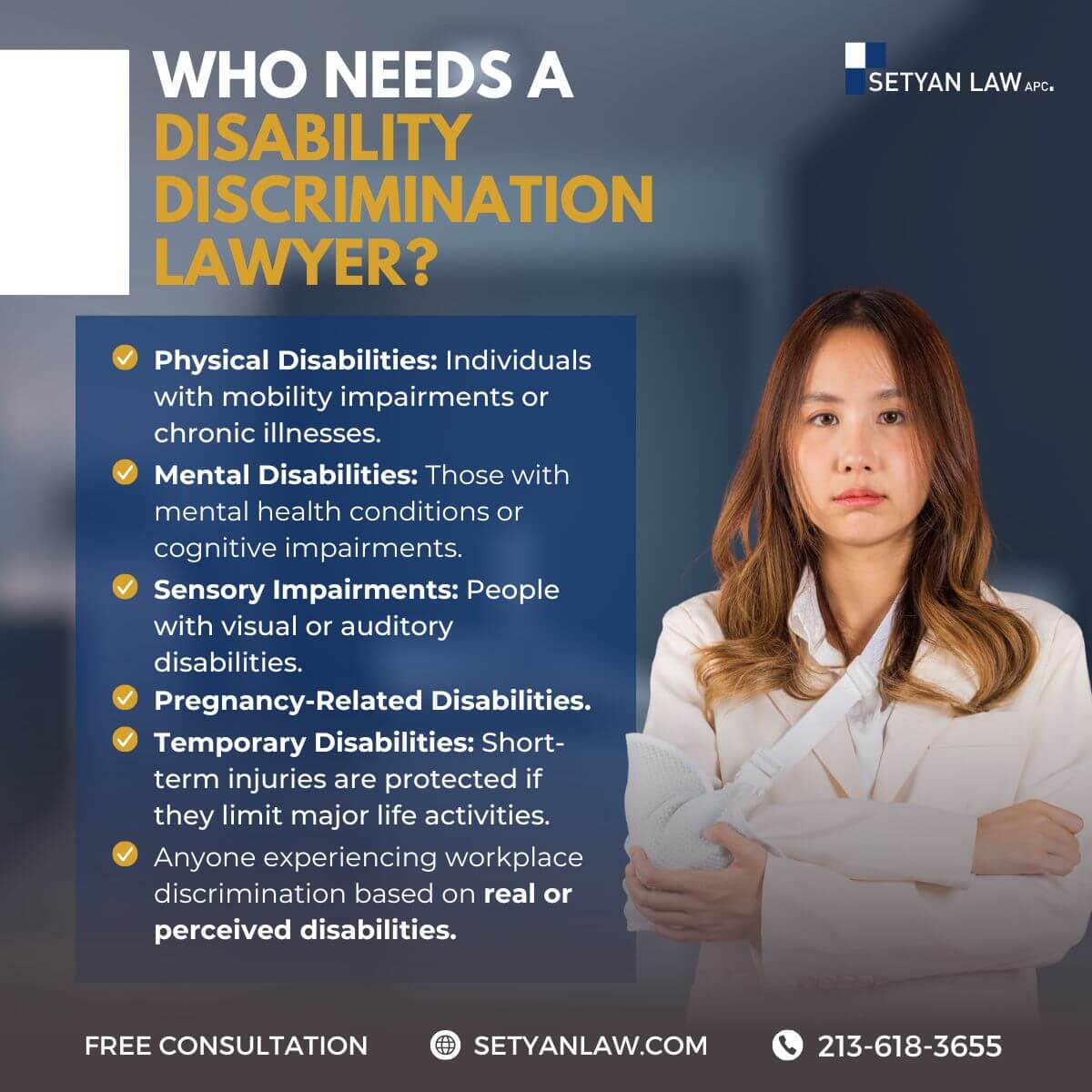
Call Setyan Law at (213)-618-3655 to schedule a free consultation.