
Updated July 19, 2026
ADA Compliance California: Essential Guide to Protecting Employees with Invisible Disabilities
Many California employees with invisible disabilities face workplace discrimination without understanding that ADA compliance California frameworks provide powerful legal protections. Invisible disabilities, including chronic pain, mental health conditions, diabetes, and autoimmune disorders, often go unrecognized by employers who fail to provide necessary accommodations. You have a right to reasonable workplace modifications under both the Americans with Disabilities Act (ADA) and California's Fair Employment and Housing Act (FEHA). In fact, California law offers even broader protections than federal standards. This guide explains your rights, common accommodation examples, how to address discrimination, and when to seek legal help.
What Are Invisible Disabilities Under California Law
Invisible conditions affect millions of workers who appear healthy to colleagues and supervisors. In fact, an estimated 74 percent of Americans with a disability defined as severe don't use assistive devices like wheelchairs or walkers. This reality means most disabilities remain hidden, yet they significantly impact an individual's ability to perform job functions.
Common Types of Invisible Disabilities
ADA compliance California regulations recognize a wide range of conditions that qualify for workplace protections. Invisible disabilities encompass any physical, mental, or neurological condition that isn't immediately noticeable but substantially affects daily activities.
These conditions include:
- Chronic pain conditions: Fibromyalgia, chronic fatigue syndrome, complex regional pain syndrome, migraines
- Mental health disorders: Depression, anxiety, PTSD, bipolar disorder
- Autoimmune diseases: Lupus, multiple sclerosis, rheumatoid arthritis
- Neurological conditions: Epilepsy, traumatic brain injuries, autism spectrum disorders
- Metabolic disorders: Diabetes (Type 1 and 2), thyroid conditions
- Digestive conditions: Crohn's disease, irritable bowel syndrome, celiac disease
- Learning disabilities: Dyslexia, dyscalculia, ADHD
- Respiratory/cardiac conditions: Severe asthma, heart disease
- Other conditions: Long COVID, endometriosis, hearing impairments, chronic obstructive pulmonary disease
Medical conditions like cancer (even in remission), HIV/AIDS, and substance use disorders in recovery also receive protection under California law.
Physical vs. Mental Invisible Disabilities
Physical impairments affect the body's structure or function without obvious external signs. Examples include chronic pain that limits standing or walking, diabetes requiring frequent monitoring, heart conditions restricting physical exertion, or neurological symptoms like sensitivity to light and sound. These conditions may fluctuate in severity, creating unpredictable work limitations.
Mental impairments disrupt mental or emotional well-being and affect 14% of adult California residents. Conditions such as depression, anxiety, cognitive disabilities, traumatic brain injury, and attention deficit disorder all qualify for protection. A mental disability can also include a condition someone has a history of but does not currently experience. PTSD serves as a clear example: someone who was seriously injured in a car accident may have healed physically, but the psychological trauma lingers, causing panic attacks or extreme anxiety in triggering situations.
Both physical and mental invisible disabilities receive equal protection under California employment law. Employers cannot treat one type as less legitimate than the other.
How California Defines Disability Differently from Federal Law
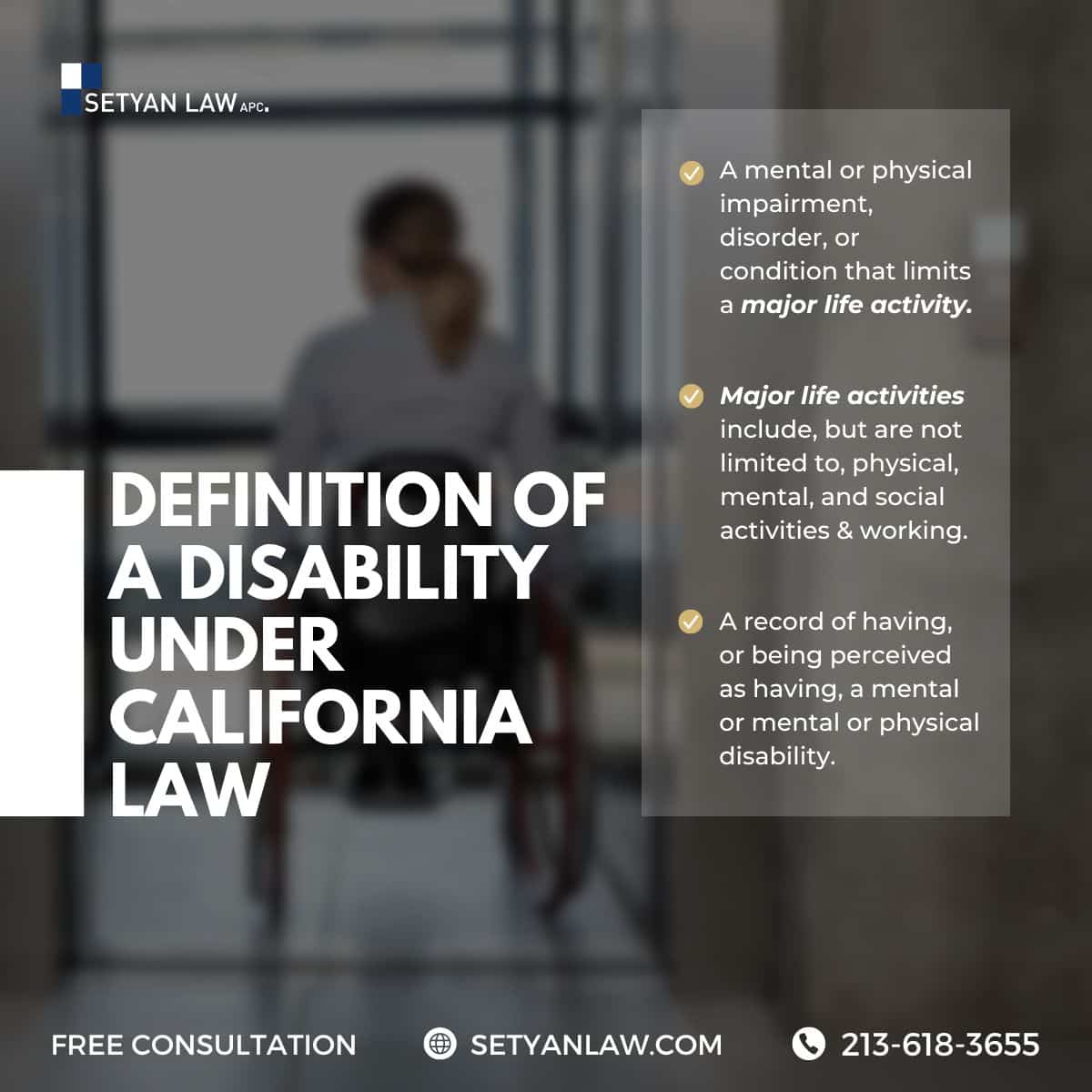
The ADA defines disability as a physical or mental impairment that substantially limits one or more major life activities. Major life activities encompass daily tasks such as walking, speaking, hearing, and thinking.
California's FEHA provides broader protection. A disability under FEHA is any impairment that makes performance of a major life activity difficult. This distinction matters considerably. The ADA's "substantially limits" standard creates a higher threshold, while California's "makes difficult" standard offers protection to more workers.
FEHA also explicitly includes serious medical conditions, including diabetes, cancer, and AIDS. California definitions and protections can be broader than protections under federal law. Even temporary conditions qualify if they substantially limit a major life activity. Short-term injuries, surgery recovery, or temporary mental health crises receive protection that federal law might not provide.
The ADA considers disabilities without accounting for mitigating measures. This means even if medications, devices, or treatments improve quality of life, conditions still count as legal disabilities. Someone managing diabetes with insulin or controlling depression with medication maintains disability protections.
California's expanded framework means workers with short-term or less severe impairments may still qualify for legal protection under state law. You need not "look disabled" to receive accommodations and protection from discrimination.
Call Setyan Law at (213)-618-3655 to schedule a free consultation.
Legal Protections for Employees with Invisible Disabilities
Dual legal protections shield California workers with invisible disabilities from workplace discrimination. Both state and federal laws create overlapping safeguards, with California standards often exceeding federal minimums.
Fair Employment and Housing Act (FEHA)
California's Fair Employment and Housing Act prohibits discrimination based on visible and invisible disabilities. FEHA applies to employers regularly employing five or more persons, including direct or indirect agents of an employer, and state and local governments.
The law protects your right to seek, obtain, and hold employment without discrimination because of disability or perceived disability. FEHA also prohibits harassment and retaliation against anyone exercising their rights under the act.
FEHA requires employers to provide reasonable accommodations unless doing so would cause significant difficulty or expense. Employers must engage in a timely, good faith interactive process with employees needing support. Failure to engage in this interactive process can be set forth as a separate claim in a lawsuit for employment discrimination.
Under FEHA, disability means any physical or mental impairment that limits a major life activity. This broader definition covers conditions that might not qualify under federal standards. The law also protects individuals perceived to have a disability, even without an actual impairment.
Americans with Disabilities Act (ADA)
The federal Americans with Disabilities Act provides employment rights as an individual with a disability. Title I of the ADA applies to private employers with 15 or more employees, as well as state and local governments, employment agencies, and labor unions.
The ADA defines disability as a physical or mental impairment that substantially limits one or more major life activities. The ADA Amendments Act of 2008 significantly expanded protections by clarifying that the definition should be construed broadly in favor of coverage.
The law prohibits discrimination in all employment practices, including hiring, firing, promotions, compensation, training, and other terms and conditions of employment. Employers cannot refuse to hire, demote, or terminate based on disability.
Key Differences Between FEHA and ADA
ADA compliance California frameworks differ from federal requirements in significant ways. The ADA applies to employers with fifteen or more employees, while FEHA applies to companies with five or more employees. This lower threshold allows more employees to seek legal protection.
The disability definition creates another crucial distinction. FEHA only requires that a physical or mental condition limit a major life activity, whereas the ADA requires it substantially limit such activity. Individuals with short-term or temporary disabilities may qualify for protection under FEHA but not the ADA.
An employer's duty to accommodate an employee's disability is broader under FEHA than the ADA. The ADA limits compensatory and punitive damages a disabled employee can pursue during an employment law claim, while FEHA has no such cap on damages.
Which Law Applies to Your Situation
While the ADA provides a floor of protection to people with disabilities, FEHA provides additional protections that are independent of those in the federal law. California employment discrimination law covers nearly all employers.
Both laws can apply simultaneously to your situation. Employers must follow the law that provides the greatest benefit to employees. Workers with fewer than 15 colleagues receive protection exclusively under FEHA, while those at larger companies benefit from both frameworks.
Setyan Law

It’s always best to consult a qualified Medical Condition Discrimination Attorney regarding your case before you file. Employment law has many pitfalls and an attorney can help you navigate past them safely. Sam Setyan will review your grievance, tell you your options, and guide you to the most favorable outcome possible. It’s your call.
Call 213-618-3655 for a free consultation.
Workplace Rights and Reasonable Accommodations
Employees with invisible disabilities hold specific rights to workplace modifications that enable job performance. Understanding these rights helps you request appropriate support and identify when employers violate legal obligations.
What Qualifies as a Reasonable Accommodation
A reasonable accommodation is a modification or adjustment to a job, the work environment, or the way things are usually done during the hiring process. These modifications enable an individual with a disability to have an equal opportunity not only to get a job, but successfully perform their job tasks to the same extent as people without disabilities.
ADA compliance California standards require accommodations in three employment aspects: ensuring equal opportunity in the application process, enabling a qualified individual with a disability to perform essential job functions, and making it possible for an employee with a disability to enjoy equal benefits and privileges of employment. Accommodations should not be viewed as special treatment and they often benefit all employees.
The Interactive Process Requirement
California employers must initiate an interactive process when an applicant or employee requests reasonable accommodations. The employer must also offer to initiate an interactive process when the employer becomes aware of the possible need for an accommodation. This awareness might come through a third party, by observation, or because the employee has exhausted leave benefits but still needs reasonable accommodation.
The process requires an individualized assessment of both the job and the specific physical or mental limitations of the individual that are directly related to the need for reasonable accommodation. In California, failure to engage in a timely, good faith, interactive process is unlawful. The interactive process involves a good-faith, collaborative dialog between the employer and employee to determine whether the requested accommodation can be provided.
Common Accommodation Examples for Invisible Disabilities
Many job accommodations cost very little and often involve minor changes to a work environment, schedule or work-related technologies. Examples include making existing facilities accessible, job restructuring, part-time or modified work schedules, acquiring or modifying equipment, changing tests, training materials, or policies, and providing qualified readers or interpreters.
Specific accommodations for invisible disabilities include flexible work hours, noise-canceling headphones, certain software, remote work arrangements for conditions like anxiety, ADHD, or immunocompromised status, ergonomic workstations, additional breaks for medical needs, and adjusting work schedules so employees with chronic medical conditions can attend medical appointments and complete their work at alternate times or locations.
When Employers Can Deny Accommodations
The ADA requires employers to provide reasonable accommodations unless the employer can show that doing so would pose an undue hardship to its operations. Undue hardships involve financially straining the company or causing substantial disruptions to business operations. Employers can potentially deny accommodation requests if they can establish that the accommodation creates an undue hardship.
California law permits businesses with fewer than five employees to avoid offering accommodations based on the number of workers they have. The employer must prove that the request creates an undue hardship for the company.
Protection Against Retaliation
California law protects employees from retaliation for requesting reasonable accommodations. Requesting a reasonable accommodation for a disability is a legally protected activity. Section 12940(m)(2) provides that employers violate California law if they retaliate against an employee who requests an accommodation, regardless of whether the request for accommodation was granted or not. Protection applies even when the accommodation is denied. Retaliation is illegal under both state and federal law.
Common Forms of Discrimination Against Employees with Invisible Disabilities
Discrimination against workers with invisible disabilities takes forms that violate ADA compliance California standards. Employers who fail to recognize non-visible conditions often engage in unlawful practices that deny basic workplace rights.
Dismissing or Minimizing Accommodation Requests
Employers frequently dismiss accommodation requests by claiming the condition isn't serious enough or questioning its legitimacy. Comments like "but you don't look sick" or "everyone gets tired sometimes" minimize legitimate medical conditions based solely on visual perception. When appearance doesn't match disability expectations, employers struggle to understand accommodation needs. This skepticism creates an additional burden where employees must not only request accommodations but also educate others about non-apparent conditions.
Requiring Excessive Medical Documentation
Both federal and state laws restrict an employer's ability to make disability-related inquiries. Demanding excessive medical documentation or invasive disclosure violates these restrictions. You are not required to produce your entire medical or mental health history. Documentation should be limited to a doctor's note or medical documents showing that you have a disability and need accommodation.
Creating a Hostile Work Environment
Employers and coworkers may create hostile conditions through harassment, gossip, or exclusion based on disability. Being left out of meetings, training opportunities, or team events after disclosing a disability demonstrates potential discrimination. Exclusion from workplace activities following disability disclosure often signals discriminatory targeting.
Wrongful Termination Based on Disability
Terminating employees instead of providing accommodations violates California law. Termination following accommodation requests frequently violates both FEHA and ADA protections. Wrongful termination soon after an accommodation request is made represents extreme retaliation.
Failure to Engage in the Interactive Process
Employers who ignore accommodation requests, refuse to discuss potential modifications, or dismiss needs without evaluation breach their legal obligations. Failure to engage in the interactive process is a violation of the law, even if the employer could not ultimately provide a reasonable accommodation.
What to Do If You Experience Disability Discrimination
Taking action after experiencing discrimination requires strategic documentation and understanding procedural requirements. ADA compliance California violations demand prompt response.
Document Your Condition and Accommodation Requests
Start by gathering documentation to support your case. Keep records of discriminatory incidents, including dates, times, witnesses, and what was said or done. Save emails, performance evaluations, witness statements, and any communication related to your disability and workplace accommodations. This documentation serves as evidence if you pursue legal action.
File a Complaint with the California Civil Rights Department
Contact the Civil Rights Department (CRD) to file a complaint. You can file online through the California Civil Rights System, by phone at 800-884-1684, by email at contact.center@calcivilrights.ca.gov, by mail, or in person. Be prepared to provide details about the discrimination you experienced, including dates, names of individuals involved, and relevant evidence.
Consider Filing a Lawsuit
If CRD investigation does not resolve the issue, request a Right-to-Sue Notice. This document grants you the right to file a lawsuit against your employer in court. Your attorney will draft necessary legal documents and initiate litigation.
Time Limits for Taking Legal Action
Complaints must be filed within three years of the last act of discrimination. Once CRD issues a Right-to-Sue letter, you have another year to file a lawsuit. Missing these deadlines means losing your right to pursue justice.
How an Employment Attorney Can Help
An experienced employment attorney evaluates your case and provides legal guidance. They handle CRD complaint filing, evidence gathering, and court representation if necessary.
Conclusion
California provides some of the strongest workplace protections for employees with invisible disabilities in the nation. Above all, remember that you don't need to "look disabled" to qualify for legal protection and reasonable accommodations. Whether you have chronic pain, mental health conditions, or any other non-visible disability, FEHA and ADA frameworks shield you from discrimination.
Document every accommodation request, discriminatory incident, and workplace communication. In that case where your employer fails to provide support or retaliates against you, this evidence becomes essential. Don't hesitate to contact the California Civil Rights Department or consult an employment attorney. Your rights exist specifically to ensure equal workplace opportunities, regardless of whether others can see your condition.
References
https://legalaidatwork.org/factsheet/disabilities-in-the-workplace-reasonable-accommodation/
https://www.bradley.com/insights/publications/2026/02/cant-i-just-wfh-best-ada-practices-for-evaluating-remote-work-requests
https://www.eeoc.gov/publications/ada-your-employment-rights-individual-disability
[9] – https://calcivilrights.ca.gov/complaintprocess/how-to-file-a-complaint/
Call Setyan Law at (213)-618-3655 to schedule a free consultation.