
Updated January 26, 2026
When Assumptions Become Illegal in California
Discrimination in the workplace often begins with a seemingly harmless assumption. "She's too old to learn new technology." "He won't want that promotion because of his family." "They probably can't handle client meetings with that accent." Despite appearing as casual observations, these assumptions can cross the line into illegal discrimination under California's robust employment laws.
In fact, California maintains some of the strongest worker protections in the nation, recognizing that discrimination based on perceived characteristics is just as harmful as discrimination based on actual ones. When employers make decisions based on assumptions about protected characteristics rather than individual merit or qualifications, they potentially violate state and federal laws.
Focus: Stereotypes, Perceived Disability, or Even Perceived Pregnancy
This article explores how workplace assumptions transform into illegal discrimination, examines the specific characteristics protected under California law, and provides real-world examples of cases where employers faced legal consequences for assumption-based discrimination. We'll also cover the legal frameworks that protect employees and practical strategies for preventing discriminatory practices before they occur.
Call Setyan Law at (213)-618-3655 to schedule a free consultation.
Understanding Assumption-Based Discrimination
Most people navigate workplace interactions through a series of unspoken beliefs and expectations. Workplace assumptions form the invisible foundation upon which daily decisions are built, operating largely beneath our conscious awareness.
What are workplace assumptions?
Workplace assumptions are beliefs or ideas we accept as true without verifying them . They represent the invisible, taken-for-granted beliefs and values that form the culture of an organization and impact how it performs .
Making assumptions comes naturally to humans – it's a mental shortcut we use to process information quickly. Unfortunately, these mental shortcuts can lead us astray, particularly when they involve judgments about colleagues based on protected characteristics.
These assumptions manifest in various forms:
- Expecting someone to handle anything because they're "independent"
- Labeling colleagues as "difficult" for expressing concerns
- Providing less flexibility around family needs based on unfair judgments
- Offering fewer growth opportunities despite strong performance
While individual instances may seem minor, these patterns accumulate over time, affecting how included, respected, and valued employees feel in the workplace .
How assumptions turn into illegal actions
The path from assumption to illegal discrimination often begins subtly. An employer might make an unfounded assumption about an employee's abilities, intentions, or characteristics based on stereotypes rather than facts.
Notably, the legal standard doesn't require malicious intent. As one expert explains, "Discrimination doesn't always come from malicious intent. Sometimes, it's an uninformed or hasty decision that's made without proper consideration" .
What makes assumption-based discrimination particularly problematic is that it often stems from fear – fear of the unknown or incorrect knowledge . For instance, a manager might assume an employee with a medical condition presents a safety risk without verifying whether this concern has any factual basis .
Furthermore, discrimination can occur even when assumptions are inaccurate. Consider an employer who incorrectly assumes an employee follows a certain religion based on appearance and subsequently treats them unfavorably. Essentially, the discrimination is still illegal even if the assumption was wrong .
Why California law treats assumptions seriously
California maintains particularly strong protections against assumption-based discrimination, recognizing that stereotypes and biased thinking can lead to significant workplace harm even without explicit prejudice.
At the heart of this approach is the understanding that implicit bias – the subconscious attitudes or stereotypes that influence perceptions and decisions without conscious knowledge – can lead to unfair treatment . Unlike explicit bias, these unconscious biases operate automatically and often go unnoticed by the person holding them.
California law addresses this reality by focusing on discriminatory impact rather than just discriminatory intent. Consequently, employers can be held liable even if they weren't consciously trying to discriminate.
A case that illustrates this principle involved the Royal Bank of Scotland, where a manager incorrectly assumed a black employee's complaints against a white manager were racially motivated. The tribunal found this unfounded assumption constituted direct race discrimination, noting that the reverse assumption would not have been made if a white employee had complained about a black manager .
Above all, California's approach recognizes that stereotyped assumptions can "easily unconsciously rear their ugly heads, and cause considerable offense" . By treating assumptions with the same seriousness as explicit discrimination, the law provides comprehensive protection for workers facing subtle forms of workplace bias.
Protected Characteristics Under California Law
California's anti-discrimination framework stands among the most comprehensive in the United States, offering robust protections across numerous characteristics. Understanding which traits are legally protected serves as the foundation for recognizing when workplace assumptions cross into illegal territory.
Race and color
Race and color discrimination occurs whenever an employee or applicant receives unfavorable treatment due to their race or personal characteristics associated with race, including hair texture, skin color, or facial features . Importantly, this protection extends to all races, not merely those historically subjected to discrimination .
California's Fair Employment and Housing Act (FEHA) specifically protects traits associated with race, such as hair texture and hairstyle . Additionally, racial harassment—including racial slurs, offensive remarks about a person's race, or displaying racially offensive symbols—is explicitly prohibited .
A critical point to understand is that discrimination can occur between people of the same race . Moreover, employment policies that appear race-neutral can still be illegal if they disproportionately harm employment opportunities based on race without being job-related or necessary for business operations .
Gender identity and sexual orientation
California law protects employees from discrimination based on their actual or perceived gender identity, gender expression, and sexual orientation . This protection extends to transgender and transitioning status, non-binary identities, and gender non-conforming expressions .
Under both state and federal frameworks, employers cannot discriminate in any aspect of employment, including hiring, firing, promotion, pay, benefits, training, or other employment conditions . The protection applies to organizations with five or more employees .
Worth noting is that employers cannot ask about sexual orientation, gender identity, or gender expression during interviews or the application process . Employees have the right to be addressed by their lived name and pronouns regardless of whether they have legally changed their name and gender marker .
Age and disability
Age discrimination protections in California cover workers who are 40 years or older . Both state and federal laws prohibit employers from paying older workers less than younger workers for substantially similar work .
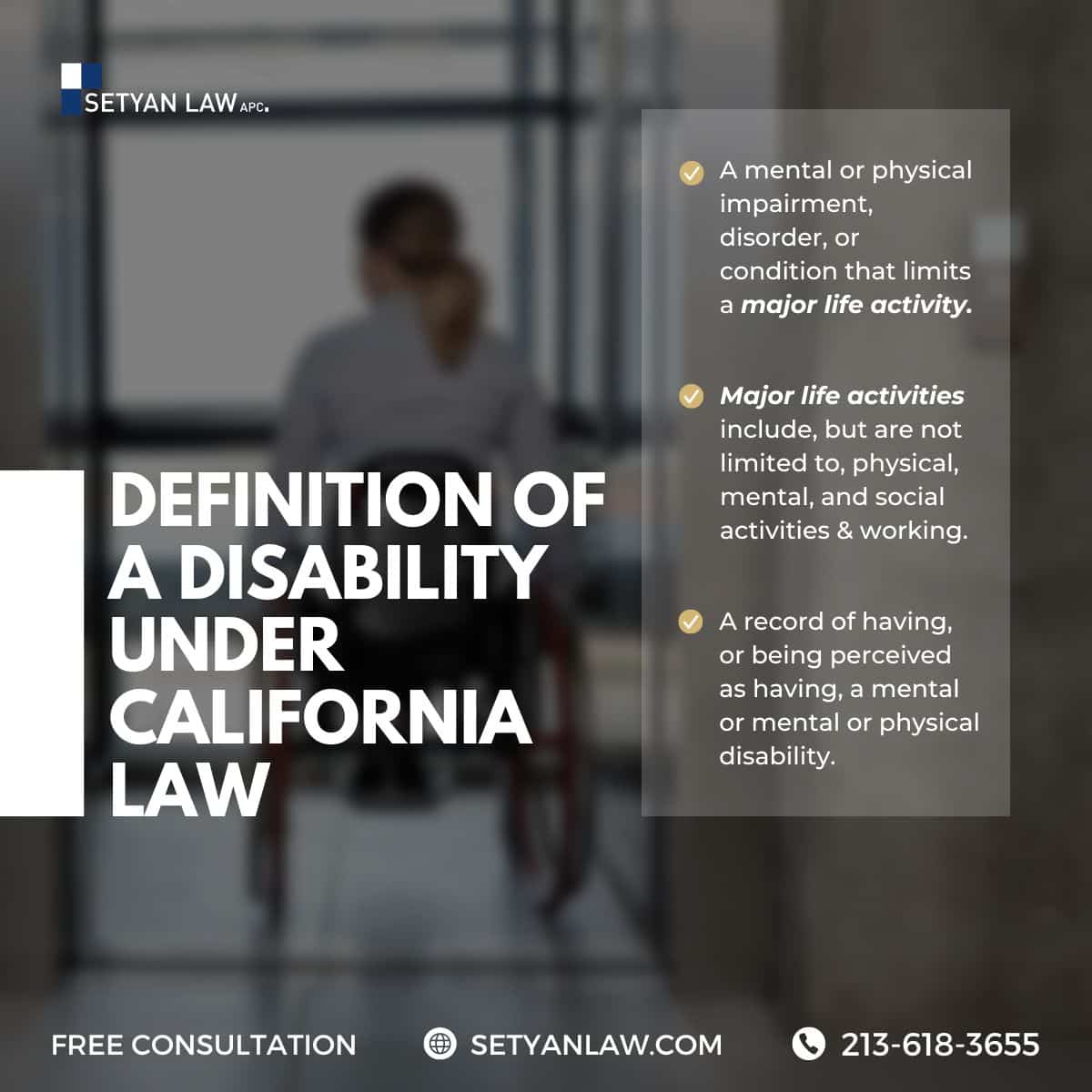
Regarding disability, discrimination occurs when an employee faces unfair treatment due to an actual or perceived physical or mental impairment . Forms of disability discrimination include:
- Failing to provide reasonable accommodations
- Wrongful termination
- Harassment
- Demotion
- Denying opportunities despite qualification
In fiscal year 2022, there were 1,338 disability charges filed in California, accounting for 5.4% of disability charges nationwide .
Religion and national origin
Religious discrimination involves adverse employment actions based on religion or religious attire . The term "religion" is broadly defined to include moral or ethical beliefs sincerely held with the strength of traditional religious views .
California law requires employers to permit reasonable accommodations for religious practices, including religious dress and grooming practices . Compared to federal standards, California imposes a higher burden on employers to demonstrate undue hardship before denying religious accommodations .
National origin discrimination includes language-based discrimination and discrimination based on possession of a driver's license issued to undocumented immigrants . Employers cannot restrict language use unless necessary for business operations .
Marital status and medical condition
Marital status discrimination occurs when employment decisions are based on whether an employee is single, married, divorced, widowed, or separated . California's FEHA explicitly defines marital status as an individual's state of marriage, non-marriage, divorce, separation, widowhood, annulment, or other marital state .
Employers cannot ask about marital status during interviews or the hiring process, including questions about whether someone is married, planning marriage, or their partner's name .
Medical condition protections cover genetic characteristics, cancer, or a record/history of cancer . The law also protects reproductive health decision-making and requests for family care leave, personal health condition leave, and pregnancy disability leave .
Through these comprehensive protections, California ensures that workplace decisions focus on qualifications and performance—not assumptions about personal characteristics.
Real Examples of Assumptions Becoming Illegal
Beyond abstract concepts, assumption-based discrimination manifests in real workplace scenarios with serious legal consequences. Courts regularly rule against employers who make decisions based on stereotypes rather than individual merit.
Case: Denied promotion due to age assumptions
In the landmark Caldrone v. Circle K Stores, Inc. case (2025), three long-term employees were denied the opportunity to apply for a West Coast Regional Director position. The company never posted the job opening and quietly promoted a younger employee who was approximately 9.3 years younger than the plaintiffs. The Ninth Circuit Court recognized this age gap as evidence that the promoted employee was "substantially younger" than the overlooked workers . The court found particularly troubling the company's decision to circumvent normal application procedures, effectively preventing qualified older employees from even being considered .
Evidence showed company executives had made age-related comments, calling older workers "out of touch" and suggesting they "think about retiring" . The court firmly established that employers cannot avoid liability for age discrimination simply by never opening a job to applications.
Case: Gender stereotypes in hiring
Gender discrimination remains pervasive in recruitment and advancement decisions. Research confirms that 9 out of 10 people worldwide hold some bias against women . This unconscious bias manifests when employers favor male candidates despite equivalent qualifications.
While female representation has improved in high-paying positions, women still comprise merely 35% of the workforce in the top 10 highest-paying jobs . Assumptions about gender frequently lead to women being evaluated more harshly or criticized for traits that would be praised in men. For instance, women described as "aggressive" face criticism, whereas men exhibiting identical behaviors receive praise for showing "leadership" .
Case: Language-based national origin bias
Language discrimination illustrates how assumptions about national origin become illegal. In Davis, California, a restaurant employee named Francisca Pérez was terminated for speaking Spanish to a colleague about a work-related matter .
California law permits language restrictions only when they meet three stringent criteria: justified by business necessity, narrowly tailored, and clearly communicated to employees . Importantly, English-only rules are "never lawful during an employee's non-work time" including breaks and lunch periods . Courts consistently find that customer or coworker preference alone does not justify language restrictions .
Case: Disability misperceptions and job roles
Assumption-based discrimination frequently affects workers with disabilities. Contrary to common misconceptions, studies show 58% of disability accommodations cost absolutely nothing to implement .
In one study, mock job applications that disclosed disabilities (either spinal cord injury or autism) received 26% fewer expressions of employer interest than identical applications without such disclosure . These prejudices persist despite evidence that workers with disabilities often perform equally well or better than their colleagues without disabilities.
Nearly one-third of surveyed employees with disabilities reported experiencing negative bias including feeling underestimated, excluded, or noting coworker discomfort . Accordingly, 47% believed they would never achieve leadership roles regardless of their qualifications or performance.
Setyan Law

It’s always best to consult a qualified Medical Condition Discrimination Attorney regarding your case before you file. Employment law has many pitfalls and an attorney can help you navigate past them safely. Sam Setyan will review your grievance, tell you your options, and guide you to the most favorable outcome possible. It’s your call.
Call 213-618-3655 for a free consultation.
Legal Frameworks That Protect Employees
Powerful legal protections serve as the foundation for combating workplace discrimination in California. These frameworks provide the teeth behind anti-discrimination principles and offer crucial recourse for employees facing assumption-based discrimination.
California Fair Employment and Housing Act (FEHA)
The cornerstone of California's workplace protections, FEHA prohibits discrimination based on protected characteristics in employment, housing, and public accommodations. This comprehensive law applies to employers with five or more employees—a significantly lower threshold than federal standards. For harassment claims, FEHA applies to all employers regardless of size.
FEHA protections extend to job applicants, current employees, former employees, and even independent contractors. The law prohibits discrimination in all aspects of employment—from hiring and firing to promotions, pay, and working conditions.
SB 1137 and intersectionality protections
In September 2024, Governor Newsom signed Senate Bill 1137, making California the first state to explicitly recognize intersectionality in anti-discrimination laws . Taking effect January 1, 2025, this groundbreaking legislation clarifies that discrimination can occur based on combinations of protected characteristics, not just individual traits .
Intersectionality acknowledges that different forms of inequality can operate together, creating unique, amplified forms of prejudice . For instance, an Asian female employee might experience discrimination based on the specific combination of her race and gender—facing stereotypes different from those experienced by Asian men or non-Asian women .
Role of the California Civil Rights Department (CRD)
Formerly known as the Department of Fair Employment and Housing, the CRD serves as California's enforcement arm for civil rights laws . As the largest state civil rights agency in the country, CRD investigates complaints, mediates disputes, and prosecutes violations.
The department handles everything from employment discrimination to housing bias, hate violence, and human trafficking . Through its Dispute Resolution Division, CRD offers free mediation services to resolve complaints outside of court.
How federal and state laws interact
Federal protections like Title VII of the Civil Rights Act, the Americans with Disabilities Act, and the Age Discrimination in Employment Act establish baseline protections . Nevertheless, California's frameworks typically provide broader coverage and stronger remedies.
Importantly, when state and federal laws overlap, employers must comply with whichever offers the most protection to employees . This complementary relationship ensures maximum safeguards against workplace discrimination.
Preventing Discrimination Before It Starts
Proactive prevention represents the most effective strategy against workplace discrimination, saving organizations from costly legal battles and reputation damage. California employers have both legal and ethical obligations to create environments free from discriminatory practices.
Training to recognize unconscious bias
Effective bias mitigation training helps employees identify and manage unconscious biases that might influence decision-making. California Senate Bill 303, effective October 1, 2025, provides legal protection for employers conducting such training, creating a "safe harbor" provision that clarifies how employee acknowledgment of personal bias during training doesn't constitute discriminatory conduct . The University of California offers a six-course online training series on managing implicit bias, with each course lasting 15-20 minutes.
Clear anti-discrimination policies
Under California law, employers with at least 5 employees must adopt and distribute written discrimination, harassment, and retaliation prevention policies. These policies must outline all protected categories, provide clear complaint mechanisms that don't require reporting to immediate supervisors, and establish thorough investigation procedures. For workforces where 10% or more speak a language other than English, employers must translate these policies accordingly.
Structured decision-making processes
Structured processes offer more protection against bias than training alone. As research indicates, introducing objective data collection and standardized evaluation criteria into hiring significantly reduces discrimination . Structured interviews have emerged as the most effective selection procedure based on validity estimates.
Regular audits and documentation
Regular self-audits help identify potential discrimination issues before they become problems. Documentation should verify explicit definitions of prohibited conduct, accessible complaint mechanisms, and training records . Employment decisions should be focused on job-related abilities, skills, and essential functions.
Inclusive workplace culture initiatives
Organizations like the California Department of Technology implement voluntary diversity training, policy review through equity lenses, and communities of practice where employees share knowledge in safe spaces. Effective inclusive culture initiatives help employees recognize different cultural perspectives and establish forums where all voices can be heard and respected.
Conclusion
Assumption-based discrimination represents a significant yet often overlooked threat in California workplaces. Though assumptions might seem innocuous, they can quickly transform into illegal actions with serious consequences for employers. California stands at the forefront of employee protection, recognizing that harmful stereotypes affect workers regardless of whether these assumptions prove accurate.
The extensive protections under California law safeguard employees from discrimination based on race, gender identity, age, disability, religion, national origin, and numerous other characteristics. Furthermore, recent legislation like SB 1137 acknowledges the complex reality of intersectionality, where multiple protected characteristics combine to create unique forms of discrimination.
Real-world cases clearly demonstrate how assumption-based discrimination manifests across various contexts – from older workers being passed over for promotions to employees facing discipline for speaking languages other than English. Above all, these examples highlight the tangible harm caused when employers make decisions based on stereotypes rather than individual merit.
Employers must therefore take proactive steps to prevent assumption-based discrimination. This approach includes implementing comprehensive training programs, establishing clear anti-discrimination policies, and creating structured decision-making processes that minimize the impact of unconscious bias. Regular audits additionally help identify potential issues before they escalate into legal problems.
The path toward truly inclusive workplaces requires vigilance from both employers and employees. While California law provides robust protection, prevention remains the most effective strategy. Ultimately, workplaces that focus on individual merit rather than assumptions about protected characteristics not only avoid legal liability but also cultivate environments where all employees can thrive based on their actual abilities and contributions.
References
https://www.ca.gov/departments/215/
https://www.eeoc.gov/racecolor-discrimination
[8] – https://www.lmlfirm.com/practice-areas/employment-law/racial-discrimination/https://calcivilrights.ca.gov/wp-content/uploads/sites/32/2023/01/Workplace-Discrimination-Poster_ENG.pdf
http://ucnet.universityofcalifornia.edu/career-community/career-development/professional-development/uc-managing-implicit-bias-series/
https://pomonachamber.org/building-a-diverse-and-inclusive-workplace-in-california/
Call Setyan Law at (213)-618-3655 to schedule a free consultation.